The mobile gaming industry has seen prominent advancements in recent years. Now, with an increase in player expectations, many businesses and startups are investing more and more in creating engaging mobile games these days.
And as they start doing so, a common question arises, how much does it cost to develop a mobile game in 2026?
The answer depends on many factors, such as the game genre, design complexity, platform compatibility, and so much more. However, as a generic estimation, the cost can range between $20,000 – $2,500,000+.
Stay tuned as we continue to reveal all about the development costs of mobile games. We will also break down the different development stages and their cost. So, let’s get right into it!
How Much Does It Cost to Develop a Mobile Game in 2026? – Based On Game Genre And Complexity
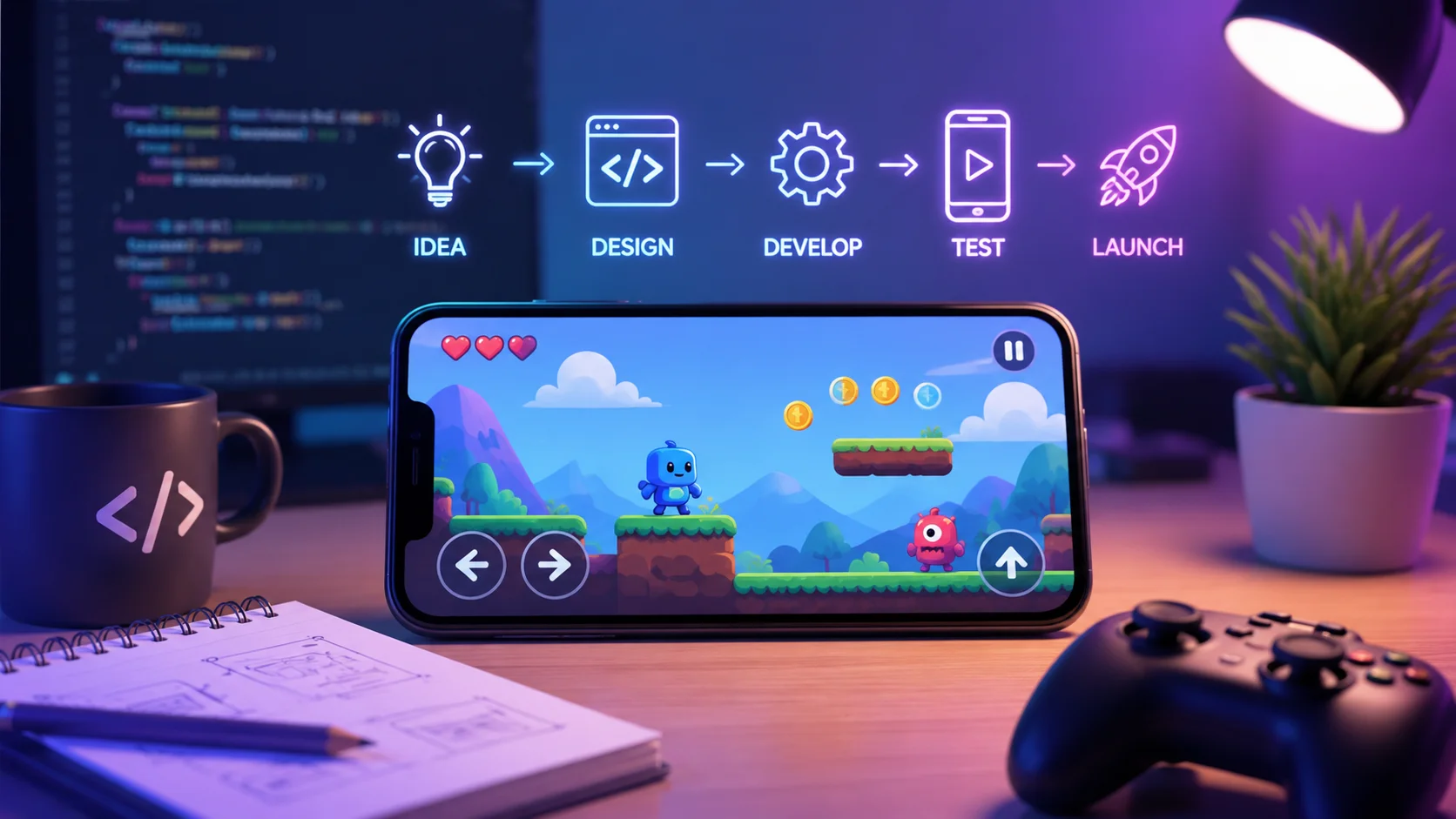
Mobile game development is no longer just about paying for lines of code. It involves technical complexities, player retention hooks, and modern development efficiencies.
With that being said, mobile game development cost has also scaled up as the gaming landscape has undergone a drastic transformation over the last few years.
There is no one specific number when it comes to developing a mobile game. Many factors contribute to the development process, and depending on personal requirements and complexities, the cost can vary anywhere between $20,000 – $2,500,000+.
In fact, the cost can be nearly up to $20,000,000 if the game has advanced requirements like most AAA video games.
As you can see, the number we just told you varies largely. So, for a better understanding, let’s look at the cost based on different complexity levels.
| Genre Or Complexity | Cost | Development Time | Key Features |
| Hyper-Casual Games | $20,000 – $80,000 | 2-4 Months | Simple mechanics, bite-sized gameplay, leaderboards and challenges, minimal design |
| Casual Or Puzzle Games | $60,000 – $250,000 | 4-8 Months | Intuitive mechanics, on-the-go sessions, meta-progression, colorful visuals |
| Mid-Level Strategy Games | $300,000 – $1,500,000 | 1- 1.5 Years | More well-developed mechanics, multiplayer system, robust graphics, highly engaging visuals |
| Complex AAA Games | $2,000,000 – $20,000,000+ | Over 2 Years | Complex gameplay mechanics, immersive environment, large team-play |
Cost Breakdown Based On Mobile Game Development Phase
Now you know about the cost to develop a mobile game in 2026 based on the specific genre of the game. But we believe that’s not enough to be able to properly calculate the cost for your app, especially your own custom mobile game.
Every mobile game has its own unique challenges, which lead to the need for a distinctive development process every time. As a result, the overall development cost looks different for every case.
This is why it’s important to understand the costs based on each development phase of a mobile game.
1. Discovery
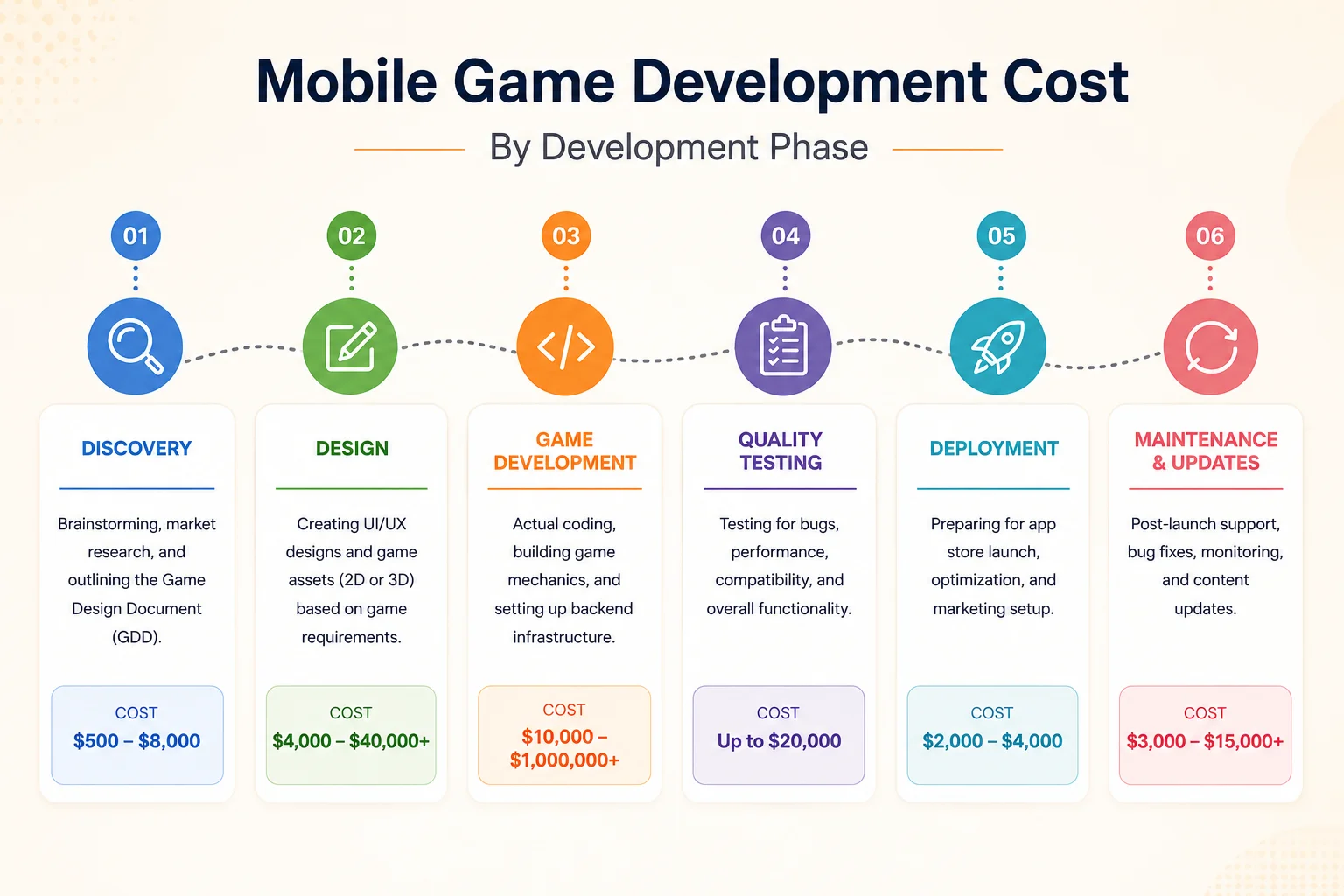
Just like every other software development process, game development also begins with the discovery phase. This phase is crucial for brainstorming the game’s scope and design, as well as researching the market and the target audience.
In the gaming world, this is basically known as the outlining Game Design Document (GDD). The GDD will not only outline the core mechanics and gameplay loop, but also the entire development process roadmap.
Usually, the charge for this phase begins around $500-$600. However, the cost can exceed up to $8,000 for complex projects that require rigorous development efforts.
2. Design
The next phase is the design, covering both the UI and UX. 2D mobile games have a very simple interface, and they don’t require very sophisticated visuals either. So, the design phase of such games can be covered within $4,000 to $10,000.
Needless to say, 3D games thrive off much more complicated UI and UX designs. So, depending on the number of assets they require and their complexity levels, the budget can go over $40,000.
3. Game Development
The third phase is Game Development. This is where the actual software development happens. The backend infrastructure is built in this phase, working on the game mechanics while maintaining dedicated servers.
Single-player offline games need very minimal backend logic. The cost usually ranges anywhere between $10,000 – $50,000. However, highly complicated games whose backend infrastructure is much more complicated can cost nearly $1,000,000.
4. Quality Testing
Once the actual gaming software is built, next comes the step for testing. From analysing the overall performance to working on bug fixes and compatibility, every little step ensures proper functionality.
Depending on how rigorous testing is needed, the budget can go up to $20,000.
5. Deployment
After the quality testing is cleared, the game will then be prepared for launch. For that, the game has to be prepared according to app store guidelines and promoted as well. So, beyond the initial development approach, the game also has to be optimized accordingly.
Moreover, every app store, whether it be Google Play Store or Apple’s App Store, requires a one-time fee to list the game.
Altogether, to deploy the game successfully, you will need to set aside a budget of $2,000-$4,000.
6. Maintenance And Updates
Lastly, no development cycle should end without post-launch maintenance and updates. At this stage, the game has to be monitored routinely to ensure correct functionalities and eliminate bugs and glitches. Moreover, the game has to be updated to keep up with growing user bases.
Maintenance and updates for basic games can be covered by $3,000. However, for advanced games that might require consistent, large-scale updates, the cost can bump up to $15,000.
Existing Relevant Contents:
How Much Does It Cost To Develop an AR App?
How Much Does It Cost To Develop An Educational App?
How Much Does It Cost To Develop An E-Wallet App?
How Much Does It Cost to Develop a Web App?
How Much Does It Cost To Develop A Fitness App?
5 Key Factors That Affect The Development Cost Of A Mobile Game
Besides the type of game and its complexity, several other factors play a role in determining the development cost. Here is a complete breakdown of those factors and how they affect the overall cost.
1. Mobile Platform
Firstly, the platform you’re launching the game on is a major factor. When it comes to game development, cross-platform development is the most efficient and economic option.
A cross-platform development approach allows developers to use a single codebase for both Android and iOS, thus simplifying the process.
On the other hand, native development requires a higher budget. This is because developers have to maintain two separate codebases. However, it also provides device-specific support, making it a better option for some games.
2. Backend Infrastructure
The backend, which involves handling data, player accounts, security, and networking, significantly affects development costs too. A simple offline puzzle game usually requires very little backend investment.
However, a complex multiplayer game can easily raise the overall budget. Moreover, there will be additional security and maintenance costs for such mobile games.
The actual investment for the backend heavily depends on the custom architecture and the networking models.
To give you an idea, games where player actions happen intermittently require minimal data transmission. Hence, they’re much cheaper and easier to build.
However, real-time multiplayer games that function off dedicated servers increase the development cost. Setting up real-time matchmaking, lobby systems, analytics-tracking, voice chats, and global region synchronization can significantly push an initial backend development budget.
3. UI/UX Design
The visual assets and art styles of a mobile are the first things players notice, and thus, they are a crucial budgeting factor.
But, it isn’t just for the visual aesthetics, it also dictate the technical performance, the design team that will be needed, and the length of the development time.
Minimal interfaces that can be done with 2D assets and a solid colour palette are on the more affordable side. However, things get tricky when you aim for a high-quality UI that requires pseudo or realistic 3D models. Custom animations will further add to the cost.
Moreover, the UI assets must be designed responsively for all device orientations. Unlike consoles, mobile devices have thousands of different screen resolutions, aspect ratios, and camera notches. Hence, they require the additional development effort, which further adds to the cost.
A good UI/UX design keeps players engaged and directly impacts in-app purchase conversion rates. So, you must make sure to invest in this part of the development process accordingly.
4. Mobile Game Testing And Marketing
Other than the initial development process, a good development team will also take care of proper testing and then post-launch marketing. And, you must take these two factors into account when estimating the overall cost.
Early and continuous testing is a crucial part of the entire service. Your development team should integrate this early on. However, if you are hiring separate mobile game testers, you will be charged based on their hourly rates.
And to put it simply, the more complex a mobile game is, the more rigorous testing it will require. Hence, the charges will increase too.
Now, coming to the marketing aspect. Marketing is just as crucial as any other step, if not more. On average, you have to set aside at least 30-40% of your initial development budget.
5. Development Team
Lastly, the development team you hire is also going to impact the overall cost. There are many options when it comes to a developer, however, you have to be wise and select one based on your unique requirements.
The most affordable way is to opt for a freelancer. However, not all freelancers are skilled enough or have the right technical support to handle complex AAA projects, especially if they are just starting out.
Another cost-effective method is to outsource. You can hire from regions with low hourly rates, such as Vietnam, India, or even Eastern Europe.
However, if you don’t want to compromise on the quality of service at all, we recommend going for an in-house development team. While the charges would be significantly higher, it would give you consistent, real-time access to highly skilled developers.
4 Mobile Game Development Trends to Use For Maximum Profit
If you truly want to make the most out of your mobile game, you can’t just stick to the same old development strategies.
We recommend you adapt to the latest trends to take the game to the next level, while also maximizing your revenue.
So, here are 4 development trends that will give you instant results.
1. Combine Ads And In-App Purchases
Combining In-App Advertising (IAA) with In-App Purchases (IAP) has become a common trend for those who are looking for ways to optimize their revenue. This allows developers to generate revenue from both casual players as well as highly engaged, consistent players.
For example, regular players are ready to watch rewarded ads to unlock extra lives, boosts, or in-game rewards. On the other hand, dedicated users will go the extra mile to purchase premium bundles, upgrades, or ad-free experiences.
This strategy covers different types of spending behaviours among users. Thus, it helps maximize overall earnings and player retention.
2. Seasonal Reward Systems For Long-Term Engagement
Next trend that we can’t recommend enough is relying on seasonal reward systems. Such systems reward players with exclusive content, unlockables, and progression-based motives during a limited timeline.
This will ensure a consistent revenue stream while also providing users with the incentive to stay active in the game. So, you no longer have to rely on a one-time purchase.
3. Expand Revenue Beyond App Store Ecosystems
Many game studios are now investing in Direct-to-Consumer (D2C) web stores, so that they can reduce platform commission fees. It basically allows players to purchase in-game items, bundles, and currency directly from the developer.
In fact, studios nowadays encourage web-based purchases by offering additional rewards, bonus currency, or exclusive deals unavailable inside the app.
This not only improves profit margins but also gives developers more flexibility in managing promotions, customer relationships, and user data.
4. AI-Based Optimization For Ads
Many modern gaming platforms now use AI to optimize advertising performance. It actually helps identify which ad network is most likely to generate the highest revenue for each impression.
AI-driven advertising technologies will analyze player behavior, engagement patterns, location, bidding activities, and so much more! Thus, helping developers make the most out of ad earnings while providing a smoother user experience.
Connect With App-Concept For Innovative Mobile Game Development Strategies
So you have an out-of-the-box idea for a mobile game, but is that enough? Players nowadays expect smooth performance, strong progression, and even immersive experiences.
To keep such users satisfied, a creative idea alone won’t take you far. What you also need is a skilled development team that can transform your business idea into a gaming project that gives instant results.
This is where App-Concept can help you! As a leading app development company in Germany, App-Concept prioritizes creating games with long-term monetization potential.
App-concept plans every project with a user-centric approach. The team is dedicated to designing gameplay systems that can truly connect with the target audience. Thus, maximizing retention and encouraging sustainable revenue growth.
Whether you are planning a hyper-casual game, multiplayer experience, educational game, or mid-core mobile title, our team will work relentlessly to provide you with the game of your dreams.
With 15 years of experience, here’s exactly what App-Concept can do for you.
Here’s what App-Concept has to offer for your app.
- Client-centric approach for all operations.
- Platform-specific development solutions.
- Complete backend support.
- Innovative game design.
- Intuitive and engaging interfaces.
- Seamless integration services.
- Consistent post-launch maintenance and support.
- Appropriate scalability solutions.
- Industry-specific solutions.
- Modern technologies and AI implementations.
So, what are you waiting for? Contact App-Concept today for top-notch services at the best price!
FAQ
Q. Is 2D game development cheaper than 3D game development?
Yes, 2D games are generally more affordable than the 3D ones. This is because they require less design, animation, and rendering work, which significantly lowers the development effort.
Q. How long does it take to develop a mobile game?
A simple game can take 2-4 months, whereas advanced multiplayer or feature-rich games can take 12 months or longer.
Q. Which platform is better for launching a mobile game, Android or iOS?
Platform selection depends on the game’s target audience and monetization potential. Android provides a wider global reach, on the other hand, iOS users typically generate higher in-app purchase revenue
Conclusion
The cost of developing a mobile game actually depends largely on the game’s complexity, feature set, visual quality, and long-term business goals. Simple mobile games can be developed on relatively modest budgets, however, advanced multiplayer ones with immersive graphics require significantly larger investments.
However, beyond development itself, as a business, you should always consider monetization planning, player retention strategies, scalability, and ongoing maintenance for long-term success.
Hopefully, this guide was helpful for you and you will be able to build the best possible mobile game.