
Businesses must reach users globally, prompting the demand for simultaneous app development for Android and iOS. They want both these platforms without increasing their costs or development time. That is when cross platform development emerged to become one of the most widely adopted methodologies.
Cross platform mobile app development involves creating a single mobile application that operates on various operating systems, primarily Android and iOS, using a shared codebase. This method allows programmers to write code once, reducing costs and time for development and maintenance. Many startups and companies use it to enter the market quickly and efficiently.
Do you still have doubts about choosing the right approach for your company? Keep reading to find out everything about cross platform app development methodology.
What Is Cross Platform Mobile App Development?
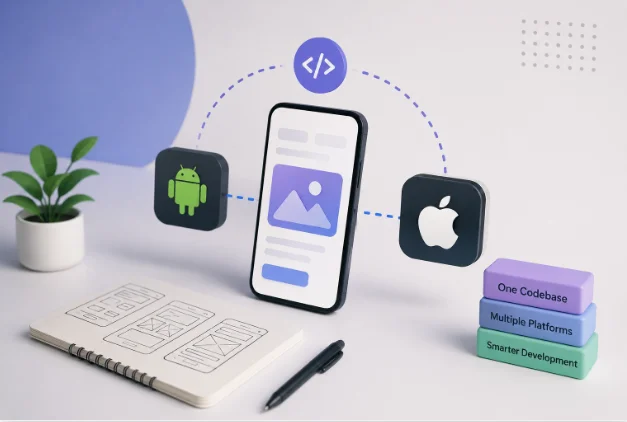
Cross-platform app development refers to the process of creating applications for several different operating systems from the same code base.
As opposed to creating an Android app and an iOS application, in cross-platform development, most of the app’s logic, interface, and functionality are developed once. And then modified to fit the requirements of each specific OS.
Ever asked yourself how it is possible for one app to be available both on Android and iPhone without creating two different applications? This question can be answered with the help of cross-platform frameworks such as Flutter, React Native, Kotlin Multiplatform, and .NET MAUI which enable creating an app with a great part of reusable code.
In recent years, the capabilities of cross-platform technologies have significantly advanced. Today, a lot of major companies are implementing them in order to save money, time, and ensure consistency of user experience.
It’s necessary to find out what attracts people to cross-platform technologies before deciding to implement them. The list below shows the main reasons.
Why Businesses Choose Cross Platform Mobile App Development

Every company has its own unique needs, budget constraints, and technical requirements. While some require quick release, others want to cut long-term expenses on development.
Many startups and even big corporations prefer cross-platform development rather than developing two separate Android and iOS apps. It is mainly because of the advantages listed below.
1. Shared Codebase for Many Devices
The main point about cross-platform development is that the developers have to create only one single codebase which runs on both Android and iOS. Instead of maintaining two distinct apps, the greater part of the application will be created only once.
It helps save development time and efforts spent by engineers. Developers can spend their time on perfecting the app functionality instead of creating duplicates of the code for different operating systems. Companies can get fast app updates and easy app maintenance in this case.
Companies usually ask, “Is it possible to create one codebase for two different devices?” With today’s technologies such as Flutter and React Native, this question is fully justified. There might be some customization for specific platforms but most of the application will be the same for all devices.
2. Lower Development Costs
Saving costs is among the leading factors why businesses choose this development method. Development of two entirely distinct native apps involves working with two different development teams, which entails significant project costs.
Cross-platform development allows for saving development hours as much of the effort is done only once. Thus, in most cases, the cost of development gets lowered without sacrificing performance and functionality.
Although some complex enterprise-level apps still need native components, most startups and mid-sized businesses can save significantly through a unified codebase.
3. Fast Time-to-Market
Fast launching of an application is a significant competitive advantage as companies who launch first get crucial feedback from users long before other apps hit the market.
As developers need to develop only one application instead of two separate apps, the development cycle is considerably shortened. Testing, debugging, and implementing new features get easier as well.
4. Easier Maintenance and Updates
Any mobile application needs regular updates. It implies bug fixing, improving security and adding new features to keep users happy.
It becomes much easier to maintain one codebase. Developers need to do changes to most features only once instead of doing it for every operating system. In addition to lower long-term maintenance costs, it helps to release future versions faster.
Moreover, business asks, is cross platform mobile app development easier to maintain? For most applications, the answer is positive. One codebase makes it easier to control versioning, testing and maintenance.
5. Consistent User Experience
Users expect the same quality from the app, irrespective of what device they use. Cross-platform frameworks enable developers to build interfaces that will look similar to those on other platforms.
Despite differences in design guidelines of Android and iOS, current frameworks enable developers to customize the user interface of apps while keeping it recognizable.
Popularity of cross platform mobile app development is growing because of the ability of businesses to provide a consistent customer experience without building separate applications.
6. Wider Market Reach
Launching an app on Android and iOS instantly broadens the customer base. Companies no longer have to stick to just one operating system anymore.
Starting on multiple platforms is extremely helpful in making companies grow faster, get more customers, and generate more revenue. It is even more useful for startups that need to build brand awareness.
The most common question among many companies is “Should I launch my app for Android or iPhone first?”
Well, cross-platform development solves this issue by covering both platforms.
7. Streamlined Development Team
Native app development normally involves hiring Android developers, iOS developers, designers, testers, and other experts in the platforms. Having several development teams complicates the development process and raises the project cost.
Cross-platform development usually entails fewer developers because most of the app is the same. Such teams can work more productively and release new versions quicker.
8. Access to Modern Development Frameworks
Modern cross-platform frameworks have already changed considerably. Frameworks like Flutter, React Native, Kotlin Multiplatform, and .NET MAUI are equipped with advanced development tools and huge developer communities.
With those frameworks, you can get native device functionality, smooth animations, high performance, and various third-party libraries. Developers can create complex applications without building new applications from scratch.
9. Better Scalability for Business Growth
Many young companies start their work with an app and then evolve over time. A proper cross-platform architecture helps developers add new features to an existing app.
When a company grows, it may need to use payment systems, cloud solutions, AI technology, analytics, messaging, and many other advanced features. Planning everything ahead will make future scaling much easier.
Many companies wonder whether cross-platform apps can support business growth. Definitely, if built properly, cross-platform applications can be scaled to serve millions of customers.
10. Strong Community and Continuous Innovation
Cross-platform development gets better each year. The big technology firms put a lot of effort into developing their frameworks, thus making them work better and adding features to them.
Also, there are large communities of developers that provide thousands of plugins, tutorials, code libraries, and practices for overcoming problems. Therefore, development becomes easier, and risks get minimized.
Companies get the advantage of innovation because it is much easier for them to integrate new technologies into their application. Also, choosing the right framework ensures stability.
Existing Relevant Contents:
How Hybrid App Development Can Reduce Costs?
How Is App Development Different From Web Development?
How To Write A Business Plan For Mobile App Development?
How Much Does It Cost To Develop An App?
5 Popular Cross Platform Mobile App Development Frameworks
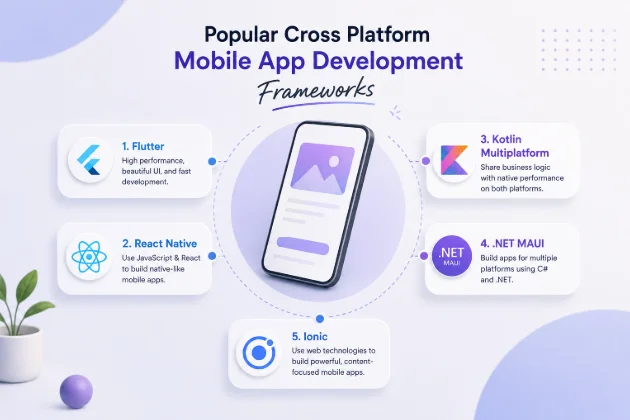
Selecting the correct framework is perhaps one of the crucial steps during app development. There is a certain level of strength, weaknesses, and suitability of the frameworks.
Have you ever thought about, “Which cross-platform framework would suit my business needs the most?” There is no one particular answer, but it all depends on your budget, app complexities, performance requirements, and other aspects related to business goals.
1. Flutter
Flutter is a popular open-source software framework created by Google to develop Android, iOS, web, and desktop applications from a single codebase. Flutter utilizes Dart programming language and is renowned for its great-looking user interface design and outstanding performance.
Flutter comes with its own rendering engine which makes it easier to create uniform UI designs across multiple devices. In addition, it features Hot Reload functionality, which means that developers can immediately see changes in their code which accelerates the whole development process.
2. React Native
React Native is another well-known open-source framework developed by Meta to enable developers to build mobile applications through the usage of JavaScript and React with nearly native performance of the application.
Startups mostly prefer React Native because of the vast community of developers, plenty of reusable libraries, and excellent third-party support. It is widely used for business apps, eCommerce apps, social media platforms, and on-demand services.
3. Kotlin Multiplatform
Sharing of business logic between Android and iOS platforms is possible through Kotlin Multiplatform while creating native UI for both platforms. Therefore, code sharing goes hand in hand with native performance.
Those businesses which place more emphasis on platform-specific experience prefer Kotlin Multiplatform because of its flexibility compared to traditional frameworks and reduction in redundant development efforts.
4. .NET MAUI
.NET Multi-platform App UI (MAUI) is the latest cross-platform framework by Microsoft to develop applications on Android, iOS, Windows and macOS through C# and .NET languages.
Enterprises that are already running software from Microsoft usually prefer .NET MAUI framework because of its compatibility with enterprise software.
5. Ionic
Ionic is a framework that uses web-based technologies like HTML, CSS, and JavaScript to build mobile applications. It serves well when developing content-oriented applications, enterprise applications or internal business tools.
Native App Development vs Cross Platform Development
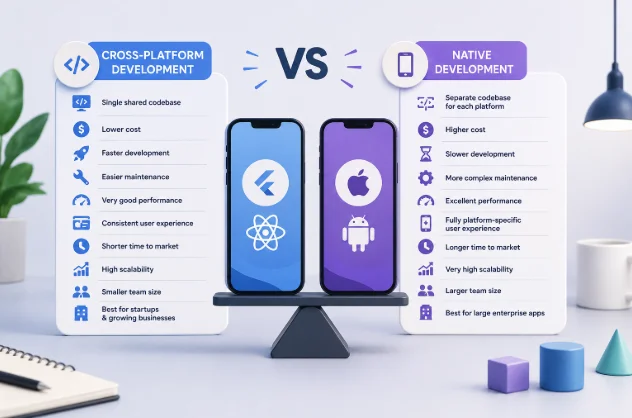
One of the most popular questions that companies face before embarking on a mobile application development process is whether to go for native or cross-platform development.
Have you ever asked yourself, “Should I develop native applications or go for cross-platform development?” It is important to have knowledge about the two for making informed decisions.
| Feature | Cross-Platform Development | Native Development |
| Codebase | Single shared codebase | Separate codebase for each platform |
| Development Cost | Lower | Higher |
| Development Speed | Faster | Slower |
| Maintenance | Easier | More complex |
| Performance | Very good | Excellent |
| User Experience | Consistent | Fully platform-specific |
| Time to Market | Shorter | Longer |
| Scalability | High | Very High |
| Team Size | Smaller | Larger |
| Best For | Startups & growing businesses | Large enterprise apps |
Both approaches have advantages. Businesses should choose the option that best matches their technical requirements, budget, and future growth plans.
Industries That Benefit Most from Cross Platform Mobile App Development
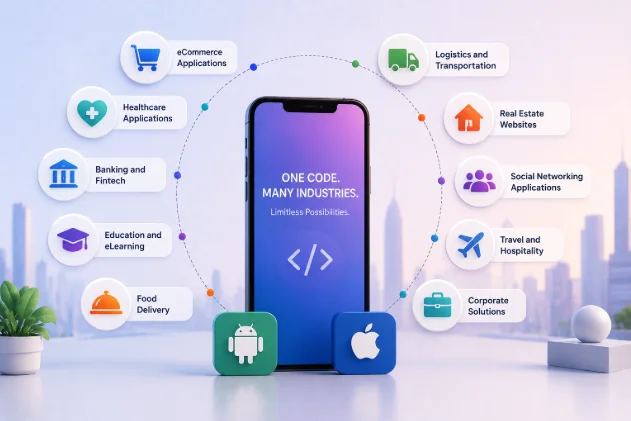
The cross-platform development model is applicable for almost any business sphere. It helps organizations create apps quickly and manage expenses effectively.
Did you ever wonder, “What businesses can benefit most from cross-platform applications?” Here are the spheres of business that usually use cross-platform development.
- eCommerce applications
- Healthcare applications
- Banking and fintech
- Education and eLearning
- Food delivery
- Logistics and transportation
- Real estate websites
- Social networking applications
- Travel and hospitality
- Corporate solutions
Companies from these industries need to satisfy the needs of users who have access to Android and iOS devices right away. Cross-platform development can help them do it easily without having to develop different projects.
Moreover, the demands of customers increase. So, companies can benefit from quick updates, maintenance, and scaling.
What Factors Affect Cross Platform Mobile App Development Costs?

Despite being cheaper than native app development, several elements determine the total budget for cross-platform software. Did you ever ask yourself, “Why does one cross-platform application cost $20,000 and another costs more than $200,000?” This can be explained by the following factors.
- Project Complexity: Apps that are easy to use will cost much less than enterprise solutions that require advanced business logic and integration with cloud infrastructure and AI capabilities. The more complicated the workflow, integration and interaction design of the app is.
- Number of Features: Features like authentication, payments, messaging, GPS tracking, video streaming, and artificial intelligence affect development costs greatly. Businesses need to focus on core features at first and develop all other advanced features step-by-step after the launch.
- Design: Basic templates cost less than fully customized design with animation, personal dashboards and other interactive components. A good design increases usability and reinforces the brand image.
- Third-Party Integration: A lot of apps require integration with payment gateways, cloud storage, CRM systems, analytics platforms, maps or messaging services. All these integrations take additional time and effort in development, testing, and long-term maintenance.
- Backend Infrastructure: Applications with real-time synchronization, cloud database, API, and many users will need a stronger backend design. A reliable infrastructure ensures future growth without compromising on the performance of your applications.
- Security Needs: Applications handling private customer data will need higher encryption, secure authentication, and regulation adherence. Higher security standards mean increased time and cost during development.
- Team Expertise: Skilled developers command higher hourly costs but provide high-quality codes with low bugs and faster development processes. Hiring experts may actually cut down future maintenance costs.
- Maintenance and Future Enhancements: Development does not stop at launching the application. Frequent updates, operating system compatibility, bug corrections, and enhancements continue to demand constant costs. Maintenance should always be included in the total development budget by any business.
Common Challenges in Cross Platform Mobile App Development
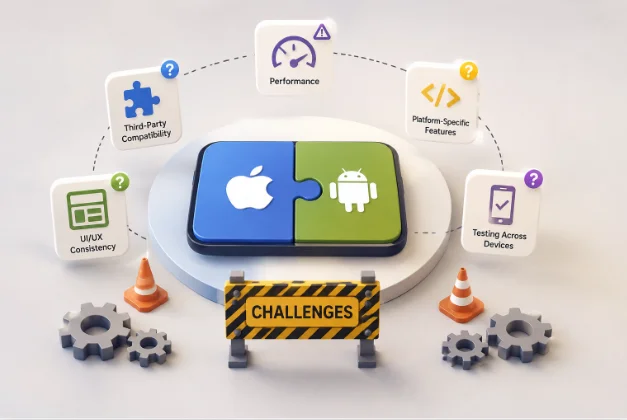
Despite the numerous benefits of cross-platform development, there are some technical problems faced by the developers when they are working on their projects.
Early knowledge about the challenges will allow the companies to set realistic development deadlines and select the appropriate development approach.
- Optimization: The complexity of certain applications may lead to the necessity of writing platform-specific code for the sake of obtaining optimal performance. Good architecture and professional developers will help minimize the performance gaps.
- Platform-Specific Functions: Sometimes new capabilities or functionalities of the platforms may arise. In this case, developers have to write native code only for those specific parts of the application and leave the remaining code shared.
- User Interface Consistency: Shared code guarantees consistency of user interfaces but Android and iOS use different design guidelines. Developers have to make the trade-off between consistency of the brand and requirements of different platforms.
- Compatibility of Third-Party Plugins: Not all third-party plugins are updated regularly. Careful choice of libraries with good community support will guarantee compatibility in the future.
- Testing across Various Platforms and Hardware Configurations: Despite having just one code base, developers should test their applications on different devices. Comprehensive testing helps ensure a smooth experience for every user.
Best Practices for Successful Cross Platform Mobile App Development
However, it takes much more to develop a successful application besides selecting the best frameworks. Firms that use the recommended approaches can release their products much faster without making any mistakes.
- Formulate the business goals before the development process starts.
- Develop an MVP and add new features step by step.
- Select the framework which is suitable for your project.
- Create a user-friendly interface.
- Design the scalable back-end system.
- Think about the security measures in advance.
- Test the product on different devices during development.
- Take users’ feedback into account.
- Update the frameworks and libraries regularly.
- Collaborate with professionals in mobile app development.
Thus, following the recommended practices helps firms develop stable applications which will stay competitive for many years.
10 Common Mistakes to Avoid in Cross Platform Mobile App Development
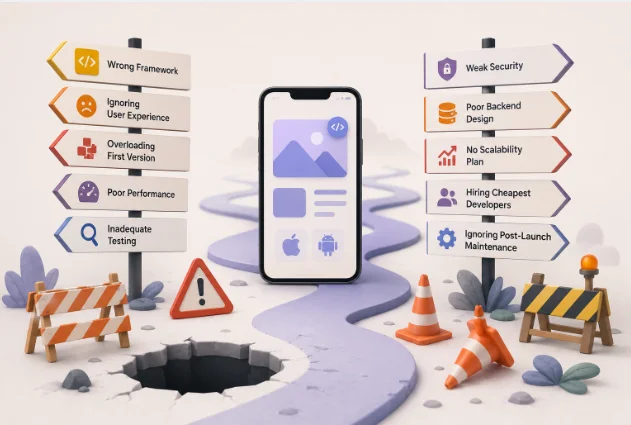
Cross-platform development is chosen by many companies due to its efficiency. Nonetheless, a bad approach to planning may cause delays, additional expenses, and decreased performance.
Have you asked yourself the question “why do some cross-platform apps work and others fail”? Here is what the answer usually is: they managed to avoid the mistakes listed below.
1. Choosing the Incorrect Framework
Not all frameworks fit all projects. There are frameworks for simple business applications and frameworks for enterprise applications. Businesses should take into account the scalability, performance, the community around the framework, and maintenance when choosing one.
2. Disregarding User Experience
The code reuse doesn’t mean that the user experience is poor. People using Android and those who use iOS expect different navigation and UI. Developers should provide users with natural-looking interfaces while maintaining consistent branding at the same time.
3. Packing Too Much into the First Version
Many companies want to implement every feature available in their first version. It adds development time, expenses, and risk to a project. The launch of an MVP allows to validate concepts and improve the application over time.
4. Neglecting Performance Optimization
Poorly optimized programs will feel sluggish, particularly on outdated devices. Programmers must optimize images, animations, requests to API, and application architecture for smooth performance.
5. Insufficient Testing on Various Devices
Testing only a few smartphones will not suffice since different devices, operating systems, and screen sizes may react differently. Testing allows for the detection of potential compatibility problems in advance.
6. Poor Security Design
Most mobile applications are responsible for handling confidential information. Inadequate protection puts users at risk. Authentication methods, encrypted communication, protected API access, and regular security updates should be implemented in every case.
7. Poor Backend Architecture
No matter how well-designed your frontend is, the poor backend can ruin the whole performance of the program. Businesses must consider investing in scalable servers, efficient databases, and safe APIs.
8. Failing to Plan Ahead for Scalability
Not all companies have the foresight to plan their further development. With more users, it will become increasingly difficult and costly to modify the app. With good planning ahead of time, the business will be able to add new features later.
9. Hiring Cheapest Developers
Hiring the cheapest development team often results in lower-quality code, more bugs, and higher maintenance costs later. Experienced developers usually deliver better architecture, stronger security, and more reliable applications.
10. Ignoring Post-Launch Maintenance
Launching an application is only the beginning. Mobile operating systems, user expectations, and security standards constantly evolve. Regular updates, bug fixes, and feature improvements help applications remain competitive for years.
Future Trends in Cross Platform Mobile App Development
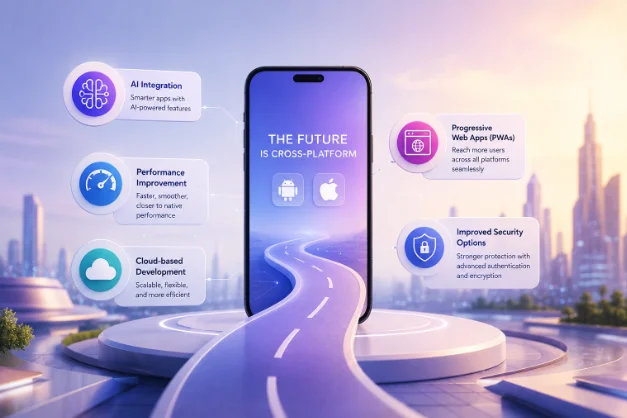
There is no standstill in cross-platform app development, as there is an increasing need for quicker development and better UX. Modern frameworks get more advanced every year.
Have you ever wondered, “What is the future of cross-platform mobile development?” It is safe to assume that these trends will define the industry in the years ahead.
AI Integration
AI has become a mandatory component for many mobile apps, as businesses use AI for chatbots, recommendations, automation, image recognition, and predictive analytics. Modern cross-platform frameworks provide much better integration of AI services.
Performance Improvement
The frameworks, such as Flutter and React Native, still develop in terms of performance and rendering speed. It is worth noting that the difference in performance between native and cross-platform applications is becoming smaller.
Cloud-based Development
Cloud services make the process of backend development and data storage easy. Moreover, cloud integration allows companies to scale their applications more efficiently.
Progressive Web Apps (PWAs)
Most businesses today integrate cross-platform mobile applications with PWAs in order to address their audience across both browsers and mobile devices. Use of PWAs increases flexibility without raising development expenses.
Improved Security Options
With the rising number of cyber threats, more authentication and encryption options, biometric checks, and anti-fraud mechanisms have been introduced. Security is going to be among the major concerns of future mobile application development.
How to Choose the Right Cross Platform Framework
Choosing the appropriate framework is probably the most critical part of the development process. Each company has its own technical needs. When choosing a framework, you need to ask yourself the following questions:
- What is my project budget?
- Who are my target users?
- Which platforms do I have to cover?
- What is the importance of native performance?
- Do I need any hardware access?
- How urgent is the release?
- Does my application have potential for scalability?
- What kind of maintenance is expected from my project?
- Which programming languages do my developers know?
- What are the long-term business goals of my company?
Answering these questions will help companies pick a framework that fits their present and future needs.
How App-Concept Can Help You Build a Cross Platform Mobile Application
Nowadays, it must be clear why cross-platform development became such a widely used approach by modern companies. However, to develop an effective application, it takes technical skills, well-thought planning, and experienced developers.
In this case, App-Concept may assist you in reaching your goals.
App-Concept is a professional company that provides mobile app development services for startups, expanding and enterprise companies. The team of experienced developers is focused on developing convenient solutions for long-term business growth.
Here is what businesses can get using the services of App-Concept:
- Custom mobile app development
- Cross-platform and native app development
- Flutter and React Native development
- User interface and user experience design
- Backend development and API integration
- Cloud application development
- Integration of third-party services
- Quality assurance and testing
- Application maintenance and updates
- Performance optimization and scalability
Using the services of experienced developers allows reducing technical risks, improving the quality of the code and speeding up the whole development process.
Frequently Asked Questions
Is cross-platform development appropriate for enterprise applications?
Yes. Contemporary technologies such as Flutter, React Native, and .NET MAUI allow developing enterprise-grade applications by means of proper architecture, security, and scalable backend.
What companies develop cross-platform mobile applications?
Many startups as well as world-renowned corporations make use of cross-platform tools in building business, eCommerce, healthcare, finance, education, and social networking apps.
Are there any restrictions in using device hardware in cross-platform apps?
No, most contemporary frameworks provide access to cameras, GPS, Bluetooth, biometric authentication, push notifications, microphone, and a lot of other native device capabilities.
How much time is required to create a cross-platform mobile application?
For a simple application, you would need 3 to 5 months. Development of more complex business or enterprise applications might require 6 to 12 months or more.
Which one is better – Flutter or React Native?
There is no definitive answer here. Flutter provides superior UI and performance whereas React Native has a well-established ecosystem and JavaScript community. Choose the most suitable option depending on the project.
Is it possible to convert an existing native application into a cross-platform one?
Yes, it is but whether it would be easy or not depends on the application architecture, complexity, and existing codebase. Some features may need to be rebuilt during migration.
Conclusion
Cross platform mobile app development is critical in helping organizations make wise technological choices prior to embarking on their mobile journey. It enables faster development processes, cheaper costs, easier maintenance, and reusing codes, making it one of the best approaches for both startups and large corporations.
Selecting the most appropriate framework, observing the best practices in developing applications, and collaborating with professionals are all essential elements towards a successful journey. Whether you are creating a new mobile application or upgrading your current product, it may be a worthwhile investment.