The pathway to a successful mobile app doesn’t start with writing the first line of code, it begins long before that with a well-structured business plan. And, regardless of whether you’re a start-up or building an enterprise, you must know how to create a business plan for your app.
So, exactly, how to write a business plan for mobile app development?
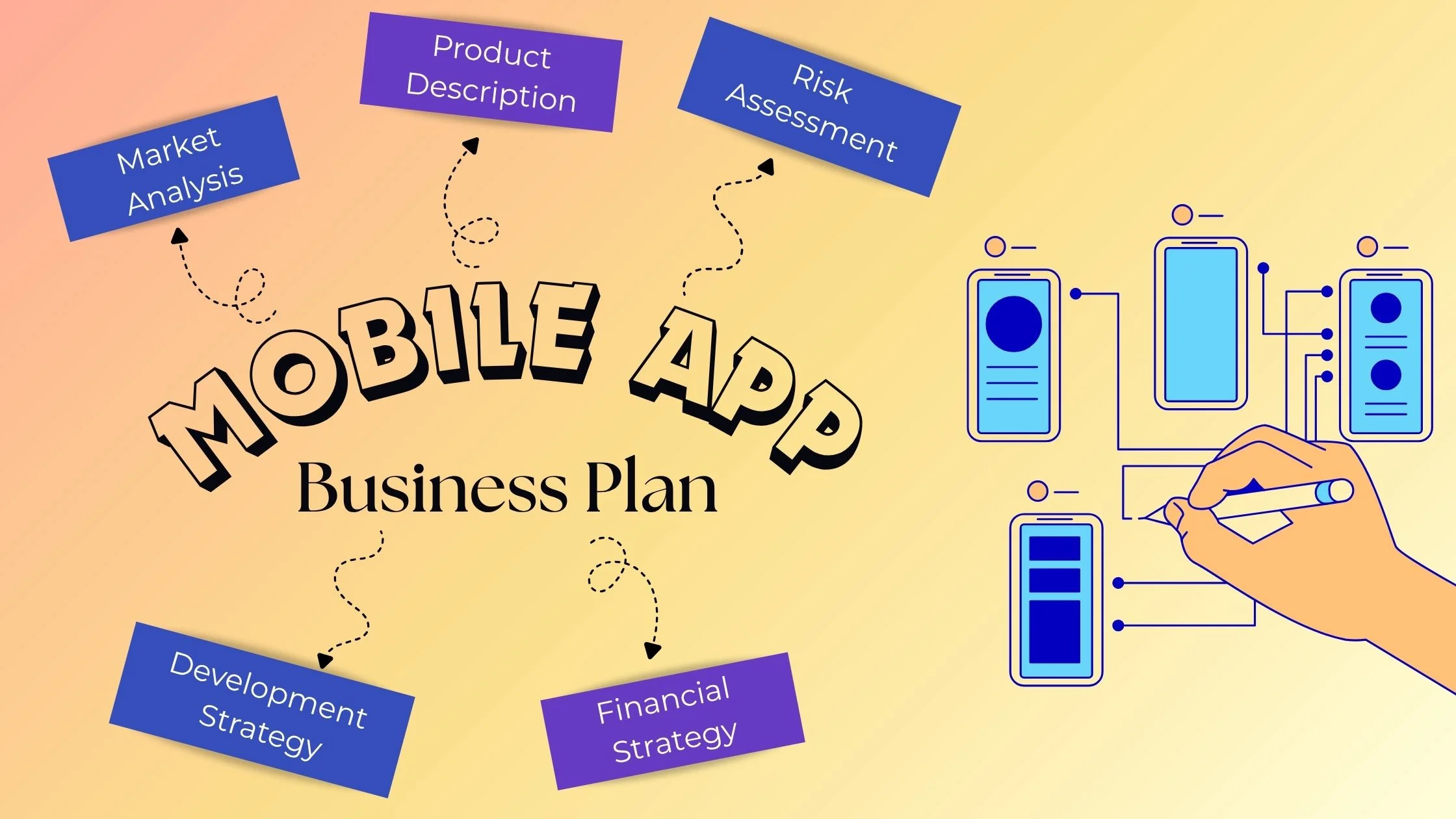
A mobile app development business plan starts with the executive summary and company introduction. Followed by this, you need to address the more technical aspects, such as the development strategy. Then include your marketing strategies and finish it up with legal considerations and the appendix.
Stay tuned as we give you a complete step-by-step guide for writing an app development business plan. Additionally, we will also address three ways to validate your business plan. So, let’s dive right into it!
Why A Solid Mobile App Business Plan Is Necessary
A mobile app development business plan isn’t just a simple document. In fact, it plays a very important role in bringing an app to life. It will serve as a strategic roadmap for every phase of your app development.
Without a clear business plan, it becomes very easy to lose direction during development. Thus, it can lead to overspending on unnecessary features or even target the wrong audience.
The right business plan will help you document your goals and market research, develop your strategy, and prepare financial projections. So, you create a framework that keeps your project aligned with your business objectives.
Here is a deeper look at what a good mobile app development business does for you.
- Validates your app idea.
- Helps secure funding.
- Keeps all development members and stakeholders aligned.
- Supports smarter and more efficient financial planning.
- Improves marketing and user acquisition.
- Identifies risks before they become problems.
- Creates opportunity for growth and expansion aligned with long-term goals.
How To Write A Business Plan For Mobile App Development? – 10 Detailed Steps
Now you know the importance of a good app development business plan. Let’s now get into the actual focus and help you build a solid, result-driven business plan.
Simply follow the 10 steps below on how to write a business plan for mobile app development
1. Executive Summary
To begin with, you’re going to write a proper summary about your business. Introduce the app while briefly mentioning the problem it will solve, this is going to demonstrate how valuable the app is. Moreover, don’t forget to write why your idea stands out.
Additionally, briefly describe your demographic, market potential, competitive advantages, and your financial expectations.
Keep the summary concise, but make it interesting. You should inform your prospective investors about your app’s true potential just from the summary.
2. Company Introduction
Next, move on to introducing your company. Start by writing about your company’s vision, inspiration, and future goals. Moreover, add what values you will prioritise as a company.
Then, move on to the more essential company information such as business structure, the mode of operation (remote, on-site, or hybrid), team capacity,, accomplishments, and history. Also, if you’re working on-site, add the location.
You can also add a separate segment introducing your core team members, their work experience, and background.
Along with the core members, write about your advisory panel too. Try to write about their industry expertise and how long they’ve been working. This will help convince the investors about your company’s reliability and credibility.
3. Product Description

The third section is where you will be providing the most crucial, detailed information. Here, you will extensively describe the product you want to sell. Spare no details in this segment!
Firstly, mention what kind of service your app will provide and the problem it will solve. Don’t write this part hastily. Take your time to convince the reader why the service you will be providing matters. If needed, include some statistics and data related to the problem.
Next, highlight all the core features and functionalities of the app. Include any out-of-the-box or innovative features to show how your app stands out. Also, don’t skip out on describing the interface.
And, it goes without saying, try to avoid excessive technical jargon. Going overboard with it can confuse the reader and lose their interest.
4. Industry Analysis
You can’t launch an app without studying the specific industry it’s built for. So, in the fourth section, you will be conducting a thorough analysis starting with the market demands and capacity.
Start by discussing the Total Addressable Market ( TAM). Then, write about the Serviceable Addressable Market (SAM) and Serviceable Obtainable Market(SOM).
These are standard business metrics that any investor will expect, so research them accordingly and stay prepared.
Don’t just focus on the market capacity, rather, try to stay ahead by researching future insights. Study past history as well as current trends to gain your own understanding.
Additionally, include your target audience. To begin with, mention your ideal demographic, their requirements, interests, pain points, and even their behavioral patterns.
You must also have a segment for competitive analysis. Here, you’re going to compare your app with competitors and prove why yours is better. Start by mentioning the competitors’ strengths and weaknesses.
Then, try to create a visual grid showing your app against your rivals across different factors such as price and value proposition, product quality and features, customer service and experience.
Additionally, you can try using the SWOT analysis. In this technique, you simply mention the strengths, weaknesses, opportunities, and threats related to your app.
5. Development Strategy

What even is an app development business plan without the development strategies? Needless to say, you have to include a detailed development or operational plan in your business plan.
Provide a well-structured roadmap to show all the key phases of the development process. Include individual deadlines for each phase. Moreover, try to mention the process of beta testing as well as post-launch services.
However, it’s not just about the roadmap. You should also include all the tools and technologies that will be used. Mention the programming language, frameworks, IDEs, as well as the infrastructure for cloud operations.
6. Marketing Strategy

You’re halfway done with the business plan! The next section will be about your marketing strategy, which will explain how you will attract users and retain customers over time.
You have already assessed your target audience during your industry analysis. Now, use that to write your messaging and marketing channels.
Next, outline your user acquisition strategy. This can include Search Engine Optimization (SEO), App Store Optimization (ASO), content marketing, social media campaigns, email marketing, and more.
Moreover, try to set specific key metrics for tracking your app’s development. It’s crucial for you to track your customer acquisition cost (CAC), app installs, and click-through rates.
Furthermore, explain your branding strategy. Describe your app’s unique value proposition, key messaging, and how it is unique compared to its competitors.
Lastly, customer retention is just as important. Write about offering loyalty programs, personalized experiences, regular feature updates, and customer support initiatives that give users an incentive to keep using your app.
7. Financial Goals

Moving on to the seventh section of your app development business plan, which is about your financial goals. This isn’t just about profitability, it’s also about sustaining long-term growth as a company.
In this segment, you have to provide a roadmap for revenue generation, cost management, and future investment. However, before all that, you must elaborate on all the expenses for bringing the app to life.
Include costs associated with design, development, testing, maintenance, marketing, customer support, and even upgrades. Moreover, mention the hiring costs and salaries.
Next, write about your short-term and long-term financial objectives. It could be anything like reaching a certain number of app downloads, securing funding or investment, or expanding into a new market.
Moreover, financial projections should typically cover the first three to five years of operation. Try to add your projected revenue, expenses, profit margins, and cash flow forecasts.
8. Risk Assessment
No business plan is a hundred percent foolproof. It’s common for every project to face potential challenges. So, in your app development business plan, you need to add a section discussing potential risks and threats.
In fact, a risk assessment section shows investors and stakeholders that you are prepared to face any minor obstacle in your way.
So, begin by mentioning technical risks such as integration challenges or scalability limitations. If there’s any potential cybersecurity threat, make sure to mention that as well.
However, what’s more common is facing unpredictable challenges from external factors. It could be anything like technological upgrades and changes in industry trends or customer preferences.
While they are considered unpredictable, you must still remain prepared, and that’s exactly what you will be writing in your business plan.
9. Legal Compliance
We are almost towards the end of your app development business plan. For the ninth section, you have to elaborate on your legal requirements and how you plan on handling them.
For starters, identify the different legal and regulatory guidelines that apply to your app and target markets. You have to be mindful of these guidelines to ensure a successful launch.
Depending on your industry, location, and reach, compliance requirements may include data privacy laws, consumer protection regulations, accessibility standards, and intellectual property protection. Moreover, you will require a separate set of regulations for your marketing and advertising content.
Data protection and intellectual property protection should receive special attention. Explain how the app will collect, store, process, and secure user information.
Additionally, write about how you plan on handling trademarks, copyrights, patents, licensing agreements, and ownership rights related to the app’s technology and content.
10. Appendix
As for the tenth and the last section, you have to write the appendix. The appendix is basically a supporting section that explains additional information referenced throughout the business plan.
There is various information you can provide in this section, depending on your app’s complexity. This includes financial forecasts, product mockups, UI wireframes, and technical diagrams to help investors understand your plan.
More importantly, try to include team resumes and credentials if you haven’t already during the company introduction segment.
The purpose of this section is to provide complete transparency and credibility without overcrowding the main sections. The appendix adds a proper finishing to your business plan and helps stakeholders better understand the potential of your app.
Existing Relevant Contents:
Why Do All Companies Want to Develop Their Own Apps?
How Much Does It Cost To Develop An App?
How To Choose The Best Mobile App Development Company?
How Long Does it Take to Develop a Mobile App?
How To Validate Your Business Plan For Mobile App Development?
Okay, you’re done with writing your business plan for your app, but what’s next? How do you know that the business plan you’ve mapped out is good enough?
Well, don’t worry, we have got you covered in this matter as well!
Here are three easy ways to validate your plan and make sure your assumptions align with real market demand
Build a Minimum Viable Product (MVP)
One of the most effective ways to know whether your plan will work is to build a minimum viable product (MVP). An MVP includes only the very essential features that will solve your users’ primary problem.
So, you can launch the app quickly and collect real-world feedback without investing in every planned feature. It also allows you to measure important metrics such as downloads, user engagement, retention rates, and customer feedback.
And, if your MVP performs well, you can confidently carry on with your business plan and even develop additional features based on actual user needs.
Seek Evaluation From External Sources
It’s always a wise decision to gather perspectives from people outside your own team. Some may hesitate with this, but it helps to get a fresh perspective and reveals blind spots that internal teams may overlook as the project becomes familiar over time.
Consider sharing your business plan with industry experts, start-up mentors, business consultants, and even potential investors and ask them to evaluate crucial areas of the business plan.
Conduct An Internal Evaluation
Of course, external sources aren’t the only way to validate the plan. Sit down with your core member and assess whether your business plan has the capabilities and resources needed to execute the plan successfully.
Evaluate your budget, revenue projection, contingency plans, marketing strategies, and any other aspect that you think needs a little more refining.
A proper evaluation from your core team can keep your business plan updated as the market, customer expectations, and business priorities evolve.
FAQ
Q. Can I write an app development business plan without technical knowledge?
Yes, you absolutely can do it. But having some technical knowledge can definitely help ensure a well-defined business plan with a proper product vision.
Q. How long should a mobile app business plan be?
Ideally, any business plan should be around 15-30 pages long, especially if it’s for investors. However, if you plan on using it solely for internal use, you can limit the business plan to 10 pages.
Q. Do I need to update my mobile app business plan?
Yes, you must update your business plan periodically. If you plan on entering a new market or meeting new investors, you must make adjustments to it as required.
Bottom Line
So, that’s all on how to write a business plan for mobile app development. Remember, writing a business plan for mobile app development isn’t simply about creating a mere document for investors. You need to adhere to a proper structure without overcrowding it with too much technical jargon.
Start with a summary, company introduction, and product description. Gradually move on to more technical knowledge as you elaborate on your development plan, followed by marketing strategies and legal considerations. At the end, validate the plan with an MVP as it significantly improves your chances of long-term success!