Social media apps have become one of the most successful categories in the mobile app industry. They can be used for socializing, content sharing, building a community, learning, and even running a business. As people spend more time online, various companies start to consider possibilities of launching their own social networks.
So, how to develop a social media app?
The key steps include finding a unique idea, analyzing your audience, creating a great user experience, choosing the proper technology stack and making scalable features. Proper social media app development also includes ensuring its security, testing and maintenance in the long term.
If you plan to create a social network application, read this guide to get the knowledge about all the essential steps in the process, the current industry trends, required features, possible mistakes and other useful recommendations from the professionals.
What Is a Social Media App?
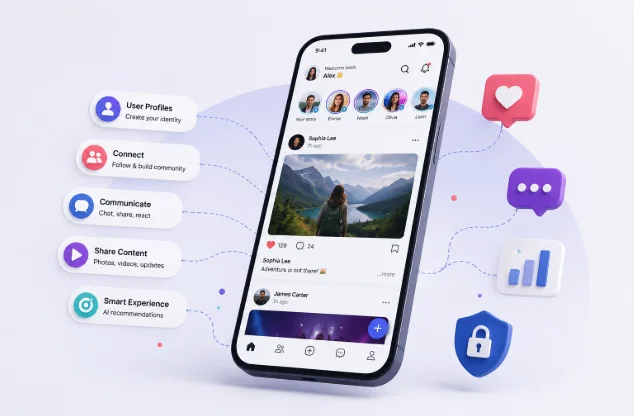
Social media applications are computer programs that give people the possibility to make profiles, connect with each other, exchange different kinds of information, and communicate. Depending on their function, the social media applications may be photo, video, messaging, networking, gaming, educational, or community-oriented.
Today’s social media applications are not limited to the role of communication channels anymore. Businesses can use them to promote products, artists to get their audience, teachers to disseminate knowledge, and companies to communicate directly with consumers.
Features like personalized feed, instant messaging, live broadcasting, and AI recommendation system revolutionized the way people use social media applications.
Many businesses wonder, “How do you make a good social media app?” The formula of success consists of providing users with an interesting experience, useful features, good security, and constant development based on users’ feedback.
Types of Social Media Applications
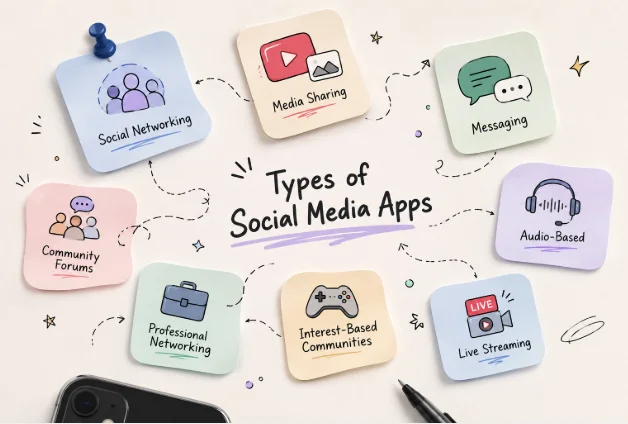
Not all social media platforms are the same. Selecting the right type of application is one of the first steps that a business takes before starting the process of social media app development. Here is the list of types of social media applications that are most popular today.
- Social Networking Applications: Such platforms are dedicated to connecting people through personal profiles, posts, comments, and communities. Examples include Facebook and LinkedIn.
- Media Sharing Applications: These applications provide users an opportunity to upload, modify and share images and videos with their followers. Some examples are Instagram, Tiktok and YouTube.
- Messaging Applications: Messaging applications prefer private communication through text, voice calls, video calls and group chats. Some examples are WhatsApp, Telegram and Messenger.
- Community Forums: Community forums provide a platform for discussion, queries and conversations. Some examples are Reddit and Quora.
- Professional Networking Applications: Professional networking applications help professionals network, recruit employees and create career opportunities. LinkedIn can be considered as the best example of such an application.
- Interest-Based Communities: These applications cater to particular interests like hobbies, industries, games, fitness, educational activities or entertainment. Such communities generate more engagement among the users due to similar interests of the users.
- Live Streaming Platforms: Such applications provide users with the feature to live stream videos while communicating with the viewers. This type of social media platform is commonly used in gaming, education and entertainment industries.
- Audio-Based Social Applications: Audio-based social platforms give users an opportunity to participate in voice conversations, live discussions and podcasts. Such applications are popular for networking and learning purposes.
Social Media App Development Process: A Complete Step-by-Step Guide

Creating an efficient social media solution goes way beyond coding. Each step of the development process requires proper planning, market research, design focused on the target audience, and scalable architecture.
No more waiting! The following process will give you an insight into the complete development journey from idea to launch.
1. Define Your App Idea and Target Audience
Every successful social media application begins by addressing a particular problem. Make sure that you know precisely who your target users are and why they would pick your application rather than any other available option.
Develop an application for a niche rather than making just another social network. This way, you will be able to easily come up with all the necessary features as well as plan your marketing strategy for a particular group of people. Proper research here will help you to avoid extra costs at the development stage.
2. Conduct Market and Competitor Research
Conducting research will help you see what already exists and what can still be done. Look not only at the biggest platforms but also at smaller niche competitors and find out their strong and weak sides as well as features they lack.
Entrepreneurs often ask how they can make their social media applications stand out. The answer is usually found while researching competitors.
3. Choose Core Features
One of the common mistakes that startups tend to make is adding all the possible features in the first release of the product. However, you should design the MVP with the most critical functions.
It may include user registration, profiles, posts, comments, likes, messaging, notifications, and search options. Later on, the user feedback will show which features should be added next. It will help cut down on expenses and accelerate the process of development.
4. Create User-Friendly Experience
The user experience is one of the key factors of success for any social media platform. In case it is hard to use, then people will not want to use it no matter how many features it has.
In order to engage users and increase the time spent on the platform, it should be simple, intuitive, responsive, and visually appealing.
5. Select the Right Technology Stack
Technology choice has a direct impact on performance, scalability, security, and maintenance in the future. Companies have to choose the technologies considering their long-term needs, and not the current trends.
State-of-the-art social media apps use cross-platform frameworks such as Flutter or React Native, backend solutions like Node.js or Django, cloud providers such as AWS or Google Cloud, and databases such as PostgreSQL or MongoDB. Choosing scalable technologies will help businesses to expand more easily in the future.
6. Build a Secure Backend Infrastructure
A backend is responsible for everything users will interact with in terms of social media application. A backend provides authentication, database management, messaging, notifications, media storage, APIs, and business logic.
Social media applications process tons of user-generated data and personal information. The backend ensures security of the sensitive data and maintains high performance as the number of users increases. Developing the secure backend infrastructure can help to avoid scalability issues in the future.
7. Develop and Integrate Required Features
After the backend infrastructure is built, the development of the core functionality begins. Each feature has to be tested separately before the integration with the whole system.
The phrase ‘develop a social media app’ becomes especially relevant during this stage because businesses must prioritize features that provide the greatest value to users. A gradual development approach improves quality and keeps projects on schedule.
8. Test the Application Thoroughly
Testing is among the most crucial steps in application development. Bugs, crashes, slow performance, and security flaws can easily ruin user trust once an app is launched.
Quality assurance departments conduct functional tests, usability tests, security tests, compatibility tests, and performance tests on multiple devices. Testing early in the process decreases expenses on changes made after launching and guarantees a pleasant user experience.
9. Launch the Application and Analyze Its Performance
Once all tests prove that everything is fine, it’s time to publish the app in the app stores and deploy it on production servers. However, launching is far from being the last step in the app development cycle.
It is essential to monitor user activity, reports on crashes, number of downloads, engagement rate, and retention. Such data will be useful for improvements.
10. Scaling and Updating the Platform
Social media applications that have been launched successfully keep developing. Updates can add some new functionality, increase security, improve performance and fix all issues raised by users.
Many businesses want to know “how do successful social media apps continue growing?” The truth is in constant improvement of the platform by adding AI-powered recommendations, live streaming, moderation system, monetization, etc.
Existing Relevant Contents:
How Do I Brief An App Development Agency?
How To Write A Business Plan For Mobile App Development?
10 Essential Features Every Social Media App Should Have
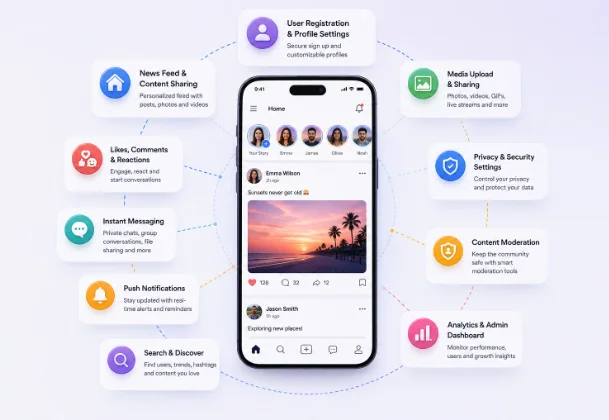
Whatever your social media platform, there are certain things that are expected from it and make the experience more engaging, interactive, and enjoyable.
Do you wonder what the key elements that make any social media application successful are? Below are the features of today’s social networks.
1. User Registration and Profile Settings
Registration is an integral element of any social media app. People need to be able to register through email addresses, phone numbers, Google or Apple accounts.
Profile settings let people add profile pictures, fill out their bios, change personal information, set privacy and other options to customize their social networking experience. Well-developed profile settings not only help engage users but also make their accounts more personal.
2. News Feed and Content Sharing
News feed is the core of any social network as it includes all posts, pictures, videos and updates according to the user’s preferences and algorithms. Many businesses wonder how social media apps keep users engaged and entertained. Personalized content feed is the main reason for that.
3. Likes, Comments, and Reactions
Social interaction is what makes any social platform work. Likes, comments, emojis, and reactions contribute to the discussion among users. Such simple engagement tools help content creators get some feedback while boosting activity across the platform.
4. Instant Messaging
Instant messaging provides users with the ability to interact with each other without leaving the platform. The modern messaging system implies text messages, images, videos, voice messages, file exchange, and group chats.
The question that many users ask is “Does every social network require messaging?”. It is not required but significantly increases retention because it fosters daily communication in the app.
5. Push Notifications
Push notifications inform users about new messages, comments, likes, follows, and any other important updates from the application. Moreover, push notifications can also remind inactive users to use the platform.
Notifications have to be smart and not too many. The more relevant notifications are, the more user engagement they create.
6. Search and Discover
A good search system helps to find new users, communities, hashtags, and content according to users’ interests.
Filters, trends, recommendations, and personalization will boost discovery and improve user experience.
7. Media Upload and Sharing
Nowadays, users expect more from text-based posts. All good platforms are equipped with photo sharing options, video support, GIFs, live streaming, document management, and short-form content options.
Cloud storage that provides reliable file storing, fast uploading, file compression, and content optimization are some of the features that make the platform work seamlessly despite millions of uploads each day.
8. Privacy and Security Settings
Privacy has become one of the most serious concerns among social media users. All people would love to have complete control over who sees their profile, their posts, stories, and personal information.
Two-factor authentication, account verification, profile visibility options, content reporting, and safe login systems are some of the features that make the platform more reliable and trustworthy.
9. Content Moderation
All growing communities need moderation tools. Without moderation options, any growing community may be faced with spam, fraudulent activities, hate speech, inappropriate content, which will negatively affect user satisfaction.
Modern platforms use a combination of machine learning and human moderators to distinguish between harmful content and regular conversations.
10. Analytics and Admin Dashboard
Admin dashboard is the option which gives complete control over users, reports, moderation processes, ads, and platform performance.
Real-time analytics also provide valuable insights into user activity, engagement, popular content, and growth trends. These insights help businesses make smarter decisions as the platform expands.
10 Proven Tips to Reduce Social Media App Development Costs
Creating an excellent app doesn’t necessarily mean spending infinite amounts of money. Good planning allows you to spend less but create an outstanding app. Here are some ways to save on development:
- Create an MVP before adding more complex features.
- Implement cross-platform development.
- Prioritize essential features.
- Leverage existing third-party integrations.
- Select scalable cloud infrastructure.
- Test your app continuously during development.
- Think of future updates at the very beginning of your project.
- Avoid unnecessary feature creation.
- Collaborate with experienced developers.
- Adopt Agile development.
Existing Relevant Contents:
How Hybrid App Development Can Reduce Costs – Everything You Need To Know
Best Technology Stack for Social Media App Development
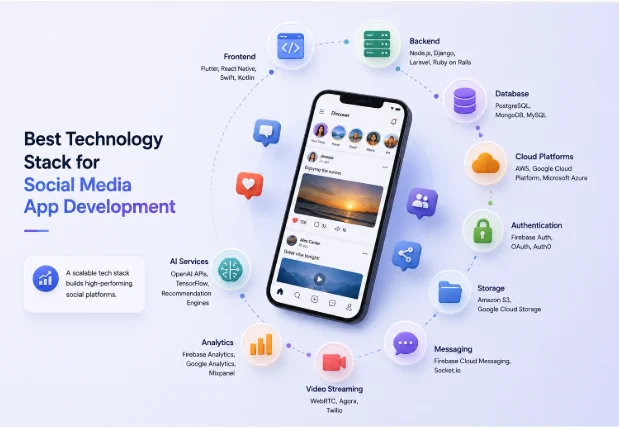
Selecting the correct technology stack will have direct effects on the application’s performance, scalability, security, and cost of maintenance. Organizations need to select the appropriate technologies for growth rather than just considering initial development.
Ever asked yourself, “What is the best choice of programming languages and framework for social networking applications?” It all depends on what the organization wants from the application.
Popular technologies include:
- Frontend: Flutter, React Native, Swift, Kotlin
- Backend: Node.js, Django, Laravel, Ruby on Rails
- Database: PostgreSQL, MongoDB, MySQL
- Cloud Platforms: AWS, Google Cloud Platform, Microsoft Azure
- Authentication: Firebase Authentication, OAuth, Auth0
- Storage: Amazon S3, Google Cloud Storage
- Messaging: Firebase Cloud Messaging, Socket.io
- Video Streaming: WebRTC, Agora, Twilio
- Analytics: Firebase Analytics, Google Analytics, Mixpanel
- AI Services: OpenAI APIs, TensorFlow, recommendation engines
Selecting a scalable technology stack reduces future migration costs while ensuring the application performs well as user numbers increase.
Social Media App Development Timeline
Many entrepreneurs ask, “How long does it take to build a social media app?” The answer depends on the complexity of the platform and the number of features included. A typical development timeline looks like this:
| Development Stage | Estimated Time |
| Research and Planning | 2–4 weeks |
| UI/UX Design | 3–6 weeks |
| Backend Development | 6–12 weeks |
| Frontend Development | 6–10 weeks |
| Feature Integration | 3–6 weeks |
| Testing and QA | 3–5 weeks |
| Deployment | 1–2 weeks |
A simple MVP usually takes around 3–5 months, while a large-scale social networking platform with advanced features may require 8–15 months or longer.
How Much Does It Cost to Develop a Social Media App?
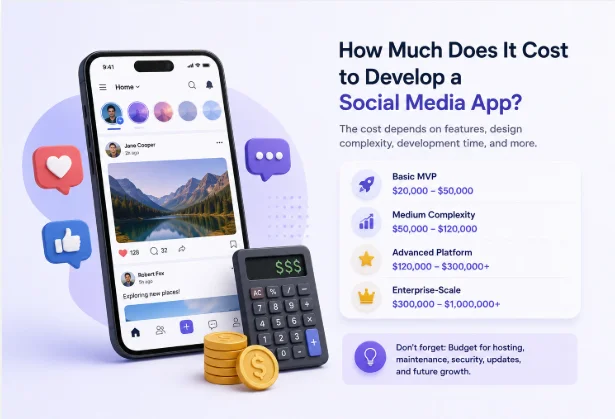
One of the most common questions businesses ask is, “How much does it cost to develop a social media app?”
The final cost depends on features, design complexity, security requirements, third-party integrations, and development location.
Typical cost estimates include:
- Basic MVP: $20,000–$50,000
- Medium-complexity platform: $50,000–$120,000
- Advanced social media app: $120,000–$300,000+
- Enterprise-scale platform: $300,000–$1,000,000+
Businesses should also budget for cloud hosting, maintenance, security updates, API subscriptions, and future feature development after launch.
Existing Relevant Content:
How Much Does It Cost To Develop An App?
Why Businesses Invest in Social Media Apps
The demand for a custom social network solution keeps increasing. Companies don’t use only traditional social media networks anymore because owning a dedicated platform allows them to have more control over user interaction and company growth.
Here are some of the greatest benefits of social media apps:
- Increased customer engagement
- Direct communication with customers
- Brand loyalty increase
- Monetization through advertising
- Ability to earn through subscriptions
- Premium memberships
- Community creation
- User-generated content
- Insightful data about customers
- Long-term business growth
Nowadays, companies in such industries as healthcare, education, fitness, gaming, finance, and eCommerce invest in creating their own private social networks.
Common Challenges During Social Media App Development
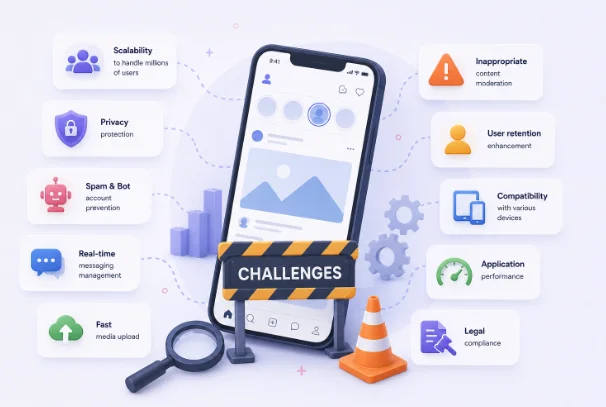
There are some common difficulties in building a social network site. Recognizing them beforehand can greatly decrease the risk of failure during development. Challenges include:
- Scalability to handle millions of users
- Privacy protection
- Spam and bot accounts prevention
- Real-time messaging management
- Fast media upload
- Inappropriate content moderation
- User retention enhancement
- Compatibility with various devices
- Application performance
- Legal compliance
Good planning and skillful developers can solve all of these problems.
10 Common Mistakes to Avoid While Developing a Social Media App
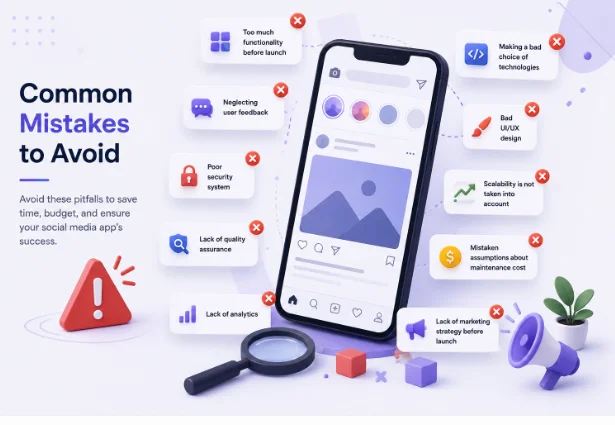
A lot of businesses fail because of similar mistakes made during their development process. By avoiding them, you can gain additional time and money. The most common mistakes are:
- Too much functionality before launch
- Neglecting user feedback
- Making a bad choice of technologies
- Poor security system
- Bad UI/UX design
- Lack of quality assurance
- Scalability is not taken into account
- Lack of analytics
- Mistaken assumptions about maintenance cost
- Lack of marketing strategy before launch
Businesses that avoid making these mistakes grow faster.
Future Trends in Social Media App Development
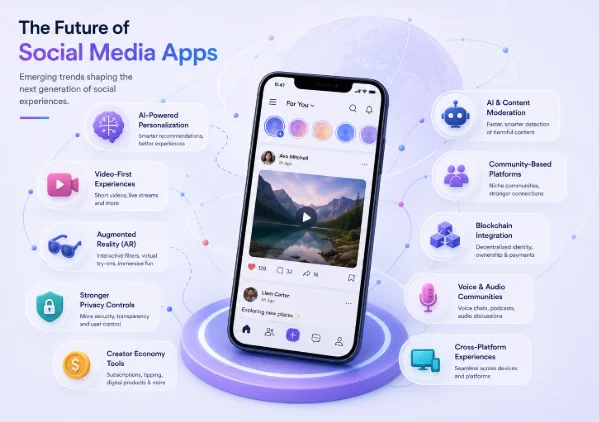
The social media industry keeps evolving as user needs and technology change at a rapid pace. Those companies that integrate the new technologies early get an edge and offer their customers a superior experience.
Have you ever asked yourself “What is the future of social media app development?” These trends will define the next generation of social networking applications.
1. Personalization with AI
Artificial intelligence changes the way users discover content online. The new recommendation algorithms use data about behavior, interests and interactions with content to deliver the personalized feeds.
Moreover, AI is used for content moderation, customer support chatbots, friend suggestions and improved advertising targeting. The more advanced artificial intelligence becomes, the more personalized social media becomes.
2. Video Content
Short videos have long been dominating when it comes to user engagement on social media. Companies developing new social applications focus more on creating video-first experience.
Video creation, editing, filters, captions and live-streaming features make users more interactive and help creators stay active and engaged.
3. Augmented Reality
Augmented reality is not only fun anymore. Users expect the interactive filters, virtual try-ons and immersive experience from the mobile application.
With AR becoming cheaper, more and more businesses integrate these technologies into
4. Stronger Privacy Controls
User privacy concerns remain to have an impact on the behavior of users. It becomes a priority for modern social media platforms to provide better encryption, privacy policies, and data controls for users.
Providing more control over personal information increases customer trust and allows companies to comply with different laws in different regions.
5. Features of Creator Economy
Modern social media platforms become a good source of additional income. Social media platforms now allow monetizing content using such features as subscriptions, communities, digital products, tipping, and partnership with brands.
When creating new social media apps, companies should think about implementing such features to increase customer engagement with the platform.
6. Artificial Intelligence and Content Moderation
Nowadays, it is impossible to handle millions of posts with human moderation. Artificial intelligence helps to moderate content much faster than traditional methods in such areas as spam, hate speech, misinformation, and fake profiles.
It remains important to have human moderators, but artificial intelligence makes the process of content moderation much more efficient and fast.
7. Community-Based Social Media Platforms
More and more users tend to move to smaller communities instead of large public networks.
Private communities, professional networking, education, and niche social media platforms tend to experience higher engagement because members share common goals and interests.
8. Blockchain Integration
Blockchain is slowly integrating itself into social media through decentralized identity, digital ownership, NFTs, secure payment systems, and transparent creator compensation.
While blockchain-based social media communities are currently under development, they can become more widespread in the coming years.
9. Voice and Audio Communities
Audio-first services keep gaining popularity with people preferring voice-based conversations over textual content.
Voice chats, podcasts, discussion streams, and audio communities add new channels for user interaction and content consumption.
10. Cross-Platform Experiences
Users need cross-platform experiences across smartphones, tablets, personal computers, smart TVs, and wearables.
Businesses with applications that support cross-platform experiences have better opportunities for success in the future.
Why Choose App-Concept for Social Media App Development?
At this point, one needs to realize that the creation of such a platform requires not only programming skills but a series of actions that require proper preparation.
And here comes App-Concept. A professional company providing mobile app development services focused on creating scalable, user-friendly, and high-performing digital solutions.
Regardless of whether your project is a small niche community platform or a massive social networking application, you can rely on App-Concept’s development team to bring your idea to life.
The list of benefits that businesses can get while cooperating with App-Concept includes:
- Development of custom social media app
- Cross-platform and native mobile app development
- UI/UX design and user research
- Backend development and API integration
- Deployment of cloud infrastructure
- Implementing real-time messaging
- Development of apps using AI
- Quality assurance and security testing
- Maintenance and performance optimization
- Updation of app features and support
It always pays off to work with a skilled development company in terms of reducing technical risks and improving development process efficiency.
Frequently Asked Questions
How much does it cost to build a social media app?
The price will vary according to the number of functionalities, platform choice, level of security needed, and the complexity of development. For example, an MVP may cost between $20,000 and $50,000, while a professional-grade platform may cost more than $300,000.
What language would be the best to develop social media apps?
There is no single best programming language. Most developers prefer Flutter or React Native for the frontend part and Node.js, Django, and Laravel for the backend development part.
Can I build a social media app with basic functionalities only?
Yes. Quite a few successful platforms have started their journey as MVPs. Having basic functionalities will help you validate your idea, gather user feedback and scale up accordingly.
How do social media apps earn money?
Common monetization strategies are advertising, premium subscriptions, in-app purchases, sponsorships, creator tools, affiliate marketing, and marketplace fees.
How critical is the scalability factor in building a social media app?
It is very critical. As the number of users increases, your app should still operate smoothly without making any drastic changes to your architecture. Scalable architecture will save you money on redevelopment.
How can I protect users’ data in a social media app?
Strong encryption, secure authentication, role-based access control, regular security testing, privacy settings, and compliance with data protection regulations help safeguard user information.
Final Thought
In any case, if you create a niche community or a global networking platform, planning is a critical factor for success. The organization should know its target audience, select the right technology stack, pay attention to user experience, make sure the platform is secure, and continue improving it even after the first launch.
When you need to develop a social media app, working with a development company that has sufficient expertise in this area will increase your chances of success. Hopefully, you will be able to build the perfect social media app for you.