The banking apps have revolutionized the finance management process. Users can make transfers, payments, apply for loans, and keep an eye on their investments right from the convenience of the app without the need to visit a branch of their bank in person.
So, how much does it cost to develop a banking app?
It usually takes anywhere from $30,000 to more than $500,000 to build a banking application, based on its complexity, security, target platforms, and functionality. While the simplest MVP might cost between $30,000 and $80,000, sophisticated enterprise-level banking apps may cost more than $300,000.
So, are you thinking about creating your own banking app? Keep reading to find out what makes up the total cost, the essential features, hidden costs, the development process stages, and how you can save on it. Let’s dive in!
What Affects the Cost of Banking App Development : 5 Key Factors
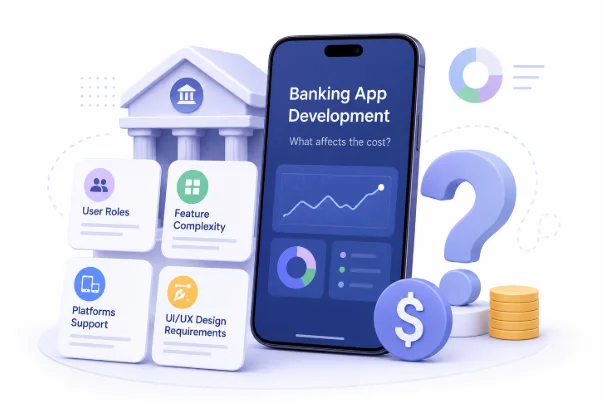
Each banking app is unique. It all comes down to your app’s features, security, target platforms, and complexity.
Ever asked yourself, “Why does one banking app cost $40,000 while another costs over $500,000?” The answer lies in the following factors.
1. Type of Financial or Banking App
The type of banking application or in a broader sense a financial app determines the cost of development the most. For example, an MVP with personal finance functions is less expensive compared to a feature-packed digital banking platform.
They include:
- Mobile banking applications
- Digital wallet applications
- Personal finance applications
- Investments applications
- Loan applications
- Neobanking applications
- Corporate banking applications
- Cryptocurrency applications
- Credit union applications
- Fintech super applications
Development of banking applications with many functions increases the time of development and implementation of integrations and security features which makes the cost of development rise.
2. Number of User Roles
Any banking application includes various roles of users, not only customers. All these roles require individual dashboards and permissions.
The typical roles of users are the following:
- Customers
- Administrators
- Customer support
- Branch managers
- Loan officers
- Financial advisors
- Compliance team
- Auditors
- Business accounts users
- Super admin
Every new user role requires more screens, testing, and security features and increases the cost of development.
The question is asked very often: “Do multiple user roles increase banking app costs?”
Yes. Every additional role adds more development work and project complexity.
3. Feature Complexity
Your choice of features will significantly influence the price of developing your banking application. Simple features will be cheap to implement, whereas more complicated finance-related features will take more work to develop.
Simple features may include:
- Authentication
- Account balance
- Transaction history
- Bill payments
- Notifications
- Profile setup
- ATM locator
- Customer support
- Money transfers
- Settings
Complicated features may include:
- AI financial analysis
- Digital wallets
- Card management
- QR payments
- Investment services
- Loan application
- Budgeting
- Fraud prevention
- Open Banking API integration
- Expense analytics
Adding more complicated features will lead to higher development, security, and testing costs, yet will also bring more value for the user.
4. Platforms Support
The choice of platforms will directly affect your budget. Development of multiple platforms requires more time than implementation of only one platform.
Examples of platforms are:
- Android
- iOS
- Multiplatform
- Native Android
- Native iOS
- Online banking website
- Progressive Web App
- Tablet version
- Desktop banking
- Smartwatch support
Developing in a multiplatform way using Flutter or React Native may lower costs as this will allow for the same codebase to work across multiple platforms.
Companies always ask, “What platform should I choose first: Android or iPhone?” The answer to that question lies in your target audience and available budget.
5. UI/UX Design Requirements
A financial application needs to be simple, secure, and user-friendly. Great design enhances brand trust and contributes to good customer experience.
Design services include the following:
- User research
- Wireframes
- Prototypes
- Custom branding
- Dashboards design
- Accessibility
- Transaction screens
- Card management
- User testing
- Dark mode
Basic design services will cost you less money. However, custom interface design and animations, along with premium branding, are more expensive.
“Do I Need Custom Banking App Design?” is a question many companies ask. In most cases, the answer is yes because better design brings more satisfied users and less customer support requests.
Cost Structure by Banking Application Development Stages
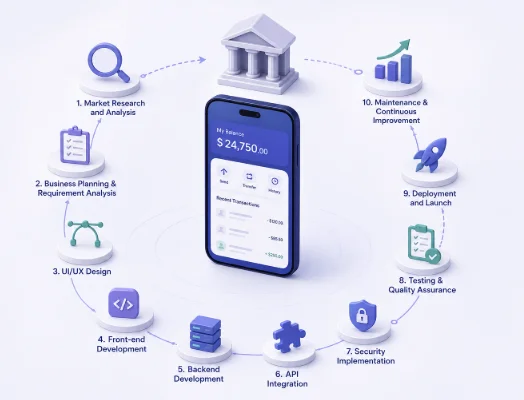
Creating a banking application involves much more effort than just programming. Every stage requires particular specialists, tests, tools, and planning, and all of these factors influence the final price of an application.
Knowing every stage of the process will help you budget properly and will prevent unexpected expenses.
A. Market Research and Analysis
Before developing a banking application, thorough market research should be done. Companies need to know their customers’ demands and competitors’ applications, security standards, and financial regulations before development begins.
Research also helps identify opportunities to create unique features that can give your app a competitive advantage. Skipping this stage often results in expensive redesigns later.
Estimated Cost: $3,000-$15,000
B. Business Planning & Requirement Analysis
The planning process sets out goals, requirements, user flow, compliance, and other aspects of development that outline the direction for both business owners and developers.
Thorough documentation decreases misunderstandings and eliminates costly feature adjustments in the middle of the development process. Moreover, it allows for accurate budget calculation.
Cost Estimate: $3,000-$12,000
C. UI/UX Design
Financial applications should be secure and simple for all users. The designer team creates wireframes, user journeys, prototypes, and UI to ensure smooth banking experience.
An intuitive user interface enhances customer satisfaction and simplifies the transaction process. Good design also increases the chances of spending more time on banking services.
Cost Estimate: $5,000-$30,000
D. Front-end Development
Front-end development involves any part that users interact with, such as dashboards, account balance, transfers, transaction history, notifications, and profile section.
If an application is built for several platforms (Android, iOS, tablet, web portal), the front-end development takes much more time due to interface optimization.
Cost Estimate: $15,000-$80,000
E. Backend Development
The backend deals with account management, payments, authentication, database, APIs, transaction history, and communication between banking systems.
As financial software works with sensitive information each second, the backend needs to be very secure, scalable, and reliable. In most cases, this is the biggest item in the development budget.
Estimated Cost: $25,000$150,000+
F. API Integration
Modern banking applications require numerous API integrations. The APIs integrate with payment processors, credit agencies, banking systems, identity verification services, investing platforms, and fraud detectors.
Each API needs development, testing, documentation, and further support. The more APIs your application requires, the more the total development costs.
Estimated Cost: $5,000-$40,000
G. Implementation of Security Features
Security is one of the critical issues in developing banking applications. The developers create security features like encryption, biometric login, secure login, fraud detection, device monitoring, and other systems.
Financial organizations also need to meet certain security standards and banking laws. Investing into robust security is important for the security of your business and its clients.
Estimated Cost: $10,000 to $60,000+
H. Quality Assurance and Testing
Testing guarantees proper functioning of all features prior to the official launching of the application. Developers perform functional testing, usability testing, security testing, performance testing, and compatibility testing.
It takes more effort and time to test banking applications than any other kind of software as even the smallest mistake can have serious consequences for users.
Estimated Cost: $8,000-$40,000
I. Deployment and Launch
The process of deployment involves such activities as setting up the cloud infrastructure, deploying the application, setting up the production server, monitoring performance, and passing app store reviews.
Final security testing is also conducted by developers before the application is launched for the use by clients. Successful deployment helps reduce downtime and enhance the overall user experience.
Estimated Cost: $2,000-$10,000
J. Maintenance and Continuous Improvement
Banking apps need continuous maintenance even after the official launching. Developers constantly fix the bugs, enhance performance, improve security, add new features, and comply with updated financial regulations.
Most businesses allocate about 15% to 25% of their initial development expenses annually on maintenance of their app.
Existing Relevant Contents:
How Much Does It Cost to Develop a Delivery App?
How Much Does It Cost to Develop a Mobile Game?
How Much Does It Cost to Develop an AI App?
How Much Does It Cost To Develop A Fitness App?
10 Essential Banking App Features and Their Estimated Costs
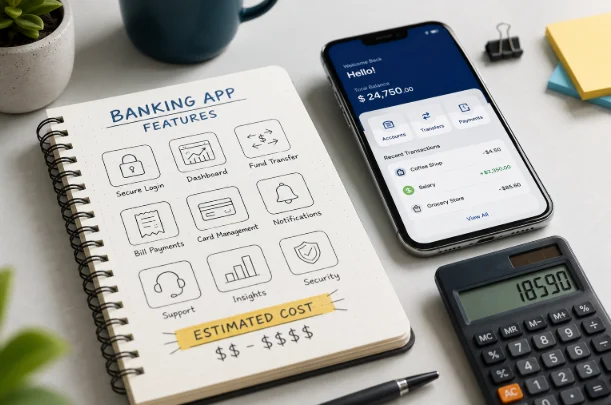
The features play a very significant role in determining the budget of the final product. As the app becomes more sophisticated, more hours are spent on developing it.
Do you think “what features each banking app should have”? Here is the list of some of the features that should be considered.
1. User Registration and Safe Login
Safe registration provides users with an opportunity to make an account using email, phone numbers, passwords, biometric authentication or multi-factor authentication.
This will ensure safe protection of users’ accounts and also improve the level of trust of users towards the app. It is also necessary for banking compliance regulations.
Estimated Cost: $2,000 – $8,000
2. Account Dashboard
Dashboard provides users with all the information about their accounts and all transactions. All accounts’ balances, recent transactions, savings, investments and financial activities can be viewed.
It makes the user interface convenient and helps customers manage their accounts fast without the need for navigation.
Estimated Cost: $3,000 – $10,000
3. System for Fund Transfers
Transferring funds between bank accounts, bank and other payment providers instantly is expected from the app.
The development of transaction systems involves complicated backend logic, encryption and transaction monitoring.
Estimated Cost: $8,000 – $25,000
4. Bill Payments
In addition to enabling people to pay for utilities, subscriptions, insurance policies, taxes, and other regular expenses via bank accounts, many applications have an option that lets users schedule regular payments.
Estimated Cost: $3,000 – $12,000
5. Mobile Check Deposit
Today, many apps let people deposit checks simply by taking a picture using their smartphone camera.
Development of such a feature requires image processing, fraud detection, and banking validation systems.
Estimated Cost: $10,000 – $30,000
6. Push Notifications
With notifications, people will be notified of successful payments, any actions related to their account, unauthorized login attempts, promotions, and other important information.
Real-time notifications increase customers’ engagement as well as add extra level of security.
Estimated Cost: $2,000 – $6,000
7. Card Management
Freezing of cards, activation of new ones, changing PINs, setting up spending limits and managing virtual cards can all be done via the application.
Giving more control over their cards to customers increases user convenience and cuts down on customer service calls.
Estimated Cost: $5,000 – $18,000
8. AI Financial Insights
Artificial intelligence can be used to analyze customers’ spending patterns, set budget plans, predict expenses, and give recommendations.
Today, many mobile banking apps implement artificial intelligence in order to make customers’ lives easier and more engaging.
Estimated Cost: $15,000 – $60,000
9. Customer Support Chat
Integrated chat provides customers with an opportunity to get help via live chat, chatbot or secure messaging right from the banking app.
Fast assistance raises customer satisfaction and eliminates frustration at financial problems.
Estimated Cost: $3,000 – $12,000
10. Admin Dashboard
With the admin panel, the user can manage customers, transactions, create reports, find out about fraudulent operations and configure system settings.
A robust dashboard makes processes more efficient and gives full control over the banking app to the administrator.
Estimated Cost: $10,000 – $40,000
Cost of Banking App Development Depending on the Type of App
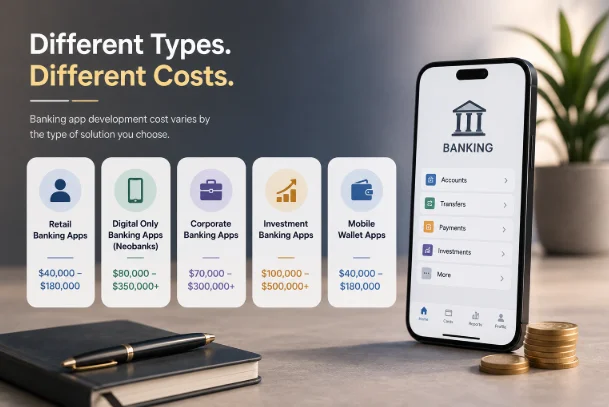
Not all banking apps perform the same functions. There are apps for personal banking, there are apps for business, investment banking or payment services.
Want to know “What is the cost of developing a banking app depending on its type and features?” This will depend on the particular banking sector you are going to serve.
1. Apps for Retail Banking
With retail banking apps, the user can manage their savings accounts, checking accounts, make transfers, and pay bills. The price of development may be from $40,000 to $180,000 depending on additional features.
2. Digital Only Banking Apps (Neobanks)
Neobanks work entirely in the virtual world. They have strict rules for onboard procedures, digital authentication, and other processes within their system. The price of creating such apps is between $80,000 and $350,000+ due to heavy compliance regulations and complicated back-end systems.
3. Corporate Banking Apps
Corporate banking solutions include services for payroll management, expense tracking, approvals, invoicing, and multi-account capabilities.
They may be priced between $70,000 and $300,000+ depending on the level of workflows and security of the app.
4. Investment Banking Apps
Investment banking applications give the possibility to manage the portfolios, trade stocks, analyze the market situation, and prepare reports.
Prices for such projects may vary between $100,000 and $500,000+ due to the integration of real-time data and analytics.
5. Mobile Wallet Apps
Wallet apps provide users with the ability to keep money on their phones and pay using this application.
The cost of developing mobile wallets usually varies from $40,000 to $180,000.
Hidden Costs Many Businesses Overlook
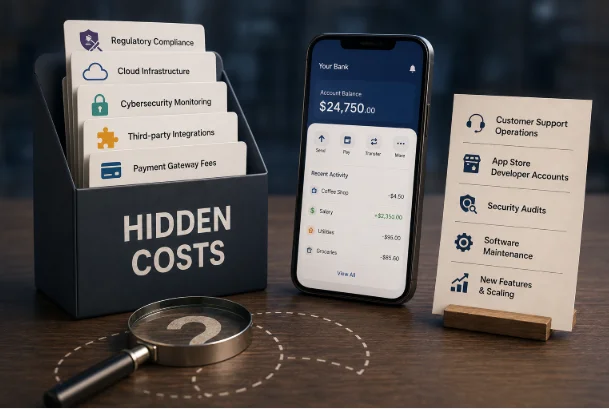
Many companies calculate their development expenses but neglect long-term costs. Do you sometimes think, “Why are banking app development projects frequently more costly than initially expected?” The hidden costs are always behind such increases.
- Regulatory compliance changes
- Cloud hosting and infrastructure
- Monitoring cybersecurity
- Third-party API subscription costs
- Transaction fees of the payment gateway
- Operations related to customer support
- Developer accounts for the app stores
- Security audits
- Software maintenance
- Adding new features and scaling
These expenses never stop after the product is launched. Neglecting them is a sure way to have financial trouble and slow down the company’s growth. Planning these costs at the initial stage lets businesses have stable operations without influencing the customers’ experience.
Cost Increasing Factors in Banking App Development Projects

There are some technical choices that greatly affect the overall project cost. If you were asking yourself “Why are some banking apps more costly to create?”, here is the answer.
- Real-time Transaction Processing: Instant payments need solid backend architecture. Banks spend much money on technologies to process thousands of transactions without any delay and safely
- Artificial Intelligence and Machine Learning: AI is the technology that is used to detect frauds, analyze finances and personal expenses, etc.
- Biometric Authentication: Fingerprints, facial recognition, and voice authentication enhance security. Nevertheless, development of biometric login requires more work.
- Regulations Compliance: Bank applications have to conform to such regulatory standards as PCI DSS, GDPR, PSD2, AML, and KYC. Compliance with those requirements takes much more time and money.
- Multiple Currencies: Using different currencies is necessary to serve international users. It complicates payment and financial calculations.
- Open Banking APIs: Integration with third-party financial institutions adds value to application. Nevertheless, integration, maintenance, and security of open banking API increase the cost of development.
- Advanced Analytics: Banking applications use dashboards, reports, and customer information for their decisions. Creation of sophisticated analytics systems takes a lot of effort and time.
- High-Level Security: Complex encryption, fraud protection, penetration tests, and authentication take time and effort to implement. Security is among one of the biggest expenses in banking app development.
- Multi-Platform Development: A number of banks develop mobile applications for Android, iOS, tablets, and web simultaneously. It increases the cost of development.
- Scalability: Banking systems have to serve millions of customers simultaneously. Enterprise architecture and databases have to be optimized to handle this load.
10 Common Mistakes That Make Banking App Development More Expensive

The reason why most banking projects go over budget is due to preventable planning errors.
Have you ever found yourself asking, “Which mistakes increase the cost of creating a banking application significantly?” Here are the main ones.
- Neglecting market and competitive analysis
- Building too many features before launching
- Hiring developers without relevant experience
- Neglecting security requirements
- Poor documentation of the project
- Delays with compliance planning
- Failure to conduct proper testing
- Using wrong technologies
- Overlooking scalability
- Communication issues among stakeholders
All of these problems typically result in high-cost redesign and delays. Proper planning, choosing skilled developers, and performing continuous testing allow companies to minimize unnecessary expenses during the process.
How to Reduce Banking App Development Cost
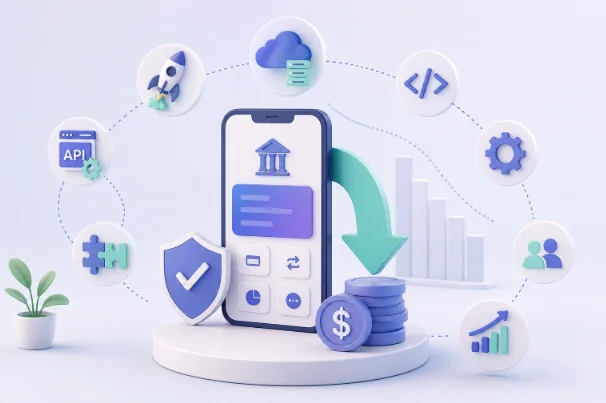
Lowering the cost doesn’t mean lowering the product quality. Have you ever been asking yourself, “How can I cut down the cost to build a banking application without affecting its security?” The following techniques will be helpful.
- Create MVP first
- Develop core banking functionalities first
- Apply cross-platform development
- Apply third-party APIs
- Build on cloud infrastructure
- Proper planning of requirements
- Agile development
- Testing from the very beginning
- Automation of processes
- Working with experienced banking app developers
Proper planning allows companies to save unnecessary expenses while maintaining high product quality. Many successful fintech startups follow these same strategies before expanding into larger platforms.
How App-Concept Can Help You Build a Banking App
Creating a secure banking application implies much more than coding. The bank app has to be safe, comply with the regulations, provide high UX/UI level, and have a scalable architecture.
And here App-Concept comes into play. We have a professional development team that provides secure and scalable banking applications development services to startups, fintechs, and finance organizations.
With App-Concept, you get:
- Custom banking app development services
- Cross-platform & native development
- Banking app security UI/UX
- Backend architecture & API integration
- Payment gateway integration
- Artificial intelligence-powered banking application features
- QA & security testing
- Maintenance & updates
Collaborating with a skilled development company is a way to minimize technical risks and make your secure banking solution available to clients faster.
So, what are you waiting for? Contact App-Concept Now!
Frequently Asked Questions
How long will it take to build a banking application?
Development of the basic banking application normally takes 4 to 8 months, while building an enterprise-level banking platform may last up to 9 to 18 months.
Is cross-platform or native development better for banking applications?
Cross-platform development will decrease costs in many cases, but native will guarantee the best performance and optimized work on devices.
Can I release my banking MVP?
Sure. A lot of fintech startups begin with a minimum viable product before adding advanced banking features.
Which is the most costly feature of a banking application?
The most costly features are security measures, fraud protection, AI capability, regulatory compliance, and transaction process in real time.
How much do you need to spend annually on banking app maintenance?
Generally, the annual cost of maintenance will be 15% to 25% of the initial development cost.
Can cloud-based infrastructure be used for banking applications?
Yes, because modern cloud infrastructure provides excellent scaling options, security, disaster recovery, and performance.
Final Thought
Knowing the cost to develop a banking app allows companies to plan their budgets in advance and save themselves from any surprises. Depending on the features, compliance, security, and the complexity of the platform, the cost of developing the application varies.
Hopefully you got a good idea on the cost of a banking app. Keep the stages, features and other important aspects in mind before actually going for it. If needed, always consult with an expert. We hope you will be able to build the best possible banking app as peer your needs.