Running a large business often means juggling multiple operations, teams, and customer interactions, sometimes all at once. Nowadays, with enterprise mobile apps, managing such challenges has become a bit easier. In fact, a lot of businesses across the world are starting to rely on such apps.
Despite such widespread use, many organizations are still unaware of the enterprise mobile application development process.
Building an enterprise app is very different from developing a standard mobile application. These apps are specifically built around business requirements, providing the employees and clients with the right support at every step possible.
Stay with us as we reveal all about enterprise mobile apps and their development process. We will discuss the different types of enterprise apps, break down the development stages, and so much more. So, without further ado, let’s get right into it!
What Is Enterprise Mobile Application Development?
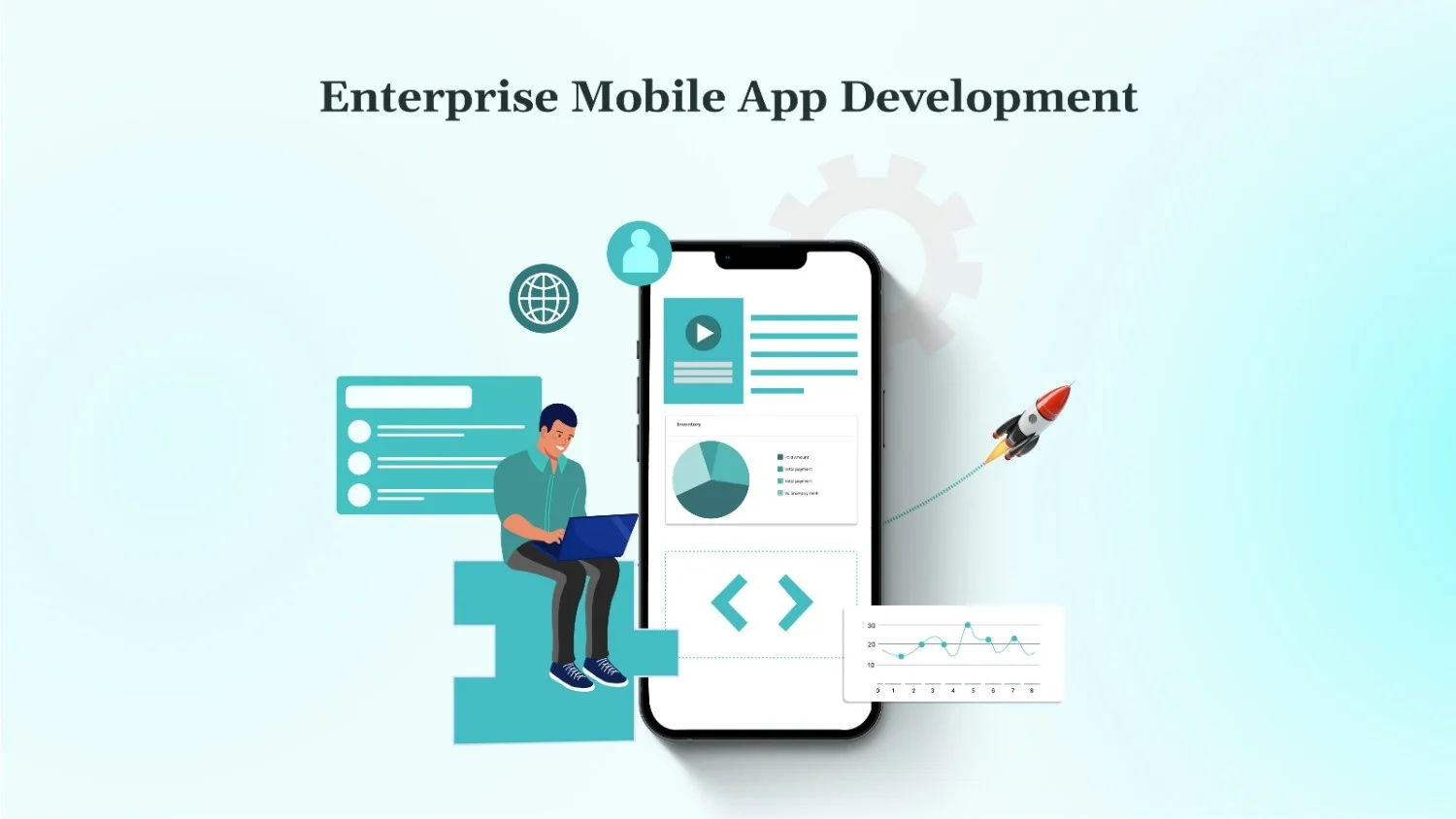
By turning to enterprise mobile application development, businesses or large organizations no longer have to rely on traditional methods to run their operations. And that’s exactly what has led to the unprecedented growth of such apps.
In simple terms, enterprise app development is the process of designing, creating, and maintaining large-scale apps specifically for businesses. However, it’s so much more than just the development phase.
Unlike regular apps that serve individual customers, enterprise mobile applications are designed to support business operations, optimize their workflows, and ultimately aid employees in tackling the business’s primary goals or problems.
These apps can be used by employees, customers, partners, suppliers, or other authorized users. They can even connect with other pre-existing enterprise systems such as CRM, HR management software, and more.
For example, retail companies may develop enterprise-level apps to handle all their employee’s needs, like checking inventory, processing orders, and communicating with managers. Alternatively, they can also launch an enterprise app to manage internal logistics.
5 Different Types of Enterprise Mobile Applications
Let’s look at the different types of enterprise mobile applications for a better understanding.
1. Employee-Facing Enterprise Mobile Apps
Employee-facing enterprise apps are to help employees carry out their day-to-day tasks, communicate with colleagues, and even access company resources when needed.
The main goal of such apps is to improve employee productivity levels while also increasing operational efficiency.
2. Customer-Facing Enterprise Applications
Next, customer-facing enterprise apps are mobile apps that businesses create to ensure that customers can interact directly with their products, services, or operations.
Common examples of such apps are mobile-banking apps, customer service platforms, or e-commerce apps. They all work to enhance customer experience as well as increase client engagement.
3. Business-to-Business (B2B) Mobile Apps
B2B mobile apps are designed to maintain interactions and even transactions between businesses, rather than between a business and individual consumers like customer-facing apps.
B2B apps tend to be useful for organizations that work with multiple partners, suppliers, distributors, wholesalers, and contractors. They ensure smooth communication among all parties, helping them collaborate with ease,
4. HR-Focused Enterprise Mobile Apps
HR-focused apps, as the name suggests, are built specifically to support human resource management and other employee-related processes.
Although employees may use these apps, their general focus is centered on human resources rather than overall workplace productivity.
Simply put, these apps can greatly reduce administrative. Not only do they digitize a lot of the HR processes, but they also provide employees with convenient access to HR services.
5. Enterprise Resource Planning Apps
Enterprise resource planning (ERP) mobile apps create a link between an organization’s core business management systems and smartphones or other devices.
Instead of focusing on one specific department, ERP apps can connect multiple business functions. Thus, they provide employees with access to centralized operational data.
7 Key Features Of Enterprise-Level Mobile Apps
Enterprise mobile apps aren’t just randomly developed with little to no thought about their functionality and features.
Needless to say, a lot goes into bringing such apps to life, starting with carefully crafting their key features. So, let’s look at the main features enterprise-level apps can’t function without.
1. Enterprise System Integration
Enterprise apps need to be able to integrate with existing business systems such as CRM, HR software, databases, and third-party APIs to keep information connected and synchronized.
So, it is absolutely necessary for such apps to have seamless integration capabilities.
2. Top-Tier Security
All business apps or platforms handle very sensitive data, both regarding the business and its customers. Hence, having strong security measures such as encryption, multi-factor authentication, secure APIs, and role-based access controls is a must for all enterprise apps.
Moreover, such apps are generally used by multiple parties in a business and even those who work alongside the business. It is commonly expected that you use such security to protect everyone involved.
3. Offline Functionality
Since most enterprise apps are used to optimize workflows, they must have proper offline functionality. You need to understand that your operations could crash if you don’t have proper offline access.
In fact, enterprise apps used by employees in areas with unreliable connectivity can support offline access, allowing users to view or enter information and synchronize it when they reconnect.
4. Analytics and Reporting
Analytics is the key to keeping track of all your operations as well as employee activity.
Your enterprise mobile app must be connected to some analytics and reporting tools. They will help monitor key performance indicators, track operations, and identify trends. Eventually, you can make better decisions using real-time or historical business data.
5. Role-Based Access
Needless to say, large-scale operations will have many different groups of employees, managers, collaborators, and, of course, clients running through it.
This is why it is of utmost importance that you maintain fixed role-based access for everyone. It will help simplify the tasks for everyone. Furthermore, security measures are implemented for each role to help maintain privacy and avoid any breach of personal data.
6. Scalability
It is safe for us to assume you would eventually want your enterprise app to accommodate a significantly large user base. However, without proper scalability measures, all enterprise-level applications will crash.
These apps need to be able to handle a large number of growing users, devices, and data without significant performance issues. Hence, scalability is a major feature, regardless of the type of enterprise app you want.
7. Cross-Platform Compatibility
The last, but certainly not least, feature that we absolutely recommend for all enterprise-level apps is cross-platform compatibility.
Generally, enterprise apps may need to work across many different types of devices and operating systems, such as Android, iOS, smartphones, tablets, and sometimes even desktops.
Cross-platform capabilities make sure your app functions across all these criteria, allowing employees and other users to access the application consistently.
Enterprise Mobile Application Development – 7 Essential Stages
If you’re considering an enterprise app for your business, you must be aware of what goes into developing such apps. Building an enterprise mobile app requires thoughtful planning, development, testing, and consistent maintenance with the help of an expert team.
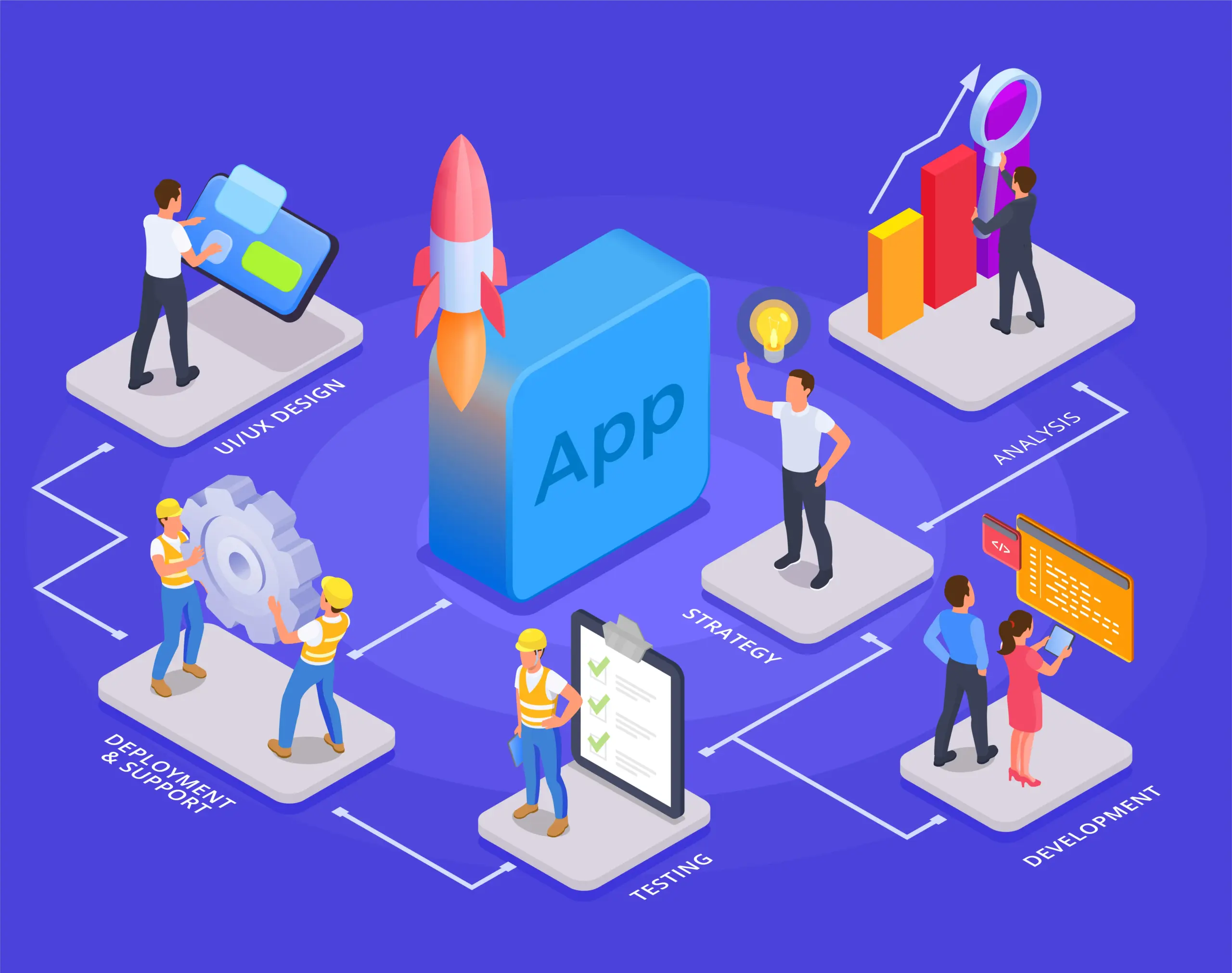
This entire process can be broken down into seven very crucial stages. Let’s have a look at them.
1. Analysis And Planning
The first step of any app development is all about identifying the app’s primary purpose, business goals, target users, and project scope. It also involves analyzing existing business processes and determining how the mobile app will improve them.
Here, developers would also like to have a clear understanding of the app’s features and functionality and your estimated budget. So that they can plan out the whole development process accordingly.
2. Tech Stack Selection
Based on your requirements and budget, developers will have to determine a specific technical architecture and choose a tech stack to work with.
This includes selecting programming languages and frameworks, databases, APIs, cloud infrastructure, and security technologies. More importantly, a key decision involves whether native or cross-platform development is appropriate.
3. UI/UX Design

Alongside the core developers, there will also be designers working on the UI and UX. They create the application’s user experience and interface based on the requirements gathered during discovery.
Moreover, they develop user flows, wireframes, prototypes, and different types of visual designs. The main goal is to show you how users will navigate and interact with the enterprise app before development begins.
4. Development
At this stage, developers build the application’s frontend and backend, implement its core features, create APIs, and configure databases. They also handle authentication and security measures to keep your app protected.
Moreover, your developers will integrate the app with existing enterprise systems such as ERP, CRM, HR platforms, payment gateways, and other third-party services based on what your app targets.
5. Testing And Quality Assurance
Once the developers are done with the core development aspects, the Quality Assurance (QA) team joins in. The QA team tests the application to identify and resolve bugs, security vulnerabilities, performance issues, and compatibility problems
At this point, developers can also conduct functional, usability, integration, performance, and security testing to ensure the app works reliably across supported devices and environments.
6. Deployment and Launch
After a long, continuous process of testing, the development team will prepare for deployment if they have gotten your approval. Depending on your organization’s requirements, the app may be distributed through public app stores, private enterprise channels, or internal deployment systems.
7. Maintenance and Ongoing Development
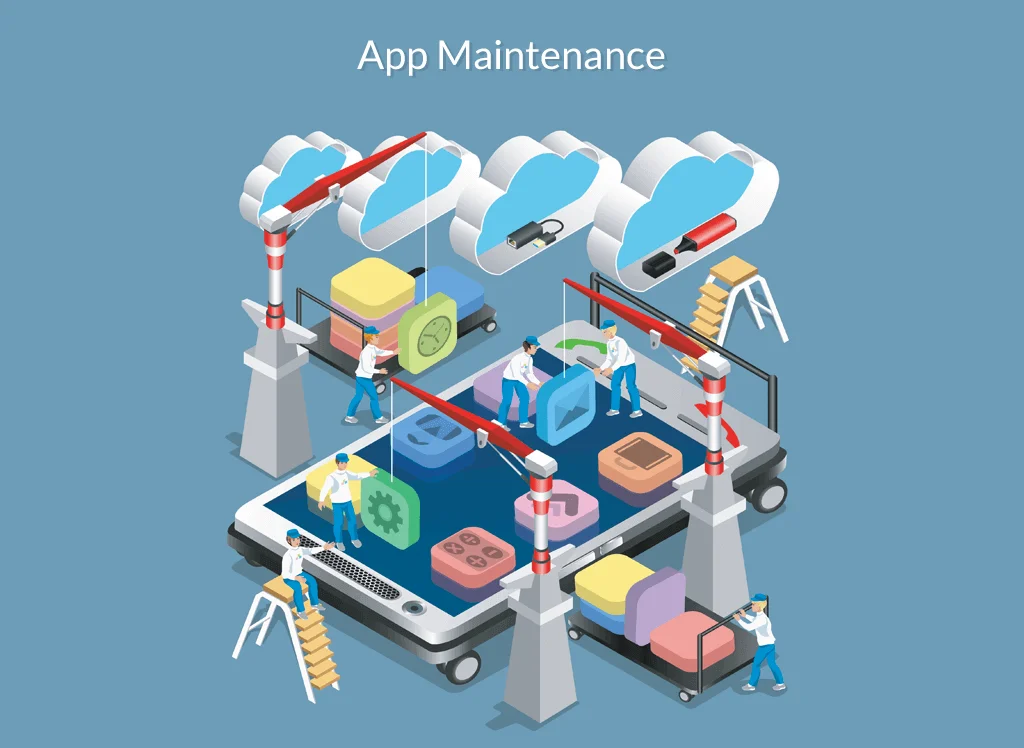
Lastly, even after the deployment, developers continue to monitor the app’s performance. They will fix bugs when needed, release new security updates, maintain integrations, and ensure compatibility with new operating system versions and devices.
If needed, they can also introduce new features and improvements as the business’s requirements evolve.
Existing Relevant Contents:
How Do I Choose Between Native And Cross-Platform App Development?
How To Develop An Educational App?
How to Develop a Social Media App?
Benefits Of Enterprise Mobile Application Development
Now, let’s look at some major benefits of enterprise mobile application development. This will further help you understand what enterprise app development can truly do for you and your business.
-
Improved Productivity And Operational Efficiency
Enterprise apps are the key to instantly increasing the overall efficiency of your business. They give employees quick access to business tools, information, and workflows, helping them become the best version of themselves.
Furthermore, they can automate repetitive tasks and help with task management. Overall, they reduce tedious workload and ensure faster operations.
-
Better Communication and Collaboration

Another major benefit of such organizational mobile apps is their ability to manage communication and collaboration across team members or outside partners.
These apps are often able to provide conversation channels, shared work displays, discussion boards, and messaging options. All of which help to coordinate the workload, communicate in real time, and most importantly, avoid miscommunications.
-
Enhanced Customer Experience
Enterprise applications aren’t just for the convenience of businesses, rather, they also ensure the correct customer experience.
Depending on the type of your enterprise app, customers are easily able to access services, manage accounts, make purchases, and do so much more. Ultimately, it all comes down to providing clients with the best possible service.
In fact, most enterprise apps offer strong customization abilities. So, you cn truly cater to your clients as per their needs, instead of providing the same solution to all.
-
Real-Time Access To Business Data
With enterprise apps, businesses can not only store and manage data efficiently, but they can also access the data in real time as per their needs.
Whether it is employees or stakeholders, everyone can access updated business information, reports, dashboards, and operational data from their devices.
So, decisions can be made faster and with more ease!
-
Greater Business Scalability
Enterprise applications are meant for tackling large-scale organizational needs. This means, from the beginning, these apps are built in such a way that they can continue to cater to a growing capacity.
As your user base, business processes, and device compatibility increase, these apps also become more and more robust to sustain such needs. Thus, allowing organizations to expand their operations without completely replacing their existing systems.
-
Reduced Business Costs

Lastly, businesses are often scared to invest in enterprise-level apps because of expenses. However, what they don’t realise is that after the initial investment in these apps, they will be able to reduce their overall expenses in the long-run.
Such apps are famously known for automating workflows, reducing paperwork, minimizing errors, and improving resource utilization. Hence, they can help organizations lower operational and administrative costs over time.
Estimated Cost And Timeline Of Enterprise Mobile Application Development
Undeniably, the cost to develop enterprise mobile apps is significantly higher than typical individual user-based apps.
However, that’s because of all the right reasons. Enterprise apps require significant development resources, effort, and consequently a longer development timeline, compared to a basic mobile app.
Needless to say, the cost and timeline can vary significantly depending on the app’s complexity, number of platforms, integrations, security requirements, and customization level.
Nonetheless, the table below summarises a general estimate of enterprise-level app development.
| Enterprise App Complexity | Estimated Cost | Estimated Timeline |
| Simple enterprise app | $50,000-$90,000 | 3 to 6 months |
| Medium-complexity enterprise app | $100,000-$250,000 | 6 to 10 months |
| Complex enterprise app | $250,000-500,000+ | 9 to 18+ months |
This should explain the typical budget for enterprise mobile apps based on complexity levels. However, as mentioned before, many other factors affect the costs.
Let’s have a look at them now, shall we?
-
Number Of Platforms
If you’re planning to developing for both iOS and Android, it can increase development and testing requirements. Thus, the costs increase too.
-
Third-party Integrations
Your enterprise app will undoubtedly require many different integrations. Connecting the app with ERP, CRM, payment systems, databases, and other APIs can substantially increase development budget.
-
Security Requirements
Depending on what your app’s primary target is, you might need very strong security measures, which can be costly. In general, features such as SSO, multi-factor authentication, encryption, audit logs, and compliance controls can add to development costs.
-
User And Device Scale
A major reason behind the costs of an enterprise app is its growing user base. Supporting thousands of users and devices can require more robust and scalable architecture. Thus, further adding to the overall costs.
-
Maintenance Requirements
Enterprise apps have to be monitored significantly for consistent maintenance and updates after the app is launched. Post-launch monitoring, security updates, bug fixes, infrastructure management, and new features can increase the costs even more.
Partner With App-Concept For Enterprise Mobile Application Development
Are you perhaps thinking of investing in a secure and highly personalised enterprise app for your business? Well, if so, then you’re in the right place.

Allow us to introduce App-Concept to you. It is a top-tier app development agency that will provide you with end-to-end enterprise mobile app development services as per your business’s personal goals and needs.
App-Concept has a team of highly qualified developers who have worked across multiple industries over the years. So, they are equipped with the right knowledge to provide you exactly what you need!
From initial planning and UI/UX design to development, system integration, testing, deployment, and ongoing maintenance, the team can support your enterprise app throughout its development lifecycle.
So, are you ready to see what App-Concept can do for you? Contact App-Concept to discuss your project requirements and get started.
FAQ
Q. How long does it take to develop an enterprise mobile application?
The timeline depends entirely on the complexity and requirements of your app. A simple enterprise application may take 3 to 6 months, whereas a complex solution with advanced security and large-scale infrastructure can take 9 to 18 months or even longer.
Q. How do enterprise apps integrate with ERP and CRM systems?
They use APIs or middleware to exchange data between the mobile app and ERP or CRM systems, which helps with real-time access to information such as customer records, orders, and inventory.
Q. Should businesses choose native or cross-platform enterprise app development?
The answer to this depends on your requirements, target user, and budget. Native development provides greater platform-specific performance but can be more costly. On the other hand, cross-platform development maintains a shared codebase across iOS and Android, reducing the development time.
Final Thought
Enterprise mobile application development can be a great tool for businesses to maintain an impeccable workflow with maximum efficiency. They automate workflows and provide employees and customers with convenient access to the correct services.
However, for businesses to gain these benefits, the apps have to be carefully developed and customized with the right approach. And, the right approach depends on many factors such as business requirements, desired features, integration complexity, security needs, expected user volume, and even long-term costs.