
Here’s an interesting fact. Mobile exercise applications occupied second place in American College of Sports Medicine’s list of 2025 fitness trends, with wearable technology being the first one.
So, fitness is no longer just gyms and fitness trainers. Fitness trackers, such as smartphones, smartwatches, and fitness platforms, allow people to track their training, make progress, adhere to dietary plans, and motivate themselves.
Now, how to develop a fitness app?
The first step would be to choose a fitness niche and target audience, plan app functionality, design user-friendly interface, and make sure the application is secure enough to provide a smooth integration with third-party devices and services. Successful fitness app development goes much further than adding some training videos or steps counting. This means creation of a product that motivates people to do some physical activities and makes them come back to an app.
However, which features to include? Which technology to select and how to monetize the application? Let’s discuss all these things.
How to Develop a Fitness App: 10 Important Steps
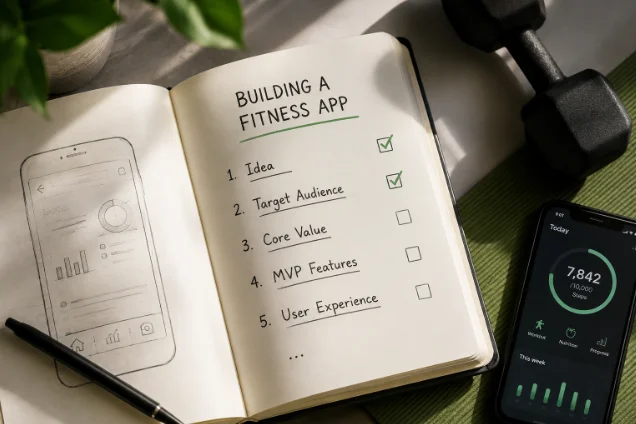
Developing a fitness app can be completely different tasks based on the particular idea. Workout tracker app, nutrition tracker, personal trainer platform, and connected fitness app, for example, can have completely different technical requirements and features set.
It would help greatly to understand the major choices made during developing a product. Here are the ten steps to take that will give a clear picture of your roadmap.
1. Select the Kind of the Fitness App
The very first step to make is defining precisely what kind of a fitness app you want to create. It is a wide market and trying to cover all of its users’ needs can be a problem when it comes to product positioning and development costs.
You may develop a fitness app for workouts, personal training, gym management, nutrition, running, yoga, or general health and wellness. Or, you may combine some of them into one comprehensive platform.
Common fitness app types include:
- Workout and exercise apps
- Personal trainer apps
- Gym and membership apps
- Running and cycling apps
- Nutrition and calorie-tracking apps
- Yoga and meditation apps
- Home workout apps
- Weight management apps
- Sports training apps
- Fitness community apps
Almost everything else depends on this choice, such as features, design, integrations, content, and revenue model.
For example, a running app would require GPS tracking and route mapping feature. A gym app would require memberships and classes booking feature. Personal training app would require video calls, workout programs, messaging, etc.
2. Define Your Target Audience
With the purpose of your app established, define your target market, a fitness app intended for professional athletes should not be built in the same way as an app meant for beginners.
Use simple questions about the users. What are the fitness objectives of the user base? What is their level of experience? Do they exercise at home or in the gym? What equipment do they have? Why is it hard for them to maintain consistency?
There may be many target markets, among which:
- Beginners
- Busy professionals
- Seniors
- Athletes
- Gym-goers
- Personal training clients
- Home exercisers
- Runners
- Those concerned with weight management
- Wellness enthusiasts
Having a well-defined target market allows for much better marketing too. Instead of trying to say that your app is “for everybody”, it becomes much easier to explain exactly who can benefit from your app and why.
The reason is obvious: there are a lot of fitness apps out there. Your app must solve some problem that other apps do not solve as well.
3. Define the Core Value of Your App
Asking yourself one key question before writing code can save you a lot of time and effort: why should someone download your app if there are already numerous other fitness applications?
Your response becomes your value proposition, which can be individualized exercise programs for busy people, cheap trainer access, easy strength assessment, or fitness programs for a certain demographic group.
For instance, instead of developing just another workout application, you might consider creating an app for people who are only able to dedicate 20 minutes a day to exercise. Everything about this application will revolve around this promise.
The same goes for limiting the development scope. You do not have to develop all popular features right away; you need the features relevant to the core purpose of your application.
This is particularly critical for the MVP concept, which suggests developing the smallest possible application that does something valuable for users and then making decisions on further improvements.
4. Plan the MVP Features
The first version should highlight the features which users will use to derive value from the app. Having too many features initially might increase the development time while not confirming their necessity by users.
Basic MVP for a fitness app can be comprised of:
- User registration/login
- Profiles
- Goals
- Workout/exercise database
- Workout plans
- Workouts tracking
- Tracking progress
- Push notifications
- Search & filters
- Basic management of the administration
The features you will need to include are entirely dependent on your app idea. For example, an app about nutrition might require food logging, but not workout plans. A marketplace for trainers might require booking and messaging.
The main point is to distinguish between must-have and nice-to-have features. The features like artificial intelligence coaches, social media, live training sessions, integration with wearables, and analytics can be added later.
This way, you will minimize your risks and learn what users are willing to have.
5. Design a Simple User Experience
Fitness apps are usually being used when a person is physically active, exercising or working out. This way the user interface of the application must be intuitive and easy to operate.
Users do not want to browse a number of screens just to begin their workout or record any exercises.
The design of a good fitness application may include such elements as:
- Simple onboarding
- Personalized home screens
- Easy-to-understand workout instruction
- Progress views
- Big buttons
- Accessible text and navigation
- Progress indicators
- Consistent navigation
- Dark mode, if it makes sense
- Responsive design
Of course, it is important to consider the context in which a user operates the application. For example, when a person is working out he or she might have sweaty hands and will be unable to concentrate on what is happening around.
This is when UI/UX research and testing play an important role. As an example, the development process of App-Concept includes Strategy and research, then prototyping, wireframing, visual design, development, testing, and ongoing support.
6. Build a Strong Exercise and Content Library
An app for fitness is as good as its content. Imagine that a user opens your app and sees a tiny and badly arranged database of exercises. You can expect them to be disappointed very soon.
The content you need may include names of exercises, instructions, muscles used, exercise difficulty level, equipment required, images, and video examples.
If you develop a workout application, you may need full workout programs as well. They may be related to strength, endurance, flexibility, weight loss, or other types of training.
In terms of safety, it is also very important that exercise instructions are correct, and information should be checked by appropriate professionals, if necessary.
If you want to give some nutritional or other advice, the process of checking should be much more thorough. Do not spread unconfirmed facts as medicine.
7. Add Personalization
Personalization allows the user to feel more involved with the application rather than just use its contents library.
For instance, it could factor in:
- The person’s fitness level
- His goals
- The history of his workouts
- The available equipment
- Types of exercises he prefers
- Duration of his workout
- The amount of activity he does
- Progress
- Frequency of training
- Preferences
Thus, the application could provide suggestions for exercises depending on these factors. The suggestions would be useful as the algorithm learns from the user’s activity.
AI could do even more here. It could recommend some exercises that were skipped by the user regularly and also a less heavy workout after a few intensive ones.
However, it is important to create an AI solution for a problem that really exists and not to do it just to have something cool to boast about. Useful, comprehensible and controllable personalization is more valuable than something complicated and rarely needed.
8. Connect Wearables and Health Platforms
Wearable devices will be an integral component in digital fitness. According to ACSM, wearable technology was named the number one fitness trend for 2025, and mobile exercise applications were second.
Depending on your target audience, your application could integrate with smartwatches, fitness trackers, heart rate monitors, or any other type of wearable device. This could help you combine data about user activities in one application.
The possible components may include:
- Steps
- Distance
- Heart rate
- Calories
- Duration of workouts
- Sleep
- Speed
- Workouts
- Active minutes
- Health components that are supported
ACSM also states that the modern wearables are capable of collecting a growing amount of data, which includes the heart rate, number of steps, distance, sleep-related data, and others.
While such integration could improve the usefulness of your application, it could also complicate your task technologically.
9. Choose the Right Technology Stack
The choice of technology influences performance, speed of development, maintenance, and scalability. You cannot choose one technology stack and use it for all fitness apps.
You can go for native development for iOS and Android, or cross-platform development. Technologies like Flutter and React Native can be used by developers for building applications that can be deployed to several platforms using the same code base.
It all depends on what you require. A basic fitness application can easily be developed through cross-platform technology while a highly technical application will require more of a platform-specific approach.
Currently, App-Concept develops both native and cross-platform applications for iOS and Android using React Native, Kotlin, Flutter, Xamarin, Swift, among other technologies.
It is also important to think about the back end. Your team should come up with plans for database, API, security, cloud infrastructure, analytics, push notifications, and integrations.
10. Test, Launch, and Improve the App
Completing the code does not mean that the product development process is complete. There are many aspects of the fitness application which need to be tested on various devices, screen resolutions, OSs, network types, and other parameters.
Testing should be conducted not only with respect to whether certain button works or not. The team needs to conduct tests with respect to performance, security, logging into an account, notifications, synchronization of data, payments, integration with wearables, and other important functionalities of the app.
Furthermore, the experience of using the application by real users should also be tested. Some features can be technically functioning well but at the same time confusing or difficult to use.
It is necessary to monitor the actions of users after the launch of the application, including retention, workouts performed, functionality used, subscriptions, and feedback from the users.
There is hardly ever any case when a good fitness app can be developed once and never changed afterwards. The app requires regular updates, bug fixes, optimization of performance and introduction of new features. This is also what App-Concept says about its post-launch support services.
Existing Relevant Contents:
How To Develop An Educational App?
How to Develop a Social Media App?
10 Must-Have Features for a Fitness App
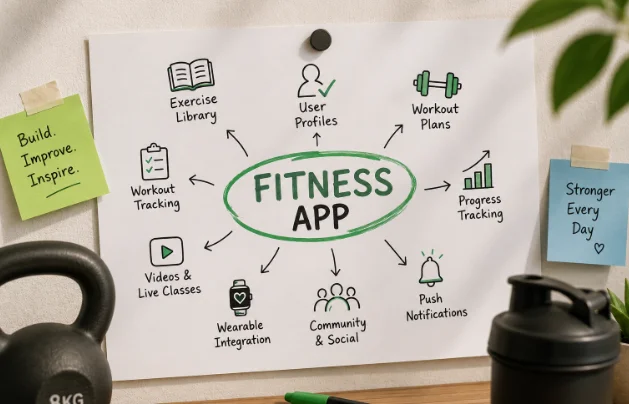
It is not necessary to include all the features that exist in the market in a fitness app.
What you should take into consideration while implementing features depends on your target audience, business model, and goals. However, there are certain features that would significantly improve the app’s performance and usage experience. The following list contains those features which are worth including in your app.
1. User registration and profiles
The users have to be able to register in the app easily by email, by phone number, or via social networks. Users’ profiles can contain such data as the user’s fitness goals, his level of activity, the preference in workouts, and other data required for personalization of the experience.
Do not overload the onboarding process. Requesting many data from the user may make him stop using the app without trying it.
2. Personalized workout plans
Personalized workout plans will make the user follow a specific routine rather than choose a workout randomly. The app can generate plans based on the user’s goals, level of fitness, the equipment, duration of workout, and preferences in workout.
For example, a beginner who wants to build strength at home could receive a different plan from an experienced runner training for an event. This makes the app feel more relevant to each user.
3. Exercise Library
The exercise database would provide users with easy access to workouts and individual exercises. Each exercise could have instructions, images, video content, difficulty level, target muscles, and equipment needed.
Search functionality and filters could help to make sense of a large library of exercises. Users could filter the exercises by targeted muscles, workout type, difficulty level, duration, or equipment.
4. Workout Tracking
Tracking would allow users to log what they actually did. The type of app will determine what is tracked; it could be the number of sets, repetitions, weights, distance, duration, calories, or workouts.
Good tracking should make the process easy for the user. If it takes too many steps to log a single exercise, users will abandon this feature. Good input flows could increase reliability.
5. Progress Tracking & Analytics
People are interested to know if their efforts bring any results. The progress dashboard could show how often users work out, personal records, completed workouts, weight loss/gain, distance covered, etc.
Visualization tools such as graphs and summary data could help in interpreting this information. Do not overwhelm users with data; concentrate on a small number of relevant metrics.
6. Push Notifications
The notifications could alert the users about upcoming training sessions, missed training sessions, milestones achieved, or new material. The notifications could also encourage users to get back into using the app if they stop using it.
However, excessive notifications could have the opposite effect. Allow the users to control the notifications they receive.
7. ideos and Live Classes
Video may be an essential part of the application if it revolves around guided workouts, yoga, dance classes, or personal training. Instead of just following the instructions given in texts, the users could see how to do things.
The option is either to provide the users with video recordings or live classes. Offering live classes imposes certain technical demands such as having the video infrastructure, schedule, chat, moderation, and delivery.
8. Integration With Wearable/Health Devices
Fitness applications may become even more useful by being integrated with compatible devices and health platforms. Depending on the type of the devices and permissions, it is possible to synchronize the activity, number of steps, heart rate, distance, and workout.
It is an important feature to consider carefully. There are different APIs, permissions, data formats, and privacy policies on different platforms. Therefore, your development team needs to decide which integrations to implement.
9. Gamification
Gamification may make workout an exciting process. There may be badges, streaks, challenges, point earning, and leaderboard participation.
It is important not to gamify the process fully but to give people motivation to develop a healthy habit through rewarding.
10. Community/Social Functionality
Community may motivate people. Depending on your idea of the application, there might be achievements sharing, challenges, following, commenting, and group activities.
Here appears the issue of moderation and user privacy. If people are able to post their content or communicate with one another, then there needs to be some form of reporting and blocking.
Advanced Features That Can Make a Fitness App Stand Out
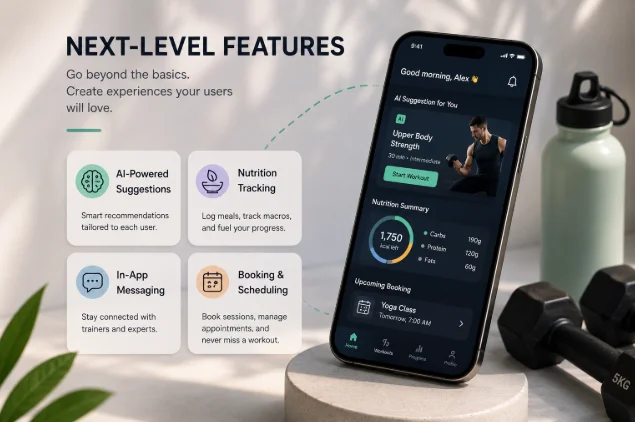
Once you have successfully implemented the main functionality, you can implement advanced features that will make your application stand out in a crowded market. Such features should be implemented because they address a particular issue of the user, rather than simply copying features of your competitors. Consider the following features to include into your application.
AI-Powered Fitness Suggestions
Artificial intelligence can be used to analyze user data and make more personalized recommendations. It may include workout suggestions based on previously performed workouts, fitness goals, availability of time, or difficulty level of workouts.
Nowadays, many fitness applications try to implement the features of AI-based coaching and personalization. Thus, for instance, the 2026 Lovable guide includes AI workout suggestions and hybrid human-AI coaching as one of its trends.
Nevertheless, AI should not be used instead of the opinion of professionals when health and injuries are concerned. Suggestions should be implemented with necessary limitations.
Nutrition Tracking
If your product includes nutrition, you may ask users to log in their meals, calories, macronutrient values, or any other information related to nutrition.
Alternatively, you can integrate an application with the database of foods. This can save users from manually entering every food item and make logging faster.
In-App Messaging
Messaging can help connect users with trainers, coaches, nutrition experts, or other support specialists. For instance, in the case of a personal trainer app, it will be helpful to provide an ability to send workout updates and comments to the client from the coach.
Real-time messaging needs extra backend development, notifications, moderation, and security measures. It is worth implementing in case communication plays an important role in your app’s business model.
Booking & Scheduling
Gym, studio, trainer, and wellness apps may require booking capabilities. It would allow users to make appointments, book workouts, cancel them, and get reminders.
From the business point of view, it is necessary to provide a possibility to manage booking capabilities, availability, trainers, classes, and appointments using admin panel.
How to Monetize Your Fitness App: 5 Key Methods
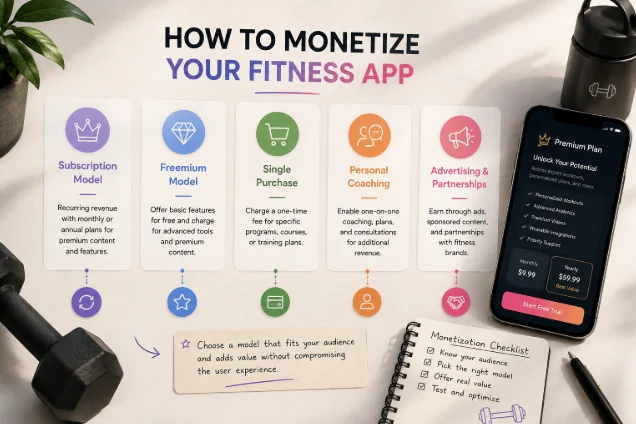
Development of an app is not the only thing you have to care about. You need a clear monetization strategy that won’t make user experience bad.
It is better to choose the right monetization approach before starting a development process.
1. Subscription Model
Fitness apps use subscriptions as a source of regular income. The app will have a possibility of monthly and annual subscriptions for the premium users, giving them access to more complicated training, personal program planning, coaching, or some special content.
Free-tier service could be helpful to attract clients, providing them with the basic features of your app before they start paying for them.
2. Freemium Model
Under this approach, users will have the ability to use the basic functions of your app for free, while the advanced ones will require payment from users.
For example, the basic function will include basic training and tracking, while subscribers would be able to get a personalized program, advanced statistics, premium videos, and integrations with wearables.
3. Single Purchase
The user will have an opportunity to purchase the program or course, which includes some specific training, such as a 12-week strength program, or another specific type of workout.
4. Personal Coaching
In case the app allows communication between users and personal trainer, the personal coaching will be able to provide additional income sources.
5. Advertising and Partnerships
Advertising can generate revenue from a free user base. Fitness brands may also pay for partnerships or sponsored content.
However, ads should not interrupt workouts or make the app feel cluttered. For many premium fitness products, subscriptions can provide a cleaner user experience.
Choosing the Right Technology for Fitness App Development
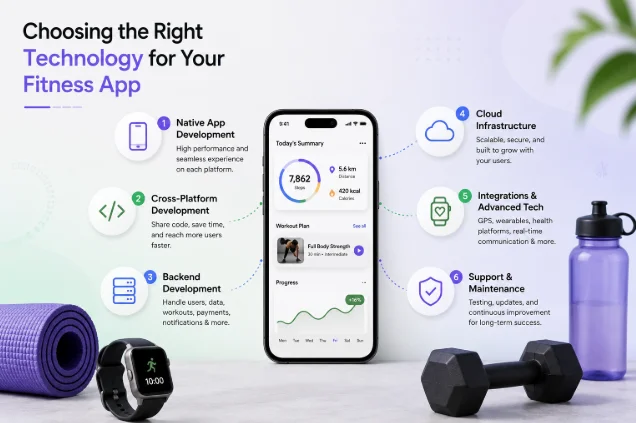
Technology choices should be guided by your product objectives and not dictate them.
Your team should evaluate such aspects as features, platforms, intended audience, integration, security requirements, and future growth in making their technology stack choice.
The primary choices to be made are:
- Native app development: Separate applications are created for Android and iOS. They offer high platform-specific performance and native device capabilities usage.
- Cross-platform app development: Platforms like Flutter and React Native enable sharing of a large portion of the code between different platforms. It helps avoid duplicating development efforts.
- Backend development: The backend is responsible for accounts, workouts, statistics, payments, notifications, APIs, and other business logic management.
- Cloud infrastructure: Cloud technologies will help with storage, databases, authentication, analytics, video processing, and scaling up as your user base increases.
- For fitness products, there might be additional technologies required, such as GPS, camera access, Bluetooth devices, wearable device APIs, health platforms, and real-time communication.
- App-Concept provides native and cross-platform mobile app development, as well as backend development, API integration, UI/UX design, testing, and maintenance services.
How Much Does It Cost to Develop a Fitness App
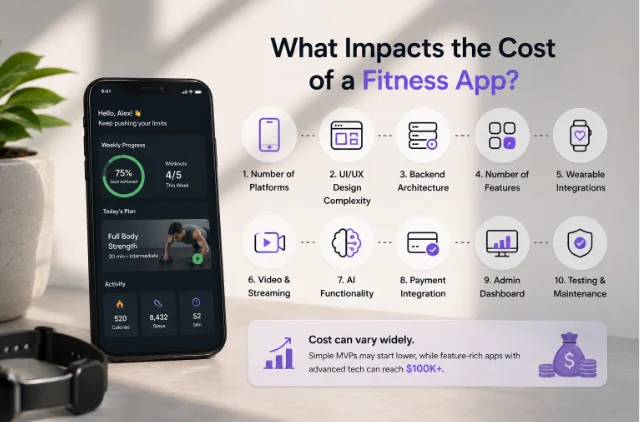
It highly depends on your specific requirements and desires. If you just want a workout tracker, it will be much cheaper than an app with live classes, machine learning, wearables integration, subscription model, and social networking functionality.
For instance, a minimalistic MVP might contain the following components: user accounts management, workout content, fitness tracking, notifications, and progress monitoring. More complex applications need more money due to the amount of extra efforts needed to develop them.
Now, for example, the latest industry guidelines put custom fitness application development between $60,000 and $150,000 or even higher depending on complexity and the development process.
In addition, another guide of 2026 sets even wider bounds, from $1,000 to $50,000+. That is the reason why there is no one true price for all fitness apps. It depends on the type of development process you use (no-code solutions, freelancers, professionals) and number of features.
The biggest cost factors usually include:
- Number of platforms
- UI/UX design complexity
- Backend architecture
- Number of features
- Wearable integrations
- Video and streaming
- AI functionality
- Payment integration
- Admin dashboard
- Testing and maintenance
The best way to control costs is to define the MVP before development begins. Build the essential experience first, then use real user feedback to decide which advanced features deserve investment.
4 Common Challenges in Developing Fitness Apps
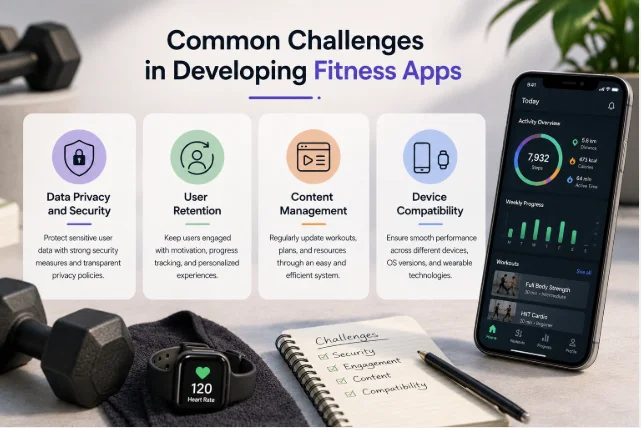
There are certain problems that may be easily ignored when you plan to develop a fitness app. However, it is better to recognize them in advance and avoid possible changes that could be expensive.
1. Data Privacy and Security
Since a fitness app stores personal, activity, location, and health-related data, security is one of the crucial issues. You should provide secure authentication and data transmission, access controls, secure storage, and privacy policy.
Also, you should gather only necessary information.
2. User Retention
While making people download an app is not hard, maintaining their interest is more difficult. To make your fitness app successful, you should encourage users to stick with it.
The features that will help users to stick to a regimen are progress tracking, reminders, attainable goals, challenges, personalization, and feedback.
3. Content Management
Exercise videos, instructions, meal content, and training plans require regular updating. It should be easy for an authorized person from your company to manage the content via your administrative panel.
Without a good content management system, even a technically perfect app will become inconvenient to manage.
4. Device Compatibility
Users may have different phones, operating systems, screen sizes, and wearable devices. Testing should cover the devices your target audience actually uses.
You should also plan for operating system updates. A fitness app that works today still needs maintenance as mobile platforms change.
How to Launch and Market a Fitness App
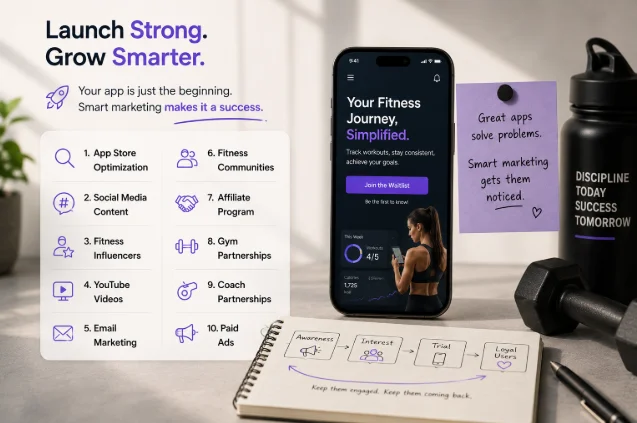
Even a well-designed application may fail due to lack of awareness of its existence. Marketing needs to start prior to the release rather than afterwards when the app hits the stores.
This should be started with the creation of a landing page explaining the problem that you solve. Create an email list, give relevant fitness content, and gather users who will test your product.
There are a number of growth hacks you could use simultaneously:
- App store optimization
- Social media content
- Fitness influencers
- YouTube videos
- Email marketing
- Fitness communities
- Affiliate program
- Gym partnerships
- Coach partnerships
- Paid ads
According to Uscreen’s research, social media, podcasting, media coverage, training sessions, and audiences could be great for promoting fitness-related products as well.
Your message should talk about what you do but not about features. If your app allows tracking workouts, say why this is helpful for your users and what it does for them.
How to Improve a Fitness App After Launch
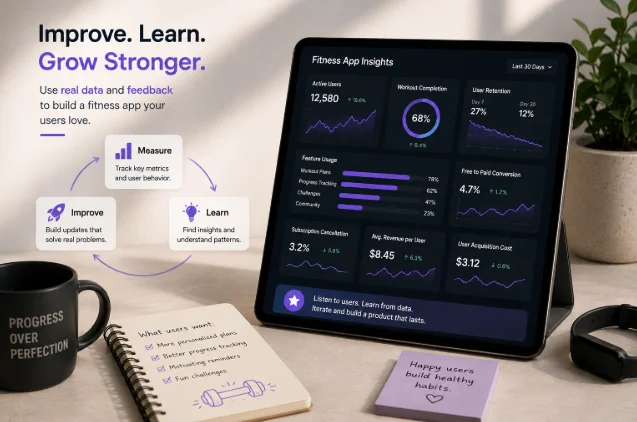
Launching the first version is the beginning of the product lifecycle.
Your next decisions should come from real user behavior rather than assumptions.
Track metrics such as:
- Daily and monthly active users
- User retention
- Workout completion
- Session frequency
- Feature usage
- Free-to-paid conversion
- Subscription cancellation
- Average revenue per user
- User acquisition cost
- Customer feedback
These numbers can show where users are getting value and where they are dropping off.
For example, if many users complete onboarding but never start their first workout, the problem may be the onboarding flow or home screen. If users start workouts but stop after a week, you may need to improve motivation, personalization, or progress feedback.
This cycle of measuring, learning, and improving is what turns a basic application into a stronger digital fitness product.
How App-Concept Can Help With Fitness App Development

Now, you probably have a better understanding of how a fitness app is created. The whole process is quite complex and involves multiple disciplines from planning and design to development and maintenance.
That is exactly where App-Concept can assist companies looking to develop their own fitness mobile app. All its services include everything necessary for creating and maintaining the mobile app.
App-Concept will allow businesses to:
- Develop a custom mobile app
- Develop apps for native iOS and Android platforms
- Develop cross-platform applications
- Design the UI/UX of the app
- Develop backend for an app
- Integrate APIs and third-party services
- Test the app and guarantee its quality
- Maintain the mobile app
The ultimate objective here is not only to launch an app but to create something professional, scalable and flexible enough for further expansion.
Frequently Asked Questions
But there are still some practical questions to answer before getting down to the business.
The following list can help you to get answers.
How long does it take to develop a fitness app?
Creating an elementary fitness application can take a couple of months. Development of a more advanced platform will take significantly more time. It all depends on many factors including features, platforms, integrations, design, testing and the size of the development team.
Can I create a fitness app without coding?
Yes, it is possible to create a fitness application using no-code and low-code platforms. But special features like integration with wearables, AI coaching, analytics and complicated payments systems can require development.
Do I need my fitness app for Android and iOS?
It depends on the targeted audience and budget. To make it available for users from different platforms it is possible to consider cross-platform development.
Does a fitness app require an admin panel?
The admin panel will help to manage users, exercises, subscriptions, content, bookings, and reporting. All features will depend on the type of fitness business and the level of control administrators have.
Can a fitness app sync with smartwatches?
Yes, fitness applications can sync with supported smartwatches and health systems to get information such as steps, exercises, heart rate, and distance walked. The amount of information received will depend on the hardware used and user’s permissions.
Can an AI feature be added to the fitness app later?
It can be done, but it is better to take care of it during the project planning stage if the AI feature is planned.
Bottom Line
Developing a fitness app involves much more than creating workout screens. You need to think about your target users, core features, content, personalization, data security, monetization, integrations, and long-term growth. Starting with a focused MVP can help you launch faster and learn what your users actually need.
Remember, whether you want to build a workout tracker, personal training platform, gym app, nutrition solution, or AI-powered fitness product, fitness app development requires careful planning and the right technical expertise.
Hopefully, this guide was helpful to you and you will be able to build the best possible fitness app for you.