
Modern businesses use digital solutions to reach potential customers, automate operations, and compete on the market. The decision to create a mobile app or a website comes at the very beginning of creating a digital product.
So, How Is App Development Different From Web Development?
The main distinction is that mobile apps are created specifically for smartphones and tablets, while websites work via web browser on any device. Mobile applications provide users with improved performance, offline mode, and greater interaction with the device features, while websites can be accessed by the user easily without the need to install anything.
If you want to learn which option would fit your business better, continue reading this blog. You will find all the major distinctions between web development and app development explained here.
App Development vs Web Development: Quick Comparison
Understanding the major differences becomes easier when comparing both side by side. Have a look.
| Factor | Website | Mobile app |
| Platform | Runs in any browser (Chrome, Safari, Edge) | Built separately for iOS/Android, or via cross-platform tools |
| Access | Instant via link | Requires download from app store |
| Core tech | HTML, CSS, JS, React, Vue, PHP, Node.js, etc. | Swift, Kotlin, Flutter, React Native, etc. |
| UX design | Optimized for responsiveness across screens | Optimized for touch, smoother native feel |
| Performance | Depends on internet speed and server | Faster – data often stored on-device |
| Offline use | Limited (PWAs help, but not full parity) | Most core features work offline |
| Device features | Minimal hardware access | Full access: camera, GPS, biometrics, NFC, push notifications |
| Security | HTTPS, server-side, firewalls | Biometrics, local encryption, secure APIs |
| Maintenance | Browser/server compatibility | OS updates (iOS/Android), app store compliance |
| Cost | Lower – fewer resources needed | Higher – especially multi-platform |
| Best for | Fast exposure, SEO, broad reach | Deep engagement, repeat use, hardware needs |
It all comes down to what you want to accomplish. While some companies get by with a website alone, some businesses find that an application suits them better.
In time, all successful businesses come around to building both platforms in order to expand their clientele base and engagement. Now, let’s get into the details.
What Is the Difference Between App Development and Web Development?
While both websites and applications are digital products, their development processes are entirely different. Often the question rises among many entrepreneurs, “How does app development differ from web development?” It is based on different principles of development, usage, maintenance, and user experience.
Here are the key distinctions that every business owner should consider before making a decision.
1. Platform and Device Compatibility
The main distinction between mobile applications and websites is what platform they run on.
The website is accessed within the browser such as Chrome, Safari, or Edge while mobile apps run directly on the device, whether it’s Android or iOS.
To create a site which is compatible with desktop computers, tablets, and smartphones you don’t need to do anything additional. In the case of developing mobile apps businesses have to develop the apps for Android and iOS platforms separately or use cross-platform technologies.
Users can easily access the site using a link but to run an application users need to download it first from the app store. Apps are more preferred by businesses since they offer better user experience.
2. Development Technologies
Website and app development involve different technologies such as programming languages and frameworks. The selection of the right technology stack depends on the platform being developed.
Web developers commonly use:
- HTML
- CSS
- JavaScript
- React
- Angular
- Vue.js
- PHP
- Node.js
- Python
- ASP.NET
Mobile app developers often work with:
- Swift
- Kotlin
- Flutter
- React Native
- Java
- Objective-C
- Dart
- Xamarin
- Firebase
- Android SDK
They have different purposes. Choosing an appropriate stack impacts development time, maintenance costs, scalability, and performance.
Businesses often wonder whether the same developers can develop apps and websites. Although some full-stack developers can develop both types of projects, app development requires special knowledge of mobile technologies.
3. User Experience (UX)
UX design differs significantly for mobile apps and websites. Mobile apps imply interaction using touch, whereas websites should be easily adaptable to different screens and browsers.
Mobile applications typically have better navigability, smooth transitions, and customized interface since they are designed specially for mobile gadgets. On the contrary, websites need to pay attention to accessibility and responsiveness to different devices. It is one of the principal distinctions between web and app development.
4. Performance and Speed
Performance is another significant feature that distinguishes these two types of development. The performance of mobile apps is usually higher because of the storage of information on the user’s device.
Internet speed, web server, browser performance impact performance of websites significantly. All pages require interaction with the web server.
Apps also make better use of device hardware, resulting in smoother scrolling, faster processing, and quicker interactions. For businesses where speed matters, mobile apps often provide a better user experience.
5. Internet Connection
The main benefit of mobile applications is that they function offline. Even though some functionality will still need internet connectivity, the majority of mobile apps let users use some functionalities without any problems.
Usually, websites can only be viewed when there is an active internet connection. The introduction of PWAs made it possible to solve this issue, but there will still be limits compared to mobile apps.
Companies often question whether websites can function offline, and the majority of the time the answer is negative. Offline functionality provided by mobile applications gives more flexibility.
6. Access to the Features of the Device
Mobile applications can easily interact with smartphone hardware and its components. It provides additional opportunities for app development.
Features available for usage include:
- Camera
- GPS
- Face ID
- Fingerprint sensor
- Bluetooth
- NFC
- Push notifications
- Contacts
- Microphone
- Motion sensors
There is little access to these features on websites because they run inside web browsers. If you have a project that requires integration with hardware, then mobile app development would be a good solution.
7. Security Requirements
Security is critical for any app and website, although security solutions used in the two cases differ drastically.
Typical mobile app security solutions are biometrics, encryption of the local storage, secure APIs, and app-level encryption.
For websites, there are solutions such as HTTPS, server-level security, firewalls, and browser protection. Usually, businesses that deal with money, healthcare, and other sensitive information invest in mobile app security because the users have expectations regarding high-level security.
8. Maintenance and Updating
Creating a website or application is one thing; however, it is necessary to maintain and constantly improve websites or apps, although the process of maintenance in two cases is significantly different. For example, a mobile app developer should take care of the compatibility of the application with frequent updates from Google or Apple, whereas website developers should be focused on browser compatibility and server-level maintenance.
Maintenance services might consist of such tasks as:
- bug fixing;
- security updates;
- performance improvement;
- feature improvement;
- operating system compatibility updates;
- browser compatibility tests;
- APIs updates;
- server maintenance;
- database optimization;
- user experience improvement.
The reason why mobile applications development is so different from website development is maintenance, which is obligatory for mobile platforms. Developers often need to update apps whenever Google or Apple releases a new operating system. Ignoring these updates can cause crashes, poor performance, or even app store rejection.
The question that often comes up in such situations is, “Is app maintenance more expensive than website maintenance?” And the answer in many cases is positive because mobile applications require constant testing on various devices and OS versions, which makes it longer and more costly than most website maintenance.
9. Development Cost
It is one of the most important factors that determine the choice of a mobile app or a website. Both require planning, design, and development but the process of developing mobile application is more complicated, thus increasing the total cost of development.
Some of the key factors that affect the cost include:
- Complexity of the project
- Number of features
- Platform choice
- Designing UI/UX
- Back-end development
- Integration with third-party services
- Security measures
- Testing
- Maintenance
- Duration of development
While the simplest website can cost several thousand dollars, even a relatively simple mobile app with several features will cost tens or hundreds of thousands of dollars. The ability to work with several platforms such as Android and iOS will increase costs.
The common question is, “Is web development cheaper than app development?” In most cases, yes. Websites require fewer resources for development and testing. Still, the right choice depends on your business goals, target audience, and the experience you want to provide.
10. Objectives and Scenarios
The choice between a mobile app and a website needs to be driven by the objectives you set. There is no single superior choice. The decision on the type of application you need to create depends on the purpose and the nature of your client base.
Depending on the objectives you pursue, you will need the following types of applications:
- Brand awareness
- Online sales
- Client engagement
- Booking appointments
- In-house business tools
- Banks
- Hospitals/healthcare
- E-commerce
- Education platforms
- Enterprise software
Websites are perfect for fast exposure through search engines and easy access that does not involve installing anything on clients’ devices. However, when you need a product that allows frequent interactions with the client and provides a personal experience, then a mobile app is a more suitable choice.
The question that many business owners ask themselves is: “Website or mobile application? Which one comes first?” The answer is contingent on the client base, budget, and future plans. Some companies start with building a responsive website; others prefer to create a mobile application initially.
Existing Relevant Contents:
Why Do All Companies Want to Develop Their Own Apps?
How Much Does It Cost To Develop An App?
How To Choose The Best Mobile App Development Company?
How Long Does it Take to Develop a Mobile App?
10 key Benefits of App Development
Mobile applications are one of the most efficient methods used by businesses to attract consumers. Apps provide improved performance, better personalization, and access to the features of a smartphone.
Ever wondered, “Why are so many businesses investing in mobile applications?” The following are the greatest benefits of app development.
1. Improved User Experience
Applications are created keeping in mind the mobile device, which makes them fast and easy to use. Navigation and interface design are easy and user friendly.
With good design, the application attracts the attention of the user for a long time and makes them come back again. User experience is very important for the retention rate.
2. Fast Performance
While in websites the data has to be pulled from a server, applications store some data in the device itself. This makes apps load instantly and react immediately to the users’ actions.
Fast performance provides better user experience and is essential for industries like finance, healthcare, food delivery, and e-commerce.
3. Offline Functionality
A lot of mobile applications function effectively even when there is no internet connection. The user will be able to access already downloaded content or perform some selected activities offline. This is an added advantage since it increases convenience and reliability. It is especially helpful for travelers and people with poor connections.
4. Push Notifications
Notifications help in direct communication between the business and the user. Updates, reminders, promotions, or important announcements can easily be sent. Notifications can make the apps more engaging and bring customers back to them. This is one of the key benefits of using mobile apps.
5. Utilization of the Device Capabilities
The apps take advantage of capabilities such as the camera, GPS, microphone, and biometric verification of smartphones. It enables the creation of more interesting interactions. Features that cannot be created on a standard website can easily be built in the application.
6. More Customer Engagement
People usually spend more time using mobile apps than websites. They engage customers using personalized content and navigation.
Several successful organizations utilize apps to connect more with their customers. Programs like loyalty, personalized offers, and saved preferences promote customer engagement.
7. Enhanced Security
The mobile application can take advantage of modern security technology such as fingerprint scans, facial recognition, encryption, and other methods of authentication. This will ensure the safety of data and increase the trust of the users. There is a great opportunity for the business dealing with money or personal data.
8. Higher Brand Awareness
The app icon will stay on the phone screen thus making the brand constantly visible to the customers. As a result, there will be a good way to remember the business. There will be a great potential for developing customer loyalty and frequent purchases.
9. More Personalized Experiences for Users
The application will remember the users’ preferences and recommend products on their basis. Thus, there will be a personalized experience for all the customers. It will be very useful for the business to achieve customer satisfaction and conversions.
10. More Opportunities for Business Growth
A mobile application opens new possibilities for earning money via subscription models, in-app purchases, memberships, and others.
As a result, there are high chances of increasing the value and retention rate of customers for the company.
10 Key Benefits of Web Development
Websites continue to be one of the main online properties for businesses as they are easily accessible, cheap and allow businesses to reach out to the entire world.
Ever wondered why organizations invest so much into websites despite the popularity of mobile apps? Websites have numerous unique qualities which make them great.
1. Ease of Access
One can open a website instantly without having to download anything using their browser. They work very well when trying to get new visitors and spreading out information.
2. Cheaper to Develop
It is always cheaper to develop a website than a mobile application. This allows for startups and smaller businesses to create an online presence without breaking the bank.
3. Higher Search Engine Visibility
They can appear in search engine results and attract users from the results. As such, they make perfect platforms for acquiring organic traffic.
4. Multi-Device Compatibilities
Responsive websites work on desktops, phones, tablets and laptops. Organizations can reach out to their users using various devices without needing to create mobile applications for every device.
5. Immediate Updates
Updates of a website are instant once the deployment is complete. Unlike mobile apps, there is no need to wait for app store approvals before users can access new content.
6. Easier Content Management
It becomes possible to modify products, blogs, images, or messages by using a content management system. The ability to work with the website’s content becomes possible without having to redesign the site.
7. Ability to Attract a Broader Audience
The website can be visited by anyone who has Internet access and a web browser. There are no requirements to have anything installed, which makes them available to a broader range of people.
8. Less Maintenance Required
Despite the fact that websites do need some maintenance, it usually becomes simpler to make modifications because there is just one version. There is no need to take care of different Android and iOS releases.
9. More Effective for Marketing
Websites provide the possibility of search engine optimization, content marketing, landing pages, blogging, and digital advertising. They become the base of most online marketing strategies.
10. Quicker Development
Website development typically takes less time than developing an application.
Mobile App Development Vs Web Development: Which One To Go For
It’s pretty common to stress about which platform one should choose. But don’t be, here we will clear out which option will personally be best for you. See for yourself.
When Is Mobile Application Development a Good Choice?
Depending on what you want to achieve, it might be necessary to choose app development. There are some businesses which need much more from mobile applications due to the way customers use them.
Have you ever wondered, “When is building a mobile app the right choice?” These situations usually make app development the better option.
- Your clients use your service often.
- You require push notifications.
- Offline access is necessary.
- Your app needs GPS or camera access.
- Biometric authentication is necessary.
- Performance should be fast.
- You want higher customer loyalty.
- Personalization is important.
- Your company provides subscriptions/memberships.
- Customer engagement in the long term is vital.
Apps are perfect for companies that need regular interactions from their users. They deliver better performance, personalization, and access to features of mobile devices.
Despite the bigger expenses on apps’ creation, they provide high user retention rates and better business growth.
When Is Website Development a Good Choice?
A website is usually the best option for any business that wants to reach the maximum number of users fast and cheaply. There is always the question of many business owners: “What are cases when a website is better than a mobile app?”
- Your budget is tight.
- You want to cover all types of devices.
- SEO is vital for you.
- You publish articles regularly.
- You need visibility online.
- You want quick deployment.
- Your clients use your website seldom.
- You need an informational website.
- Marketing is your main purpose.
- You don’t want to spend much on maintenance.
Websites have great accessibility potential and are easier to find using search engines. It may be useful for many startup companies to create a website first and then an application later.
App Development Costs vs Web Development Costs
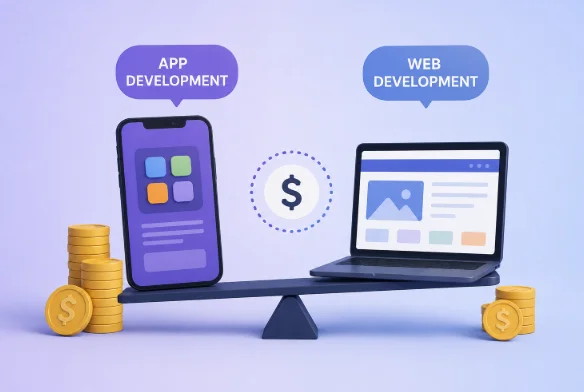
One of the main criteria for choosing between an app and a website is budget.
Many businesses wonder whether app development is more costly than web development? Usually yes.
| Project | Estimated Cost |
| Basic Business Website | $3,000–$15,000 |
| Custom Website | $15,000–$60,000+ |
| Basic Mobile App | $20,000–$60,000 |
| Medium Complexity App | $60,000–$150,000 |
| Enterprise Mobile App | $150,000–$500,000+ |
Apps are more costly to develop because of platform-dependent development processes, app stores, better security measures, and thorough device testing.
The cheaper choice for businesses aimed at building their online presence and providing information would be websites.
10 Common Mistakes Made By Businesses When Deciding Between Mobile And Web Apps
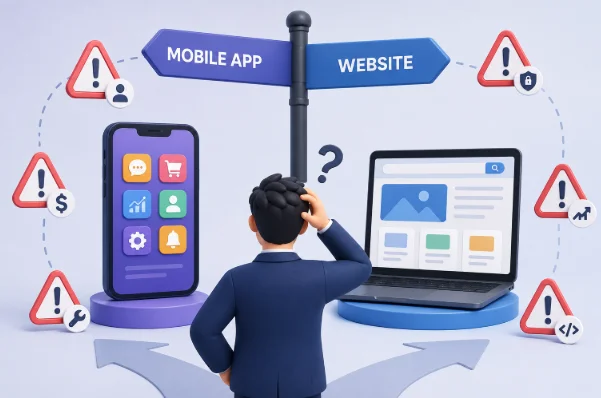
Businesses often incur unnecessary costs and miss valuable business opportunities due to incorrect decisions. It is a common practice for many companies to choose something trendy, not what is required by the business.
Did you ever ask yourself, “What mistakes must businesses avoid while planning a digital project?” These are some of the most frequent ones.
- Selecting an app when all that is needed is a website.
- Disregarding user research.
- Concentrating exclusively on the price of development.
- No consideration of maintenance.
- Not taking scalability into account.
- Disregard of security requirements.
- Incorrect selection of the technology stack.
- Developing too much functionality at once.
- Failing to consider user experience.
- Using inexperienced developers.
It is worth taking your time to get to know your target audience and business goals in order to avoid possible mistakes. The right solution will have to address the needs of your customers, not the latest trends.
Cooperation with experienced developers can prevent potential errors and ensure long-term success of your project.
App-Concept: The Ideal Partner for Developing Your Application and Website
By now, you are aware that the choice between creating an app or a website is a complex decision making process. Each business has different needs and different requirements.
This is where App-Concept might be able to assist you.
App-Concept is a professional software development company offering high-quality and scalable digital solutions for businesses, startups and enterprises.
The App-Concept team works with each client individually in order to understand their needs and deliver the right product. It could be a mobile app, a responsive website or both. The goal of App-Concept is to create products that would bring value to your business in the long run.
Hiring App-Concept will allow you to take advantage of:
- Development of custom mobile applications
- Development of cross-platform and native applications
- Web development
- User interface/user experience design
- Backend development and integration of APIs
- Cloud solutions
- Testing and quality assurance
- Applications maintenance and updates
- Performance optimization
- Scalable enterprise solutions
Cooperation with an experienced development partner can help you in many ways. Like what? Well, it can lower risks associated with project realization, decrease time needed for development and help companies create high-quality digital products.
So, what are you waiting for? Contact App-Concept Now!
Frequently Asked Questions
Is app development harder than web development?
No. Neither type of development is harder. Mobile application development requires more platform-related features whereas website development is more about browser-compatibility and responsiveness.
Which is more costly between app development and web development?
Usually, mobile app development is more expensive due to the extra testing and other processes that need to be carried out.
Can a company have a website and mobile app at once?
Yes. Most successful companies have websites to attract new customers and mobile apps to increase engagement and retain customers.
Which is better for startups: website or app development?
Startups usually go for the development of a responsive website due to higher costs of developing an app. Later on, when the business succeeds, they go for a mobile app.
Is it possible to make a website and then transform it into an app?
Yes. Most companies first develop their website and only later on proceed to creating a mobile application based on the same back-end.
Is cross-platform app development good for the business?
Yes. Cross-platform frameworks like Flutter and React Native reduce development costs while allowing businesses to reach both Android and iOS users.
Conclusion
Application or website development is different. It depends on a number of factors that include business needs, target audience, budget, and strategy. It is crucial to know why there is a distinction between app development and web development for businesses to choose the right option and spend their money wisely.
Hopefully you got a good idea and will be able to develop the best possible platform personally for you.