
Financial technologies have transformed how people save, spend, lend, invest, and transfer funds. Fintech includes digital wallets, mobile banking, investment apps, lending apps, etc. and is now an integral part of our daily life.
So, what is needed to develop a fintech application?
Start by defining the financial problem, target users, security needs, and compliance requirements. Then plan the design, development, API integrations, testing, launch, and future updates. Modern fintech apps can take several months to develop because they must be easy to use while keeping sensitive financial data secure.
But what is really needed to make a fintech app? Continue reading to find out about types, features, development process, technology, security, compliance, cost, mistakes and other aspects.
What Is a Fintech App?
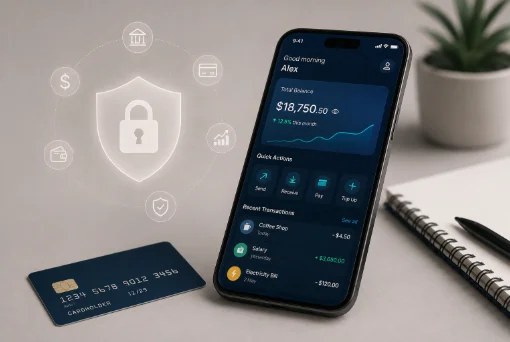
A fintech application refers to an application software used by individuals for performing financial services. The use of the software enables the users to pay, budget their finances, invest, borrow, insure items, or access banking facilities through a smartphone or a computer.
The fintech app is not limited to mobile banking alone since the fintech application software encompasses digital wallets, lending, investing, insuring, personal finance management, payments, and business finance applications.
The main difference that separates a fintech app from most other applications is the amount of trust that is needed while using it. If there is a small issue in the usability of an application such as a shopping app, the user gets frustrated. The same issue in a fintech app could lead to the user losing his/her money.
Why Are Fintech Apps Growing So Quickly?
The fintech market keeps growing as users become more familiar with the management of their finances through digital tools. As per one forecast about the fintech market until 2026 stated by Saigon Technology, the global fintech market could increase from $431 billion in 2025 to almost $2 trillion by 2035.
Financial applications have already started transforming user expectations about financial companies. Users demand immediate processing, easy-to-use interface, instant verification, real-time updates, and financial services without physical attendance at the offices of such companies.
It opens the way for startups, banks, financial organizations, and businesses that wish to integrate financial services into their solutions.
10 Types of Fintech Apps You Can Develop
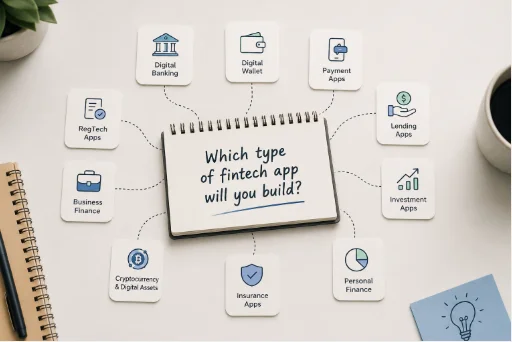
Before you start developing your application, think about the type of financial product you would like to create. It will determine the set of features, technologies used, integrations, regulatory issues, development process, and total cost of development.
Have you ever thought, “What type of fintech app should I build?” It is a matter of the financial issue you would like to solve. Here are some of the most common options.
1. Digital Banking Apps
Digital banking apps enable users to manage their accounts, transfer funds, pay bills, check transactions, and manage their cards without going to the physical branch.
A banking app typically requires robust identity verification, transaction processing, fraud monitoring, notification, account management, and connectivity to the banking system.
2. Digital Wallet Apps
Digital wallets allow users to store their payment details and facilitate digital payments. Some wallets can also facilitate peer-to-peer transfers, QR payments, cards, loyalty programs, or currency exchange. The more complicated the solution gets when the wallet has to integrate with multiple payment networks or handle different currencies.
3. Payment Apps
Payment apps are dedicated to transferring money from one person to another. Such an app can be aimed at consumers, businesses, marketplaces, or merchants. Payment processing creates additional security issues since payment details need to be processed via the application.
4. Lending Apps
Lending platforms match borrowers with financial institutions and provide tools for applications, credit scoring, document gathering, repayment monitoring, and notifications. Some more sophisticated lending platforms can even utilize automation or machine learning for assessing applications.
5. Investment Apps
Investment apps allow managing portfolios, researching financial products, buying or selling assets, or getting investment advice. In order to work efficiently, such apps will require financial data to be correct, transactions to be secure, market information to be reliable, and user flows to be carefully thought out.
6. Personal Finance Apps
Personal finance apps help people better understand and manage their finances. Such apps commonly feature budgeting, expense tracking, expense categorization, saving goals, financial statements, and account aggregation.
7. Insurance Apps
Insurtech apps can help people compare insurance policies, purchase insurance, make claims, manage documents, and communicate with their insurers. Depending on the services that such an app provides, it may require integrations with insurance databases and verification systems.
8. Cryptocurrency and Digital Asset Apps
Such apps may provide support for crypto wallets, asset management, trading, transfers, or portfolio monitoring. Special security measures will be required due to private keys, financial transactions, and digital assets creating high risks.
9. Business Finance Apps
Fintech business products can help businesses manage invoices, expenses, payroll, payments, cash flow, and financial statements. These apps will require multiple roles and permissions systems.
10. RegTech Apps
RegTech solutions can assist financial firms to deal with regulatory obligations. The solutions include automation of identity verification, transactions monitoring, compliance reporting, sanctions check, and many more.
It is recommended that fintech app choice takes precedence over technological considerations. Both a payment application and a budgeting application can be classified as fintech apps, yet they require different approaches technologically and in terms of regulations.
How to Develop a Fintech App? 10 Steps You Need to Follow
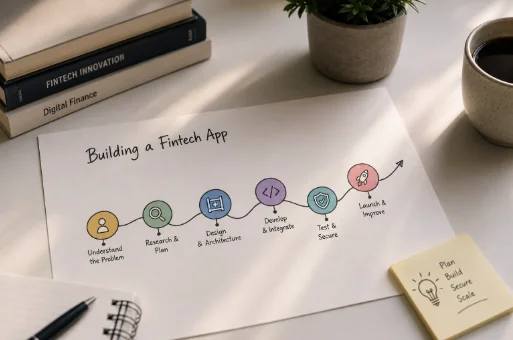
Developing a fintech application goes beyond creating an interface and coding. It requires having a good product plan, architecture design, proper integration, compliance strategy, and a good testing process.
Here is what you need to do to develop a fintech application from scratch.
1. Define the Problem and the Target Users
First, define the problem that your fintech application will solve. Instead of declaring, “I want to develop a fintech application,” define the particular problem. You might want to create an app that allows small businesses to handle their cash flow or enables easy international transfers.
The questions you need to ask yourself are:
- Who will use the application?
- What is the problem in their financial activities?
- How are they handling the problem at the moment?
- What is frustrating them?
- Why would they switch to using your product?
- What will be the target market?
- What financial service will you provide?
- How will the business generate profits?
- Who are your competing rivals and what problem do they solve?
- What should your initial version prove?
Having a problem will make your work easy in developing the product. Also, it will ensure that you don’t make the first version too complex with unnecessary features.
2. Choose the Right Fintech Business Model
The business model of the company will affect the implementation. There are several ways to earn money from the fintech product such as transactions fees, subscription models, commission, interests, interchange fees, premium models, and partnerships with other companies.
For instance, budgeting applications will use subscription models, whereas payment platforms will charge merchants per transaction. You need to decide on the business model before the development process begins as it will affect payment flows, account structure, analytics, roles of users, and backend architecture.
3. Financial Regulations Research
It is one of the most critical stages of fintech app development. Fintech apps function differently according to service types, locations, users, and the kind of financial information that they handle. Depending on your product and target market, you will have to pay attention to requirements such as:
- KYC
- AML
- PCI DSS
- GDPR
- PSD2
- Open banking
- Data protection
- Financial licensing
- Consumer protection
- Transaction monitoring
- Audit reporting
For instance, payment processing applications might have PCI DSS requirements, and a platform running in the EU would be required to consider GDPR and other payment regulations.
You should consult the requirements with compliance and legal experts for the corresponding countries. The development team could develop controls for requirements, But they should not replace legal advice.
4. Decide Which Features Your MVP Needs
A typical mistake would be trying to incorporate everything into your MVP from the start. First iteration of your product must have a minimal amount of features required to solve the problem and validate the idea through testing it with actual users. Common features for fintech MVPs might be:
- User account creation
- Login security
- Identity verification
- User profiles
- Dashboard
- Transactions history
- Payment/transfer functionality
- Push notifications
- Analytics
- Customer service
The list will depend on your product specifics. More sophisticated features like AI-driven financial advices, auto investment, advanced fraud detection, multi-currencies support and detailed financial analytics can be added afterwards in case of business need.
5. Design the User Experience
Financial solutions are often quite complicated from the backstage. User experience design should simplify things for the users. Users should be able to easily find out about their balance, latest transactions, payment status, account details and further actions.
UX design of fintech solutions should also ensure that there will be no mistakes made by the users. Confirmation screens, proper labeling of elements, transaction details, warnings and error messages can avoid costly user mistakes.
Don’t forget about the accessibility of your product. It may be used by people of all ages, different levels of abilities, technical skills, and financial backgrounds.
6. Plan the Backend Architecture
The backend is the engine behind fintech applications. It deals with user accounts, payments, authentication, financial information, APIs, notifications, reporting, permissions, and business logic.
It should be created for reliability and scalability purposes. The financial transactions require consistency and proper failover management.
For instance, in case of any issues during the transaction process, you should not have inconsistent balances or duplicated operations.
Depending on the needs of your fintech project, different technologies could be used. You may consider .NET, Java, Node.js, Python, PostgreSQL, Redis, AWS, and Azure.
Remember, there is no one-size-fits-all fintech technology stack.
7. Integration of Financial APIs and Third-Party Services
You do not need to develop everything yourself in the field of finance. With the help of third-party APIs, you can integrate with banks, payments, identity verification services, financial data, card services, foreign exchange, and more.
For example, the fintech teams can use services like payment processors, bank-data providers, KYC providers, card platforms, and more. This way, you can save time and avoid the creation of something that already exists.
But each third-party service adds another dependency to your system. It is important to check its reliability, prices, security, data management, rate limits, documentation, and alternative solutions.
8. Build Strong Authentication and Security
Security measures must be incorporated into the architecture from the ground up, not added before deployment. Some examples of security measures that might be required for a fintech application could include:
- Multi-factor authentication
- Biometric authentication
- Encryption
- Session management
- Tokenization
- Role-based access control
- Device monitoring
- Fraud detection
- API security
- Audit logs
Recent advice about developing fintech applications has also highlighted security concerns such as encryption in transit and at rest, secure identity protocols, anomaly detection, and API security.
However, the objective is not only to create an application which is hard to attack, but one which reduces any damage that might result from an attack.
9. Development of the Application
With the requirement analysis, design, architecture, and integration complete, development of the application begins. Some common roles in a development team could be UI/UX designers, mobile developers, backend developers, QA engineers, DevOps specialists, project managers, and security/compliance specialists.
For a cross-platform application, tools such as Flutter or React Native would allow for sharing code between iOS and Android. The use of native development for each platform through the use of Swift and Kotlin could be beneficial in some cases.
The right approach depends on your product rather than simply choosing whichever framework is currently popular.
10. Test, Launch, and Improve
Testing becomes crucial for fintech products because even a small mistake in software could mean losing money. Testing should include both regular user actions and unexpected ones. Serious fintech testing could involve:
- Functional testing
- API testing
- Security testing
- Penetration testing
- Performance testing
- Load testing
- User acceptance testing
- Device testing
- Compliance testing
- Disaster recovery testing
Even after the release of your product, you should not stop working on its development.
Start monitoring all critical indicators, such as transaction failures, crashes, API latency, security incidents, user drop-off, support tickets, etc. Use all this information to improve your product regularly.
Existing Relevant Contents:
How To Develop An Educational App?
How to Develop a Social Media App?
What Features Should a Fintech App Have?
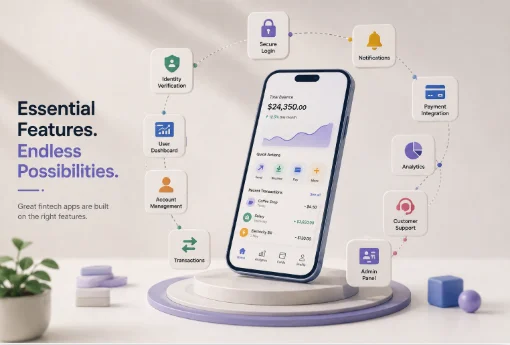
Different types of financial products have different features, which need to be selected accordingly. However, there are common features, which are present in many successful fintech apps.
When you start your research about fintech app development, you will benefit from distinguishing between basic and advanced features that are going to help you formulate a project scope.
Basic Fintech App Features:
- Secure Registration/Login: The ability for users to easily register accounts and log in is crucial. The process may involve email or phone number verification, passwords, multifactor authentication (MFA), or biometric login.
- Identity Verification: The KYC procedures involve the usage of identity documents, facial verification, liveness check, and databases screening.
- User Dashboard: It is expected from the dashboard to show users important information in a non-overwhelming manner.
- Account Management: Users should be able to control their account personal data, linked accounts, payment options, cards, and security preferences.
- Transactions: Depending on the purpose of the app, users should be able to view, make, receive, search for and comprehend transactions.
- Notifications: Notifications can notify the users about payments, transfers, changes in the account, or any other significant activity.
- Payment Integration: Payment gateways and financial APIs will help the app carry out transactions without having to develop each payment system from scratch.
- Analytics: Customers might need reports of their expenses, analysis of their investments, transaction summaries, or any other information regarding their financial health.
- Customer Support: Customer support could range from FAQs, live chats, tickets, emails to AI-driven customer support.
- Admin Panel: Businesses would require tools to manage users, transactions, reports, access control, customer support, compliance, and operations.
The advanced functionality can thus be incorporated depending on customer needs, which could range from AI financial assistants, automatic investments, fraud prediction, open banking integrations, budget optimization, card controls, or recommendations.
What Technology Stack Is Used to Build a Fintech App?
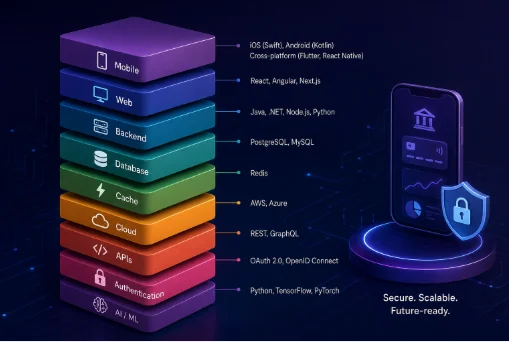
There is no single technology stack that could fit every fintech app. Your technology stack choice depends on security, performance, scalability, integrations, platform requirements, and the capabilities of your team.
One of the technology stacks could be the following:
| Layer | Popular technologies |
| iOS | Swift |
| Android | Kotlin |
| Cross-platform | Flutter, React Native |
| Web | React, Angular, Next.js |
| Backend | Java, .NET, Node.js, Python |
| Database | PostgreSQL, MySQL |
| Cache | Redis |
| Cloud | AWS, Azure |
| APIs | REST, GraphQL |
| Authentication | OAuth 2.0, OpenID Connect |
| AI/ML | Python, TensorFlow, PyTorch |
Regarding financial transactions, special attention should be paid to the database architecture. PostgreSQL and other relational databases offer good guarantees for transactions while Redis can offer caching and real-time capabilities.
Cloud can offer scalable hosting and security services, but its architecture still needs to be designed carefully.
How Long Does It Take to Build a Fintech App?
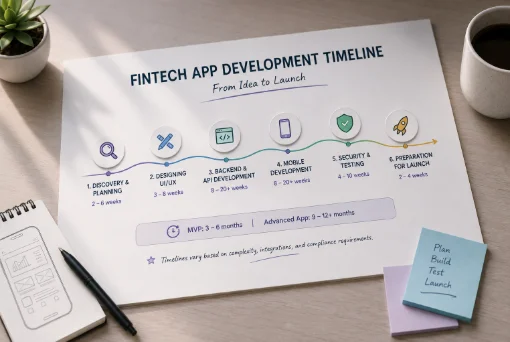
Development duration varies depending on the scale and complexity of the project.
The development of the MVP fintech solution usually takes about 3–6 months, while for an advanced product development can take 9–12 months or even more. The usual roadmap may include the following:
| Stage | Duration |
| Discovery and planning | 2-6 weeks |
| Designing UI/UX | 3-8 weeks |
| Backend and API Development | 8-20+ weeks |
| Mobile Development | 8-20+ weeks |
| Security and Testing | 4-10 weeks |
| Preparation for launch | 2-4 weeks |
These steps often run in parallel with one another, and a well-run Agile approach can allow design, development, and testing to happen simultaneously.
8 Common Mistakes to Avoid When Building a Fintech App
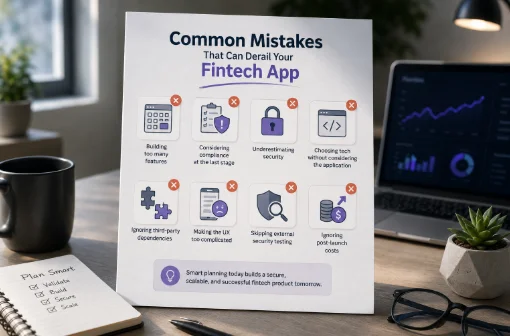
The failure of many fintech projects to fulfill its potential is attributed to poor planning and not necessarily the code being developed.
Some of the things you need to avoid include the following.
- Developing too Many Features: Too much functionality will make the initial development costly and slow. Develop the basic concept first and then develop features through experience.
- Considering compliance at the last stage: Compliance impacts architecture, data storage, authentication, reporting, and users journey. It should be planned before development and not at the end of the process.
- Underestimating Security: A normal sign-in mechanism may not be enough in the development of financial products. Security considerations must include authentications, APIs, device, data, transaction, monitoring, and incident response.
- Selecting Technologies without considering the Application: Even though some frameworks are popular, they might not necessarily suit your application. Select your technology on the basis of your performance, platform, security and maintainability needs.
- Disregarding third party dependency: The use of financial APIs is helpful and fast but your application will depend on them greatly. Look into the availability, pricing, limitations, security, documentation and backups.
- Making the UX Too Complicated: Financial products already employ complicated ideas. The app should simplify these ideas and not complicate them further.
- Forgoing External Security Testing: In-house testing is valuable, but external security testing can help reveal problems that might not be seen by your team. Penetration testing should be considered for any important financial product before its launch.
- Ignoring Post-launch Costs: The launch of an app is just the start of things to come. There will be costs for security patches, regulatory compliance updates, infrastructure growth, bug fixes, API updates, and feature additions.
What is the Cost to Develop a Fintech App?
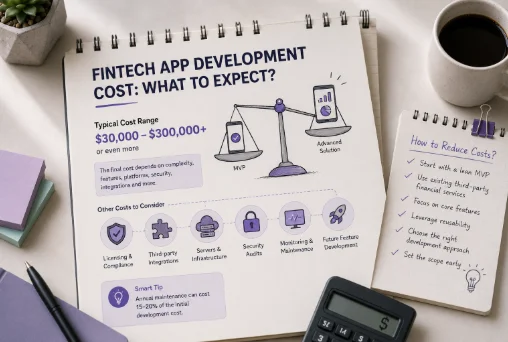
The price of the fintech app development is not fixed. According to recent surveys, the cost of developing a fintech app is somewhere between about $30,000 and $300,000+, or even more depending on complexity. And the final price will depend on the functionality of the product, chosen platforms, security measures, etc.
For instance, an MVP that has only one major fintech functionality is likely to be cheaper than multi-platform fintech solutions (banking app, lending app, payment app, etc).
However, you need to account for other expenses besides the development itself. It can include licensing, third-party integration, server setup, security check, compliance, payments to app stores, monitoring, and future feature development, etc.
According to some guides, the annual maintenance may cost you 15–20% of the initial development costs.
How Can You Reduce Fintech App Development Costs?
Cutting down costs should not mean sacrificing on the issues of safety and quality.
The idea is to concentrate spending on the elements which would help you achieve your goals regarding the development of the product.
Begin with a lean MVP. Utilize existing third-party financial services where you can. Leverage reusability, take into consideration the proper approach to development, and avoid adding unnecessary features for the first release.
Cross-platform development might also help to save effort on the development of duplications in cases when there is no need for platform-specific features.
And most importantly, set the scope before development starts. It will always be cheaper to make decisions during the process of planning.
Why Choose a Professional Fintech App Development Team?
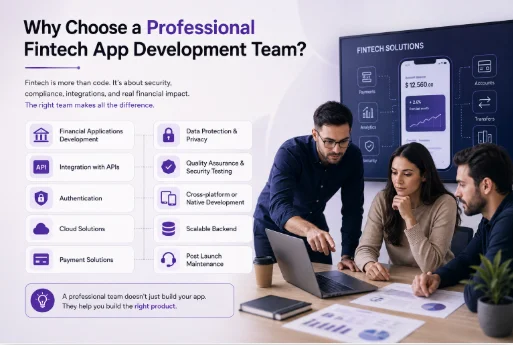
Fintech solutions incorporate software development with financial operations, security, integrations, and compliance.
This is why the selection of the development company becomes an important task. You need to find a team that knows more than just mobile interfaces and backend.
- Search for expertise in the following spheres:
- Financial applications development
- Integration with API
- Authentication
- Cloud solutions
- Payment solutions
- Protection of data
- Quality assurance and security testing
- Cross-platform or native development
- Scalable backend
- Post launch maintenance
The professional team will also be able to advise you on the choice of features for the MVP.
Build Your Fintech App With App-Concept
At this point, hopefully, it will be clear what is required to build an effective fintech application. In light of the fact that financial instruments involve thorough planning, selecting a seasoned team of developers could help manage this process in a more organized manner.
App-Concept is a mobile app development company with over a decade of experience and multiple custom software solutions built in various industries.
App-Concept delivers services in the area of development for iOS, Android, web and cross platform applications, focusing on transparent and result-oriented development.
In fintech projects, the team can provide assistance at all stages of the product lifecycle starting from the concept and MVP creation and ending with the development of an application itself as well as its further improvement. The development offered by App-Concept includes:
- Custom mobile app development
- iOS and Android development
- Cross-platform app development
- UI/UX design
- Backend development
- API integration
- MVP and prototype development
- Testing and quality assurance
- AI and advanced technology integration
- Maintenance and updates
The company also states that project pricing is flexible based on the project’s requirements, goals, and budget, with project evaluation and quotations provided before development.
For a fintech product, the goal should not simply be to launch an app. It should be to build a secure, reliable, scalable product that can continue to evolve as the business grows.
Frequently Asked Questions
Is it possible to create a fintech app with a limited budget?
Yes, but it is important to create a minimum viable product (MVP) with a clear focus. Instead of developing an entire financial system, it is better to pick a problem and develop a corresponding process.
Do all fintech applications require a license?
No, not all fintech applications require the same license. Licensing depends on the functionality, location, and direct provision of financial services.
Is it possible to develop my fintech product using third-party APIs?
Yes, third-party API solutions are commonly used in fintech software development for such purposes as payments, bank connections, identity verification, cards, financial data and more. However, it is your responsibility to be aware of the implications of such integration on the security, compliance, reliability, and user data.
Is Flutter appropriate for fintech products?
Yes, it is possible to use Flutter for many fintech products, but it always depends on what requirements and specifications there are in terms of performance, security, and integration.
What level of security should a fintech application have?
It should be developed with financial-grade security from the very beginning. This will depend on the product itself, but it may involve encryption, MFA, biometric authentication, tokenization, secure APIs, fraud detection, access controls, logs, and penetration testing.
Can I integrate AI into my fintech application?
Yes, it is quite possible. AI technology can help with fraud detection, providing financial insights, assisting users, analyzing their spending patterns, making recommendations, processing documents, and more. The thing is that AI should be implemented with caution, especially in relation to sensitive data and financial decision-making.
Do I need an MVP before building the full fintech product?
In most cases, MVP would be a wise move for startup companies. This will allow you to check your idea on actual users without investing too much in development at first. At the same time, MVP should also satisfy security requirements related to the functions it performs.
How do I pick a fintech app development company?
Consider aspects that go further than the company’s portfolio. Inquire about the company’s work with financial apps, their approach towards safety, API integration, testing process, methodology of development, and support after the product’s launch, as well as their communication process.
An ideal technical partner should be able to justify their choice of technologies and features to you.
Bottom Line
Developing a fintech app takes more than creating a good-looking mobile app. You need clear goals, simple UX, secure architecture, reliable integrations, legal checks, thorough testing, and a plan for future growth. Starting with an MVP can also help control costs and learn from real users.
Whether you are building a digital wallet, payment system, lending app, or investment platform, fintech app development is a key part of the process. If done well, it can turn your financial idea into a secure, scalable, and fully functional product.