
Software as a Service (SaaS) is one of the most rapidly growing software business models. Businesses use SaaS applications on a daily basis in order to manage projects, account, maintain their health care and educational systems and more. With the growing popularity of cloud technologies, more and more developers are wondering whether they can build and release a SaaS product by themselves.
Is it possible for a solo developer to build a SaaS app?
Indeed, it is fully possible for a solo developer to create his SaaS app. However, it would be possible to develop and release it successfully only under certain conditions, namely certain technical competencies, planning, research, time management and scalability.
If you want to build your very own SaaS application, read this article. It will explain how to build a SaaS app by yourself, what are the main difficulties, required skills, potential mistakes and why it is better to hire professionals sometimes.
Can a Solo Developer Really Build a SaaS App?
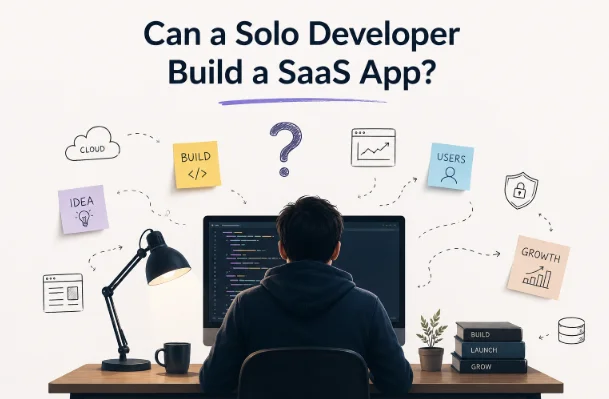
The answer is yes.
Today, many successful SaaS companies began their journey from a single developer. Contemporary cloud solutions, open source technologies, coding help by AI algorithms and third-party APIs have made developing software easier than before in the past decade.
However, development of an application and the creation of a profitable SaaS business is a whole different thing. Besides coding, a lone developer should validate the business idea, design the product, manage servers, deal with security issues, offer support, promote the product and keep working on it constantly.
Many people starting to develop SaaS ask themselves “Is it possible for one person to create a full-fledged SaaS platform?”
Well, the answer would depend on the complexity of the project.
It is possible to create a SaaS app for a niche audience with specific features, but creating enterprise-grade software would require an experienced team.
It is impossible to compete with those software products that have hundreds of developers. Successful lone founders find one specific issue to solve perfectly.
10 Benefits of Building a SaaS App as a Solo Developer
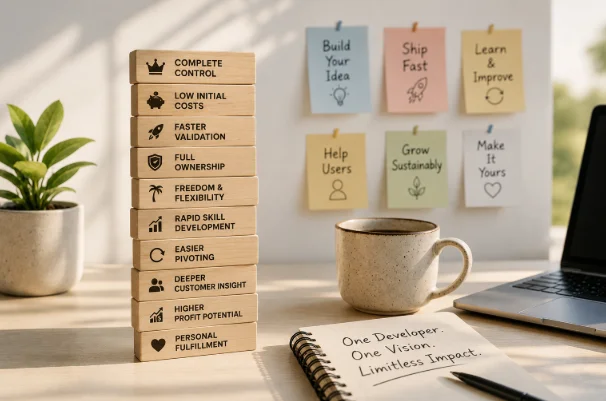
Creating a SaaS product as a single developer provides various strengths. While it takes a lot of effort, most developers like to have complete control over everything related to their product.
Here are some of the main advantages of developing a SaaS app by yourself.
- Complete Control Over Product Management: One of the main advantages of developing a product by yourself is complete control. Everything from product features and design to technology and business decisions is up to you. There are no long discussions and negotiations before implementing any changes. Many founders of successful SaaS products see it as a competitive advantage.
- Low Initial Development Costs: Many startups find hiring designers, developers, testers, and project managers quite costly. In case you develop the product yourself, all your investment will be limited to your time instead of large development costs. Moreover, many solo developers minimize their costs by using open-source technologies and third-party API instead of coding everything themselves.
- Faster Product Validation: The launch speed can show if there is interest in your product. Rather than spending several months developing many different features, a solo developer can just release an MVP. The feedback of early users will help improve future releases and make sure that you won’t be adding unnecessary features.
- Full Ownership: Most entrepreneurs would like to own the software completely. You have full control over the product roadmap, pricing strategy, branding, marketing strategy, and the product’s future development. You do not need to share the ownership with co-founders or raise money from the investors in the early stages.
- Freedom in Working Hours: Solo developers have the freedom to decide how and when to work on the project. Whether you prefer working in the evening, remotely, or even while traveling, you have all the freedom to build your product in your way.
- Rapid Skill Development: Developing a SaaS product alone gives you much more than coding experience. Developers learn how to develop UI/UX, how to set up cloud infrastructure, databases, how to manage cybersecurity and DevOps, how to market your product and support your customers.
- Easier Product Pivoting: Customer demands may change after the launch. For solo founders, it is easy to change features, pricing strategy, and even the whole orientation of the business without aligning with other members of the development team.
- Greater Understanding of Customers: Personal dealing with customer support gives you a unique chance to learn. You get information about the problems your clients face and about their needs directly from them. This way, you are able to develop a better product while keeping customers satisfied.
- More Opportunities to Generate Profit: Since you have no expenses for the payroll of employees, SaaS businesses turn out to be highly profitable. Revenue from the monthly subscriptions continues rising while the cost of running the business stays comparatively low.
- Satisfying Personal Experience: Launching a successful SaaS product is a great accomplishment. Solo developers are often proud of being able to solve problems on their own while helping thousands of people with software products created by them.
Challenges Solo Developers Face When Building a SaaS App
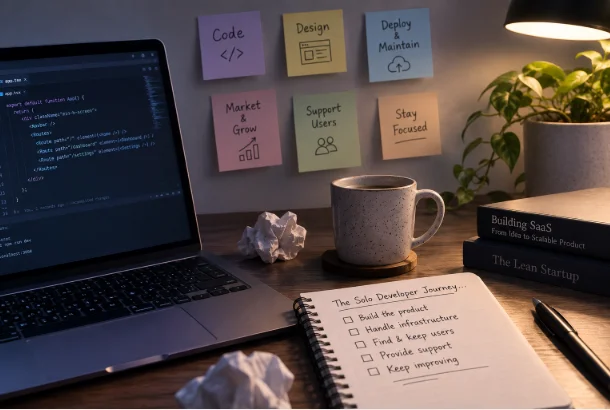
While there are numerous benefits of building your application independently, there are also several drawbacks. Knowing about those drawbacks will help developers to set realistic expectations before embarking on their project.
Have you ever asked yourself, “Why do many independent SaaS products never get launched?” In most cases, developers underrate the workload other than programming.
Not Enough Time: A single developer has to wear several hats each day. In addition to programming, there are tasks related to planning, testing, debugging, deployment, documentation, customer support, marketing, and application updates. Taking care of all these tasks can significantly slow down the development process.
Technical Challenges: A modern SaaS app requires much more than frontend development. Authentication, API, database, cloud infrastructure, payment systems, security, monitoring, backup solutions, and scaling all need particular knowledge and skills. Getting familiar with all this technology takes time and practice.
Marketing Issues: Creating software is not everything. Many times, reaching the right audience turns out to be even harder than coding. There are many developers who are having trouble with SEO, content marketing, paid advertising, social media and selling, because all these skills differ from software development.
Burnout: Working on your own for months may be mentally demanding. Developers often have to spend their evenings and weekends resolving bugs, dealing with support tickets, and releasing updates. Without planning, burnout becomes one of the most common reasons why solo SaaS ventures fail.
Lack of Feedback: There will naturally be more suggestions coming from big teams. Solo developers sometimes do not see the usability problems because there are not many people who check the features prior to the release. User feedback becomes highly important.
Customer Support Duties: Every inquiry from a customer gets to the developer. Answering emails, addressing inquiries, issuing refunds, documenting software, and dealing with feature requests take time away from development work as the customer base grows.
Security Duties: SaaS applications usually process business data of their customers or the company. The developer has to secure the account credentials, databases, payments, and cloud infrastructure from potential cyber attacks. Such errors may harm the developer’s reputation.
Scaling Problems: Success brings other challenges. When the traffic rises, there is a need for more robust infrastructure, fast databases, load balancing, and caching. It should be thought through from the very beginning.
What Determines Whether a Solo Developer Can Successfully Build a SaaS App
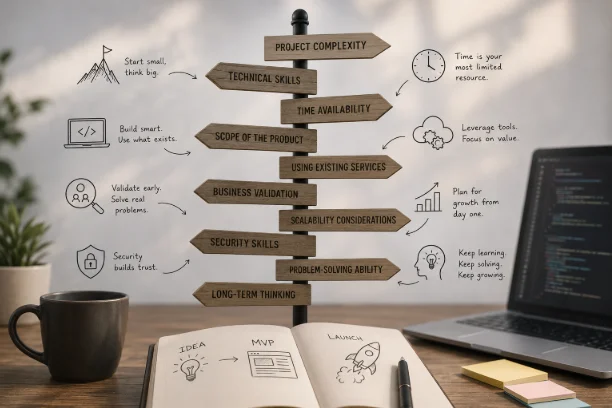
Each SaaS project is not appropriate for one developer in equal measure. Some aspects influence the decision if to develop alone or to seek additional support.
Do you know the question “Why do some solo SaaS entrepreneurs succeed while others fail?” Here you will find the answers.
1. Project complexity
The level of complexity of your SaaS project is the determining aspect. It is easier to develop an appointment booking application rather than an enterprise CRM solution, an AI platform or software with a lot of features in finance.
Solutions with complex workflow, different roles of users, advanced analytics and integrations need much effort to be planned, tested and maintained. To start from a narrow-niche solution increases the chances for success of solo entrepreneurs significantly.
2. Technical skills
Having a good technical background helps a lot in the developing process. Solo founders must know how to work with frontend, backend, databases, APIs, cloud hosting, authentication and deployment. It is possible to learn while working on a project but it takes time.
No developer is perfect. Still, having the knowledge about the basics of the whole software development cycle increases the chances to develop SaaS successfully.
3. Time Availability
Developing a SaaS product requires consistency. If someone works at night and on the weekends, it means he or she will make slower progress than an entrepreneur who dedicates all his or her time to building the product.
Developers frequently wonder, “How many hours does it take to build a SaaS application?” There is no exact answer. Even a simple MVP takes hundreds of hours of work.
4. Scope of the Product
Making the scope of the product too big is another mistake that entrepreneurs should avoid. The majority of successful solo founders start their businesses with the minimum set of features necessary for solving only one problem. Further features are added depending on the experience gained from users’ feedback.
5. Using Existing Services
With the advent of third-party software, developing a new product has become much easier now.
Nowadays, developers do not have to build their own authentication, payments, email system, analytical tools, database, etc., since there are existing platforms that could be integrated and thus save months of development process.
6. Business Validation
Even a perfectly developed app might not succeed due to lack of interest. Before starting to write hundreds of lines of code, one must validate its necessity by conducting customer interviews, surveys, creating landing pages or receiving initial signups.
Sometimes it is important to understand customer problems rather than writing perfect code.
7. Scalability Considerations
Not all SaaS applications emerge in a big way. It is always better to consider scalability at the beginning of development to prevent expensive migrations in the future. Cloud native infrastructure, modularity of architecture and scalability of databases will greatly facilitate further growth of your application.
Those who develop with a long perspective usually invest less time in rebuilding their apps after attracting more customers.
8. Security Skills
Security issues should not be addressed at the end of the development process. Appropriate authentication, encrypted communication, secure database, role-based permission system and constant updating help keep users and your data safe from any cyber attacks.
People put their valuable data into the hands of SaaS providers. It is necessary to maintain their trust.
9. Problem-Solving Ability
There will always be unforeseen problems for every piece of software developed. Problems of bugs, issues of integration, bottlenecks, and even shifts in customer demands need patience and analysis. Programmers who like to solve problems will adapt much more easily throughout their long ventures.
Constant learning can be one of the greatest strengths of successful solo entrepreneurs.
10. Long-Term Thinking
Getting the product out is just the start. Successful SaaS companies need constant maintenance and improvement through updates, support, bug fixing, marketing, features, and performance optimization. Success comes over months and years, not weeks.
Many people wonder, “Can a solo developer create a SaaS application which will develop into a successful business?” Of course, it is possible. Those who are successful treat it as a long-term venture, not a quick code job.
Step-by-Step Process to Build a SaaS App as a Solo Developer
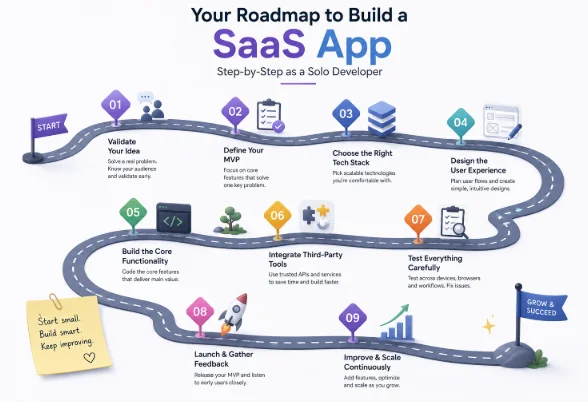
Constructing a SaaS platform alone could be daunting in the beginning. Dividing the work into small parts will make the process much easier to handle.
Have you ever thought to yourself, “In what sequence should I build my SaaS application?” Using an appropriate roadmap will help decrease the number of errors, increase speed, and ensure success.
1. Validation of Your Idea
All successful SaaS platforms start from solving the right problems. Prior to coding anything, you have to define who your customers are and what their major problems are. Speak with them, participate in different forums, do surveys, analyze competitors to ensure that your idea is in demand.
The majority of developers waste months building products nobody needs. Early validation of your idea is very useful as well as building a landing page or a waiting list.
2. Define Your Minimum Viable Product (MVP)
The attempt to develop everything at once often results in delays. It is important to concentrate on those features which are critical for solving one particular problem.
This will allow you to quickly deploy your product, gather user feedback, and improve the product incrementally instead of trying to guess what the customers need.
3. Select the Correct Technology Stack
The selection of technologies is critical both in terms of the speed of the development process and scalability. Some of the popular technologies include React, Next.js, Node.js, Laravel, Django, PostgreSQL, MongoDB, Docker, AWS, Google Cloud, and Microsoft Azure.
Quite a lot of solo developers prefer to use Firebase or Supabase for their backend. The choice of technologies that you are comfortable with usually brings better results compared to learning something new all the time.
4. Design the User Experience
Great software should be intuitive. Create simple wireframes that would define user flows within the application. Pay attention to neat layouts, clear workflows, and convenient navigation instead of making complex designs.
Professional user experience helps to create trust and eliminates customer frustration. Small usability optimizations may increase user retention and attract more recommendations for your software.
5. Create the Main Functionality
It is time to write some code. Implement the functions that would provide the core value of your product first. Don’t add any additional functionality at least until the core functions become well-working. It will help you to organize the architecture for future updates.
Remember that you have to solve one problem exceptionally good. There are many SaaS companies that gained popularity just because they did one thing better than others.
6. Implement Necessary Third-Party Tools
Modern SaaS software is not created from scratch anymore. Integrate reliable third-party tools that are used for authentication, payments, emails delivery, cloud storage, analytics, notifications, and customer support. They will help you to develop your software faster and make it more stable.
Moreover, third-party tools will let you focus on unique business features instead of implementing already existing functionalities.
7. Test Everything Carefully
Testing is as important as development. Check all features, buttons, workflows, and integrations before launch. Test your software on various browsers, screen resolutions, and devices to provide consistency.
It is a question many developers ask: “Is there any way not to test my application and launch it sooner?” Not testing often leads to even greater problems later. It typically takes much more resources to fix mistakes after launch than to prevent them in advance.
8. Launch and Gather Feedback
Launch of your SaaS product is just a start. Release your MVP to its first users and carefully analyze how they use the application. Accept suggestions from them, fix all reported mistakes, and understand what features customers like.
Customer’s real feedback is more valuable than any assumptions. It is continuous improvement that defines success or failure of a SaaS product.
9. Improvement and Scaling
After launch, you need to improve your software constantly. You should add features requested by customers, optimize your software for performance and security, and get ready for growing traffic with scaling of your infrastructure.
Successful SaaS products are constantly evolving updates make customers satisfied and allow keeping the product competitive.
Existing Relevant Contents:
How Hybrid App Development Can Reduce Costs?
How Is App Development Different From Web Development?
How To Write A Business Plan For Mobile App Development?
10 Essential Features Every SaaS App Should Have
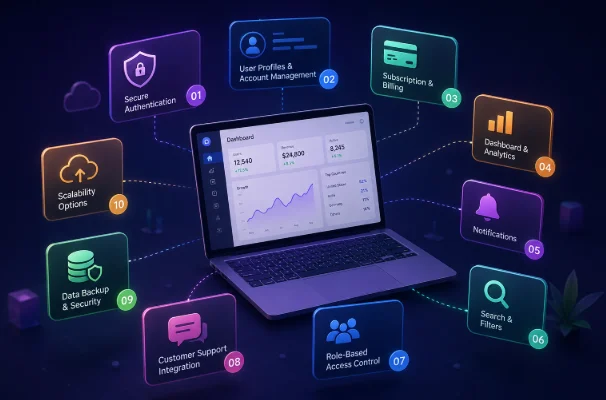
Despite the unique character of every SaaS product, there are certain features that every user expects today. Right implementation of these features will help to enhance usability, security, and scalability.
Have you ever asked yourself, “Which features must be implemented into every SaaS application?” Below there are listed components of most successful SaaS platforms.
1. Secure User Authentication
It is necessary for every SaaS application to have a reliable login mechanism.
Provide secure registration, password recovery, email verification, and optionally, multi-factor authentication. It is important to protect user accounts while increasing customers’ trust.
Security issues should be taken care of since the very beginning of software development. Customers’ information protection is needed to build long-term relationships.
2. User Profiles and Account Management
The customers should be able to manage their personal data.
Allow customers to edit profile data, change passwords, manage subscriptions, configure preferences, check their account activity via user-friendly dashboard.
Providing customers with more options makes their experience better, while reducing the amount of customer support requests regarding the simplest account manipulations.
3. Subscription and Billing System
Recurring subscriptions are the base of almost every SaaS company. Integration of secure payment gateways allowing using various payment methods, managing invoices, billing history, automatic renewals, and subscription upgrades or cancellations.
A reliable billing system improves customer satisfaction while providing predictable recurring revenue for the business.
4. Dashboard and Analytics
Users value being provided with a clear understanding of their actions. Interactive dashboards make it possible for clients to gain knowledge about crucial information through graphs, reports, statistics and performance reviews. Visualizations may enhance decision making.
It is also crucial for companies to have analytics inside, measuring the behavior of the customers, adoption of particular features and general performance of the product.
5. Notifications
Informing the users increases engagement level. Emails, pop-ups or push notifications inform the users about updates, tasks, payments, new features, actions inside the account and do not overload them.
The well thought-out notification system motivates users to use the platform regularly, maintaining a high level of communication.
6. Search and Filters
The more complicated the application becomes, the harder it is to find certain information. Such functions as advanced searching, filters, categories and sorting enable users to easily find files, records, customers, reports or any projects inside the application.
Navigation greatly improves the user experience, especially for information-intensive SaaS services.
7. Role-Based Access Control
SaaS products usually target different groups of users. Administrators, managers, employees, customers and even support department may need different rights. This will increase the security of the software and simplify the user management. This feature becomes increasingly important as businesses expand and add more team members.
8. Customer Support Integration
Sometimes users require help. Provide live chat, tickets, knowledge bases, FAQs, or even chatbot support so that customers can easily find their solutions without navigating away from the app. Effective customer support ensures customer satisfaction as well as long-term customer loyalty.
9. Data Backup and Security
Data protection is of utmost importance. Data backups, encrypted databases, secure cloud hosting, and continuous security checks decrease the chances of losing important data while ensuring business continuity. Customers prefer software that gives priority to security and reliability.
10. Scalability Options
Your software-as-a-service product needs to scale with your business. Create an application that will be able to handle growing numbers of users, bigger databases, new functionalities, increased traffic and other factors. Founders often underplay the future growth of their products.
Best Technology Stack for Solo SaaS Development
Selecting an appropriate tech stack allows solo software developers to move fast while maintaining ease of future app maintenance. It is always better to go for simplicity rather than trying to catch up with the latest framework.
One of the common questions from the beginners is: “Which is the best tech stack to build a SaaS application alone?” This question has different answers based on your skills; however, some technologies have been proven to be efficient for most cases.
Frontend: Some frontend frameworks include:
- React
- Next.js
- Vue.js
- Angular
- Svelte
They develop responsive and interactive UIs while guaranteeing scalability in the future.
Backend: Some reliable backend technologies include:
- Node.js
- Laravel
- Django
- ASP.NET Core
- Ruby on Rails
Each one has a great ecosystem, comprehensive documentation, and a large community.
Database: Some popular database technologies include:
- PostgreSQL
- MySQL
- MongoDB
- Firebase Firestore
Supabase: You should choose based on the data structure of your SaaS and its future scalability.
Cloud Hosting: Most SaaS applications depend on the cloud hosting which includes the following:
- AWS
- Google Cloud Platform
- Microsoft Azure
- DigitalOcean
- Vercel
Third-Party Services: It is better to use third-party services instead of developing everything by yourself for:
- Authentication
- Payments
- Email delivery
- File storage
- Analytics
- Error monitoring
- Customer support
Using existing services shortens development time while improving application stability.
Common Mistakes Solo SaaS Developers Should Avoid
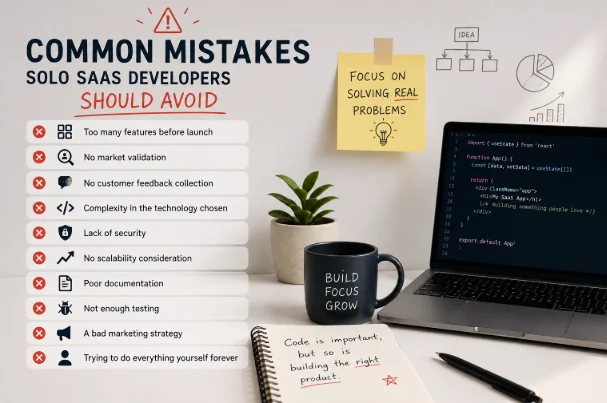
Even the experienced ones make blunders when introducing their first SaaS software product into the market. Learning from other developers’ experience will help you save precious time and not repeat their mistakes.
Did you ever wonder, “Why do so many SaaS businesses fail?” In most cases, mistakes are avoidable.
- Too many features created before the launch
- No market validation
- No customer feedback collection
- Complexity in the technology chosen
- Lack of security
- No scalability consideration
- Poor documentation
- Not enough testing
- A bad marketing strategy
- Trying to do everything yourself forever
“Developer builds a saas app himself” may be an interesting concept, but success in this case requires a balance between coding and business aspects. Many developers spend all their time writing codes but forget about marketing, support, and product validation.
Learning how to avoid such mistakes will allow you to start working faster, with fewer expenses, and produce what people really need. Sometimes simplification is the best choice.
Ways to Reduce SaaS Development Time and Cost
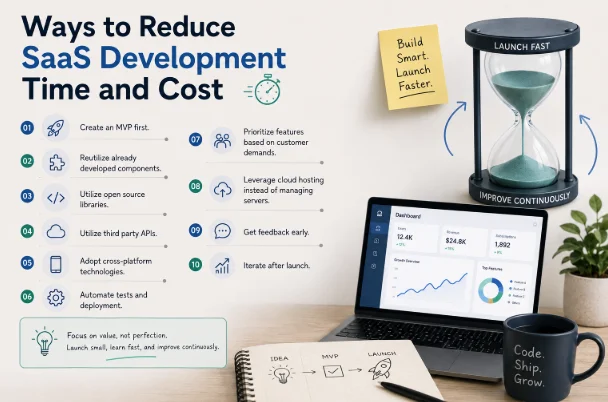
Construction alone doesn’t imply building inefficiently. Intelligent choices can save lots of time and money during the development phase without compromising the quality of the result.
The following approaches help speed up the process of developing an application and remain cost-effective at the same time.
- Create an MVP first.
- Reutilize already developed components.
- Utilize open source libraries.
- Utilize third party APIs.
- Adopt cross-platform technologies where it is possible.
- Automate tests and deployment.
- Prioritize features according to customer demands.
- Leverage cloud hosting rather than running your own servers.
- Get feedback early.
- Iterate after the launch.
Many people ask how to build a SaaS app quickly. The best solution in this case is to focus on valuable features and ignore perfection for the first release. Gradually improve your product in accordance with customer feedback.
The best SaaS products don’t release everything from scratch but rather learn, plan, and iterate.
Future Trends in Solo SaaS Development
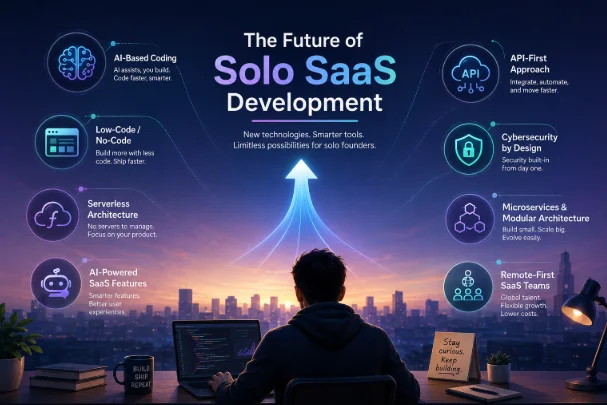
This industry keeps changing very rapidly. Thanks to new technologies, solo entrepreneurs get the opportunity to create, launch and scale software products by themselves.
Did you ever think, “How will solo development of SaaS apps be in the future?” Getting familiar with such trends will help developers create competitive products for many years to come.
1. AI-Based Coding
Artificial intelligence technology is changing the process of software development.
AI-assisted coding applications can produce code, clarify complex algorithms, find bugs, produce documentation and automatize coding processes. This allows solo developers to finish their projects quicker.
The AI doesn’t replace developers, it just makes them more productive. While developers make architecture and business decisions, AI does all the other coding work.
2. Low-Code and No-Code Solutions
Currently, most SaaS founders use both traditional coding and low-code approaches.
As a result, developers have to code fewer features by themselves as they use automation platforms, workflows, dashboards and internal tools. This greatly decreases development period.
The right usage of low-code technologies helps solo developers concentrate on creating unique product features.
3. Serverless Architecture
Serverless computing gains popularity in SaaS startups.
The infrastructure, scaling, and maintenance are managed by cloud providers. Developers need to deploy their application without managing servers.
It reduces infrastructure spending and makes applications maintenance easier during the initial period of business growth.
4. AI-Powered SaaS Functions
AI technologies are not used only by big companies anymore.
Small SaaS applications use AI for search, recommendations, chatbot for customer support, content generation, and prediction. They enhance user experience and increase product value.
When the AI service gets cheaper, solo developers can use sophisticated functionality without developing machine learning algorithms themselves.
5. API-First Approach
Nowadays software depends on APIs very much.
Developers do not have to develop everything. They integrate their applications with payment systems, authentication services, communication channels, analytics systems, and cloud storage using APIs.
It speeds up development and helps solo founders create professional products faster.
6. Cybersecurity by Design
Now security has become one of the top priorities for SaaS companies.
Users require secure authentication, encryption of the data, role-based access, and compliance with all modern privacy laws. Security can’t be considered as an additional service anymore.
Engineers who start thinking about cybersecurity from the very beginning decrease potential threats and build stronger trust of the customers.
7. Microservices and Modular Architecture
The applications become more modular.
Instead of developing a single large application, engineers split up various services into several small modules. It increases the scalability of the application and makes further improvements simpler.
While for some MVPs the modular architecture is not required, this approach becomes useful with growing SaaS businesses.
8. Remote-First SaaS Teams
Even individual founders develop their companies further.
The remote collaboration tools help to hire designers, marketers, testers, and other specialists from all over the world without having a physical office.
Such an approach enables the business to scale better and save costs on operation.
Frequently Asked Questions
How much time will it take for a single developer to develop a SaaS app?
Developing a basic MVP would require three to six months. Developing more advanced SaaS with complex functionalities would require a year or more depending on the time availability.
Is it possible for a developer to develop a SaaS app without any funds?
Yes. Several successful SaaS founders have started their companies with their own capital along with affordable cloud providers. Having an MVP will help you validate your concept before getting any external funding.
Which language is the best to use while developing a SaaS app?
There is no specific language that one should use for developing a SaaS app. Some common languages that could be used are JavaScript with Node.js, Python, PHP with Laravel, C#, and Java.
Should I build my application for the web or for mobile?
It is always advised that developers start their venture with a web-based application due to its broader reach and low cost of development.
Could AI help solo programmers create SaaS applications?
Sure. AI coding assistants will speed up the process, document the work, spot errors, suggest solutions to problems and automate routine work, helping the developer to concentrate on problem-solving.
What is the main challenge for a solo SaaS founder?
Balancing between the technical side of work and marketing, customer service, product management, etc. Successful founders devote as much time to the customers’ problems as they do to the coding process.
Final Thought
Development of SaaS applications independently became much easier now due to modern frameworks, cloud technologies, AI-powered development and third-party services. However, success largely depends on proper planning, consistent learning and solving customers’ problems, not just creating the code.
In case you are going to solo develop a saas app, start from the smallest possible MVP, validate your idea as early as possible and develop your product based on users’ feedback.
Hopefully, this guide was helpful to you and you will be able to build the perfect SaaS app.