Dating apps are becoming one of the most rapidly growing sectors in the mobile apps industry. Every day millions of people use dating apps. Due to increasing user needs in such services, numerous companies and startups are actively investing in dating app development and joining this lucrative market.
So, how much does it cost to develop a dating app?
Dating apps development cost ranges between $20,000 and more than $300,000, depending on the type of app, and tech stack. An MVP dating app can be created for $20,000-$50,000, while rich functional platforms like Tinder, Bumble, or Hinge would cost you at least $150,000-$300,000 and more.
Planning to create a dating application, you should know how much it costs to develop a dating app first. Continue reading to find out about the factors that influence pricing, costly features, unexpected expenses, and ways to successfully create a dating app for an affordable price.
What Determines the Cost of Dating App Development?
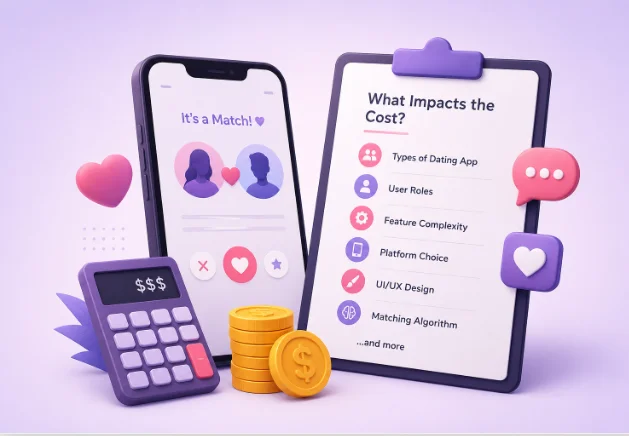
There is no universal price for developing a dating app because each app-building project is distinct from others in terms of business goals, target audience, functionality, security, etc.
Have you ever asked yourself “Why is it that one dating app costs $25,000 but another one costs more than $250,000”? Here’s why, and there are some criteria that define the overall cost of development. The list below shows the main ones.
1. Type of Dating App
First of all, the type of dating app you want to have built will make the biggest difference regarding the development cost. Different dating platforms target various audiences and require specific features.
While some of them can be simple matching platforms, others can feature live streaming, AI suggestions, premium subscriptions, video dating, etc. The more specialized your app is, the more time and effort it will take to build it.
Dating apps can be the following types:
- Swipe-based dating apps
- Relationships apps
- Niche dating apps
- Religious dating apps
- Video dating apps
- Speed dating apps
- Friends apps
- Senior dating apps
- AI matchmaking services
And there are various criteria for each type, which implies the different costs of the development process. The question many entrepreneurs ask is: “Which type of dating app is the cheapest to develop?”
Usually, a simple MVP, which includes only creating profiles, matching, and sending messages, is the most inexpensive solution. Once the application attracts its first users, advanced features may be gradually implemented into it.
2. Number of User Roles
Most dating apps have several user roles that go beyond those of regular users who use their applications for finding partners. Every user role comes with a set of different permissions, dashboards, and workflows.
Thus, while registered users browse profiles and exchange messages, moderators work on moderating reported users, blocking frauds, and dealing with offensive content, whereas administrators take care of analytics, subscriptions, and other platform settings.
Common user roles include the following:
- Regular users
- Premium users
- Moderators
- Administrators
- Support service representatives
- Verifiers
- Marketing managers
- Content moderators
- Event managers
- Super administrators
Any new user role adds complexity to the development process since developers should implement an entirely new interface for it along with appropriate permissions. When businesses ask whether having several user roles increases dating app development costs, the answer is positive.
3. Feature Complexity
List of features is one of the key elements influencing the development cost. Basic features are cheaper, whereas sophisticated ones take a lot more time to develop.
Today’s customers expect much more from a service besides viewing people’s profiles. They expect recommendations, secure messaging, video chat, identity verification, and AI matching.
Basic features include:
- User registration
- Profile creation
- Uploads
- Filters
- Suggestions
- Notifications
- Blocking users
- Editing a profile
- Favorites
- Messages
- Sophisticated features include:
- AI matching
- Video calls
- Voices
- Live video
- Personality tests
- Recommendations
- Translation
- Verification
- Virtual gifts
- Location-based matching
Development cost of a dating app increases significantly when implementing these features. First, businesses should consider providing a minimum amount of functionality and then expand their service.
A number of startups build an MVP and implement premium features later according to user feedback.
4. Platform Choice
One of the first technical decisions you have to make is about platforms your dating app will support. It influences the development cost and further maintenance. Some businesses choose to be available on Android or iOS only, while some prefer targeting both mobile platforms as well as desktop users.
Popular platform options include:
- Android app
- iOS app
- Cross-platform app
- Native Android
- Native iPhone
- Progressive Web App (PWA)
- Web dating platform
- Tablet version
- Desktop application
- Smartwatch companion app
The frameworks used to develop a mobile application can enable developers to utilize the same source code when developing an app for other OSs such as Android and iOS. As a result, this process decreases the total time and cost spent on development.
The question of “Android or iPhone? Which platform is preferable for a startup” is common. The answer to it will depend on the intended audience and finances of the company.
5. UI/UX Design Requirements
As a rule, dating applications are very dependent on their user experience design. Nice designs make people stay longer on the website viewing profiles and talking with matches.
As opposed to the majority of business applications, the dating app must have good visuals and comfortable interactions. Every gesture and every chat should be easy and natural.
UI/UX design process will include:
- User research
- Wireframing
- Interactive prototypes
- Branding
- Layouts for profile pages
- Screens with matches
- Chatting interface
- Dark mode support
- Accessibility design
- User testing
The basic interface is cheaper than the customized one with animations, premium branding, and interactive transitions.
Often, companies wonder about the value of the customized dating app design. For the most part, the answer is yes, as the proper design leads engagement, increases retention, and helps the app stand out in a highly competitive market.
6. Matching Algorithm
The matching algorithm is the core feature of any dating application. It defines the way people find matches and affects user experience directly.
Simple algorithms may match users just by age and location. However, more sophisticated systems analyze interests, behavioral patterns, user preferences, compatibility score, and other factors.
The matching algorithms can include:
- location matching
- interest matching
- personality matching
- recommendations powered by AI
- compatibility scores
- behavioral analysis
- machine learning
- preference filters
- smart ranking
- daily match suggestions.
The development of intelligent recommendation systems will require additional backend development and the implementation of AI technologies. The more sophisticated the algorithm is, the higher the cost of its development will be.
Many companies wonder, “How important is AI for dating applications?” AI contributes to better match quality and user engagement but also needs more significant investments in the process of development, data processing, and optimization.
7. Security and User Verification
The problem of security in dating applications is crucial since they work with personal data of users. People expect that their information and messages will be safe. Besides, good security features can help reduce the number of scams, fake profiles, spamming, and cases of identity fraud.
Possible security features include:
- two-factor authentication
- Identity verification
- Face verification
- Profile moderation
- End-to-end encryption
- Data encryption
- Fraud detection
- Content reporting
- User blocking
- Privacy controls
The introduction of security into an application means more engineering work, testing, and compliance. Despite the higher initial expenses, it ensures security for users and the company itself.
The common question is, “Why is dating app security so costly?” It is clear that protecting data and ensuring security from abuse involves high-level technologies and monitoring.
8. Third-Party Integrations
Most dating applications use some third-party solutions instead of developing features themselves. Integrations not only increase functionality but also decrease the development period. However, any integration involves setting up, testing, maintenance, and management of APIs, adding extra money to the budget.
The most popular integrations are:
- Google Maps
- Stripe
- Paypal
- Apple Pay
- Firebase
- Twilio
- Google Analytics
- Push notifications services
- Cloud Storage
Third-party services save time in the development process, but most of them have monthly or pay-per-use costs that need to be considered.
It is quite common for entrepreneurs to ask themselves, “Should I develop everything from scratch?” Usually, the answer is “No.” Using reliable third-party solutions reduces risks and improves the app stability.
9. Backend Infrastructure and Scalability
Every successful dating application needs a reliable back end that can support hundreds or even millions of simultaneous users. With the increase in activity, the back end needs to handle messages, profile updates, matching, notifications, and media uploads efficiently.
The following are parts of back end infrastructure:
- Cloud servers
- Databases
- API development
- Media storage
- Load balancing
- Backups
- Analytics
- Monitoring tools
- Performance optimization
- Disaster recovery
Scalability is more costly up front, but it will save you money in the long run and prevent any need to rebuild. Many businesses ask, “Can my dating app be scaled later? ” Yes, but scaling from the get go is usually more cost-efficient than rebuilding an entire application.
10. Compliance and Data Privacy
Your dating app is going to store personal information, location information, images, messages, and even financial information. That is why compliance will be one of the key issues to think about during the development process.
Depending on the markets where you want your app to operate, you will have to comply with GDPR, CCPA, age verification, and payment compliance.
Among other things, it may involve:
- GDPR compliance
- CCPA compliance
- Privacy policy
- Terms of use
- Cookies management
- Age verification
- Payment compliance
- Data retention rules
- User consent management
- Secure data storage
Compliance is often ignored when designing an application since many startups only consider the compliance aspects at the very end. This can be costly because it takes time and money to make changes in the app to ensure compliance.
A common question often arises, if legal requirements influence dating app development costs?
Well, Of course, the compliance aspect will add to the development process, but it will save your business from penalties and lawsuits.
Cost Structure According to Dating App Development Stages
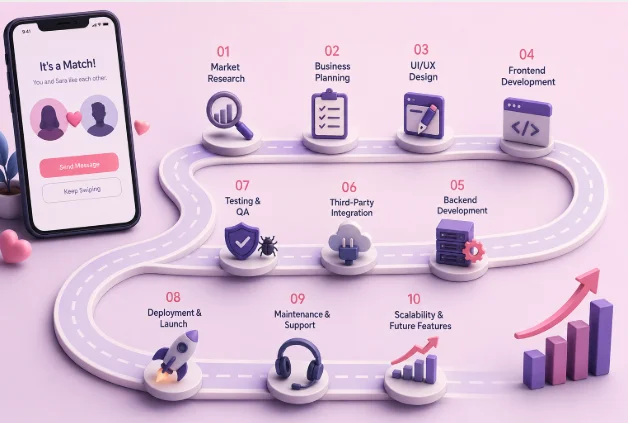
Dating app development is far more complex than just coding. Each stage requires its specific professionals, technology, and planning and influences the cost of development accordingly.
Want to know which dating app development stage is the most costly? Well, in the majority of cases, the following stages, backend development, feature implementation, security, and testing, take the largest share of the budget.
1. Market Research and Competitor Analysis
Before developing a dating app, there needs to be thorough research of the market, competitors, market tendencies, etc. This will help identify the strengths and weaknesses of the app before the start of coding.
Typical tasks include:
- Competitor analysis
- User research
- Market validation
- Audience segmentation
- Feature planning
- Industry trend analysis
- SWOT analysis
- Revenue model research
- Customer surveys
- Business feasibility studies
Estimated Cost: $2,000-$12,000
2. Business Planning and Requirement Gathering
After completing the research, the next step is project planning, which encompasses defining the features of the app, its business goals, technical requirements, timeline, and development process.
Planning ensures that there will be no confusion when developing the app, while also saving money and making sure that stakeholders are aligned.
Planned activities typically include:
Requirement documentation
- Feature prioritization
- User flow planning
- Technical architecture
- Development roadmap
- Budget estimation
- Timeline planning
- Risk assessment
- API planning
- Compliance planning
Estimated cost: $3,000 – $10,000
3. UI/UX Design
Dating apps rely on their looks more than anything else. As users decide very quickly, they need an up-to-date and nice-looking interface that is easy to use.
Designers create wireframes, interactive prototypes, user journeys, and visual interfaces before developers start working on the code. Good design usually increases the users’ retention dramatically.
Design activities typically involve:
- Wireframes
- User journey mapping
- Interactive prototypes
- Branding
- Design systems
- Mobile layout design
- Chat interface design
- Profile screens
- Matching screens
- User testing
Estimated cost: $5,000 – $25,000
4. Frontend Development
Frontend development encompasses all that users will interact with in the application. It includes profile pages, messaging pages, search filters, swiping mechanics, push notifications, and account settings.
Developers make sure the interface is responsive, smooth, and consistent across different devices. An improved frontend will result in an enhanced user experience.
Frontend development typically includes:
- Registration pages
- Profile pages
- Swiping interface
- Chats
- Search filters
- Push notifications
- Settings
- Subscription pages
- Features for premium accounts
- Dashboard for users
Estimate Cost: $10,000-$50,000+
5. Backend Development
The backend drives everything that cannot be seen by the user. It includes user accounts, database, matching algorithm, messaging, push notifications, subscriptions, and overall business logic.
As the dating app processes hundreds of interactions every minute, the backend has to be highly secure, scalable, and reliable.
Backend development consists of:
- Server development
- Databases
- APIs
- Authentication
- Matching engine
- Chat services
- Payments
- User management
- Cloud infrastructure
- Optimization for performance
Estimate Cost: $20,000-$80,000+
6. Third-Party API Integration
The majority of dating applications implement some third-party integration to avoid developing all functions from scratch. Integration increases efficiency and saves time for developers.
Integration can be implemented through various third parties including:
- Payment gateways
- Maps
- Cloud storage
- Analytics
- SMS Verification
- Push Notification
- Social Login System
Popular integrations include:
- Google Maps
- Stripe
- PayPal
- Firebase
- Twilio
- Apple Pay
- Google Analytics
- Social Media Login
- Cloud Storage
- Email Services
Approximate Cost: $3,000 – $20,000
7. Testing and Quality Assurance
Testing is a step that allows making sure that an application will function correctly. Through this process, developers will find bugs, security risks, issues with device compatibility, and performance issues.
Failure to test properly may result in additional costs when you have to fix bugs after launching an application. Quality assurance significantly contributes to the stability and successful launch of an application.
Testing usually includes:
- Functional testing
- UI testing
- Performance testing
- Security testing
- Device compatibility
- Bug fixing
- Load testing
- User acceptance testing
- Regression testing
- API testing
Approximate Cost: $5,000 – $20,000
8. Deployment/App Store Launch
The last stage of application development includes its launch. At this point, developers set up the production environment and launch the application. Also, developers monitor its launch to quickly resolve any unexpected issues and deliver a smooth experience for new users.
Deployment tasks include:
- Server configuration
- Cloud deployment
- App Store submission
- Google Play publishing
- Production testing
- Performance monitoring
- Security checks
- Backup setup
- Domain configuration
- Launch support
Estimated Cost: $2,000-$8,000
9. Maintenance and Ongoing Support
This is not the end of work, just the beginning. Maintenance ensures that the app remains safe, reliable, and adapted to operating system updates.
Some maintenance tasks include:
- Bugs fixing
- Enhancement of performance
- Security measures update
- Adding new features
- OS adaptation
- Server monitoring
- Database maintenance
- Supporting customers
- Updates of API
- Backup service
Average Maintenance Cost: 15-25% of the initial development costs per year
10. Scalability and Future Features Introduction
If your dating app becomes very popular, it will become necessary to scale the app and implement additional features. In order to achieve this, one will need technical and strategic actions.
Successful dating websites and apps continue to invest in AI, video communication, premium membership, and global market expansion for many years after the launch.
Future features may include:
- AI matchmaking
- Video dating
- Voice chat
- Live streaming
- Multi-language
- Global market expansion
- More advanced analytics
- Recommendation engine improvements
- Communities creation
- Premium subscriptions improvements
Estimated Future Features Introduction Cost: $10,000 – $150,000+ depending on the scale of improvements needed.
Existing Relevant Contents:
How Much Does It Cost to Develop a Banking App?
How Hybrid App Development Can Reduce Costs?
How Much Does It Cost to Develop a Church App?
How Much is Healthcare App Development Cost?
Must-Have Dating App Features and Their Estimated Costs
Selecting proper features plays an important role in your development budget. Even though you may be tempted to implement all possible features, focusing on the basics can help you launch faster and get better results.
Do you ever ask yourself: “Which features every dating app must have?” Here is the list of some crucial features along with their development cost estimations.
| Feature | Estimated Cost |
| User Registration & Login | $1,000-$5,000 |
| User Profiles | $2,000-$6,000 |
| Swipe & Matching System | $5,000-$20,000 |
| Chat & Messaging | $5,000-$25,000 |
| Search & Advanced Filters | $3,000-$12,000 |
| Push Notifications | $1,000-$5,000 |
| Photo & Video Upload | $3,000-$10,000 |
| Location-Based Matching | $5,000-$15,000 |
| Payment Gateway Integration | $2,000-$8,000 |
| Premium Subscription System | $5,000-$20,000 |
| AI Match Recommendations | $10,000-$50,000+ |
| User Verification | $3,000-$15,000 |
| Admin Dashboard | $8,000-$30,000 |
All mentioned costs are approximate and depend on the features’ complexity, integration with third parties, design quality, etc. Many businesses start from building an MVP and adding more features over time. Such an approach allows managing development costs and responding to real users’ needs.
10 Factors That Raise the Price of Dating App Development
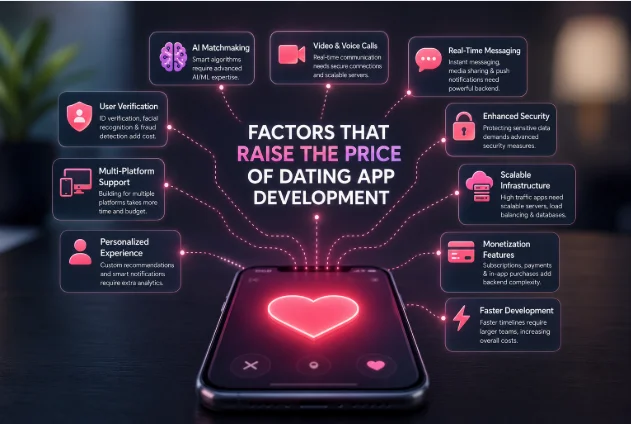
Every dating app is created with a specific budget in mind, but some additions and requirements may raise the price. The most popular reasons why prices go up are:
1. Artificial Intelligence Matchmaking
AI-based suggestions can help achieve higher matching rates through user behavior and preference analysis. However, the development of such features requires high-level machine learning skills hence, these suggestions are among the most costly features.
2. Video and Voice Calls
Real-time communication is a challenging feature that entails a secure connection, encryption, and scalable servers.
3. Real-Time Messaging
Real-time messaging and other features like instant messaging, media sending, push notifications, and read receipts are complicated features that entail powerful backend and synchronization capabilities.
4. User Verification
User verification tools such as facial recognition and selfie verification, as well as fraud detection, make an app safer however, their implementation requires the use of third-party services.
5. Multi-Platform Support
Launching your app on different platforms will cost you a lot more and will take you much longer.
6. Personalized Experience
Custom recommendations, intelligent notifications, and personalized experience increase user engagement but require extra development and analytics.
7. Enhanced Security
Security of sensitive user information entails special development and maintenance efforts.
8. Scalable Infrastructure
Apps with high user traffic demand a scalable infrastructure with load balancing and proper database design.
9. Monetization Features
Subscription, in-app purchases, premium membership, in-app purchases, and secure payment systems add backend complexity and increase development costs.
10. Faster Development
Accelerated timelines often require larger development teams, raising upfront costs while helping businesses launch sooner.
7 Hidden Costs of Dating Apps Development
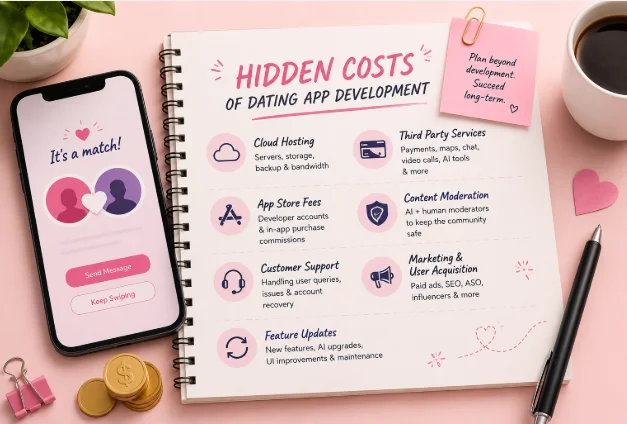
Businesses may think only about development costs but this is the tip of the iceberg because there are ongoing costs that influence your budget a lot. Knowing about them beforehand will help you to plan everything correctly.
- Cloud Hosting: Your dating app will need cloud servers to keep user data, photos, messages, etc. The larger user base you have the bigger costs you will have in the cloud due to higher traffic, backup services, etc.
- Third Party Services: Usually, applications use such services as payment gateways, maps, message delivery, video calling, authentication, moderation using AI, etc. This is great because you don’t need to develop all these features but you’ll pay for them each month.
- App Store Fees: To publish your app on AppStore and Google Play you will need developer accounts on both platforms. You should consider commission for in-app purchases and subscriptions too.
- Content Moderation: Fake accounts, scammers, spammers, and other threats need constant monitoring to be detected on dating apps. Most apps use a mix of artificial intelligence and human moderators to protect their communities.
- Customer Support: With the growing number of users, companies receive more and more requests related to account recovery, payments, and moderation problems. High-quality customer support is crucial for retaining users and increasing their satisfaction.
- Marketing & User Acquisition: Acquisition and attraction of new users require constant work in terms of SEO, paid ads, ASO, influencer marketing, and other strategies. Marketing turns into one of the biggest expenses after the launch.
- Feature Updates: Continuous feature updates help stay competitive and attract and retain users. Companies introduce many new features like AI-based matchmaking, video profiles, premium services, UI updates, and others.
10 Common Mistakes That Increase Dating App Development Costs
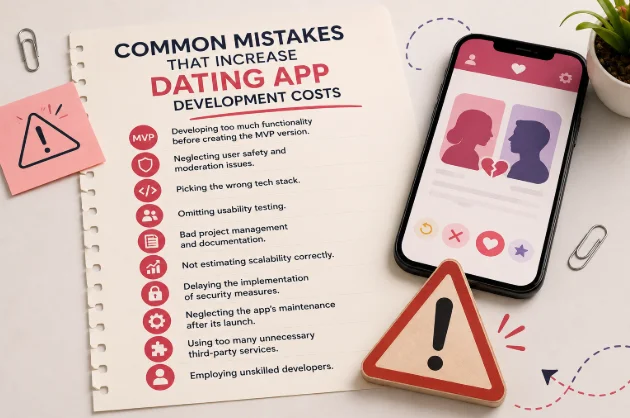
Many firms overspend due to preventable planning mistakes and not due to any technical difficulties. Have you ever wondered, “What mistakes increase dating app development costs?” You can save time and money by avoiding the following issues.
- Developing too much functionality before creating the MVP version.
- Neglecting user safety and moderation issues.
- Picking the wrong tech stack.
- Omitting usability testing.
- Bad project management and documentation.
- Not estimating scalability correctly.
- Delaying the implementation of security measures.
- Neglecting the app’s maintenance after its launch.
- Using too many unnecessary third-party services.
- Employing unskilled developers.
10 Ways to Reduce Dating App Development Costs
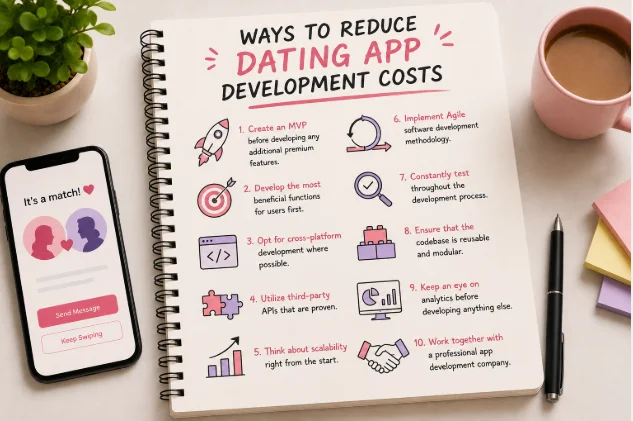
Reduced development costs do not necessarily equate to low-quality work. Effective planning allows companies to create good products while remaining under budget.
A common question among entrepreneurs is, “How do I develop a dating app without going overboard in costs?” The following methods will assist you in reducing your costs.
- Create an MVP before developing any additional premium features.
- Develop the most beneficial functions for users first.
- Opt for cross-platform development where possible.
- Utilize third-party APIs that are proven.
- Think about scalability right from the start.
- Implement Agile software development methodology.
- Constantly test throughout the development process.
- Ensure that the codebase is reusable and modular.
- Keep an eye on analytics before developing anything else.
- Work together with a professional app development company.
How App-Concept Can Help You Build a Dating App
Now that we know, building a successful dating app goes beyond just coding. Building a successful dating app entails proper planning, great user experience, security, and scalability besides other post-launch improvements.
And here comes App-Concept, a professional software & app development firm in Germany. It can help develop secure and high-performing mobile apps for startups, emerging and established companies.
When collaborating with App-Concept, you get:
- Custom dating app development
- Native and cross-platform mobile app development
- UI/UX design
- Backend development and API integration
- AI-based match-making
- Secure payment gateway integration
- Real-time messaging feature
- Quality assurance and testing
- Cloud hosting and scalability
- Maintenance and feature upgrades
Collaborating with a professional development company minimizes project risks and increases project quality besides helping launch faster.
Frequently Asked Questions
How long does it take to make a dating app?
An MVP can be ready in 3-6 months, while the sophisticated platform with AI capabilities, video calls, and additional premium features can take 6-12 months or even more.
Which option should I choose, native or cross-platform dating app?
Cross-platform application development might be cheaper and quicker compared to native one. However, the latter might have its advantages in case of very complicated applications.
Is it possible to release an MVP?
Yes. Many popular dating apps were launched by MVPs with further gradual integration of additional features in response to users’ demand.
Which feature is the most expensive one in dating app?
AI matchmaking algorithms, live chat, video calls, profile verifications, and large backend are usually among the most expensive features.
How much does it cost to maintain a dating app annually?
Annual costs of maintenance depend on updates, enhancements, etc., but are usually 15%-25% of the initial cost of development.
Can AI help to enhance dating app performance?
Yes. AI can be used for match-making improvement, fake profile recognition, personalization, automatic moderation, etc.
Bottom Line
It is vital to know about the cost of creating a dating app before you start your venture. By now, we believe you know everything related to he cost of creation of a dating app.
The ideal way to go about developing an app is by making sure that you have a sound plan for an MVP with key features for the users and also working with a competent development team. Hopefully, with proper planning and the right technical expertise, businesses can build a secure, scalable, and competitive dating platform that supports long-term growth.