Everyone has the next big idea for an app, but how many of them actually know the investment required to develop an app? If you’re truly interested in taking the first step to turn your app vision into reality, then you must start by gaining knowledge about the budget.
So, how much will it cost you to develop an app?
The cost depends on various factors such as app complexity, design, tech stack, and more. However, a simple app with only core functionalities can cost anywhere between $5,000 and $50,000. However, for more complex, enterprise-level apps, the price ranges from $250,000 to over $500,000.
Stay tuned as we reveal a comprehensive range of app development costs. We will also break down the prices based on the different development stages, and discuss so much more. So, let’s jump right into it!
How Much Does It Cost To Develop An App? -A Detailed Breakdown
If you’re trying to navigate the complexities that come with budgeting an app, you’re at the right place.
A well-structured app is of the utmost importance for any business. However, the cost is definitely a big concern, especially for those with no prior experience.
However, you have nothing to worry about; we’ve got you covered. We will now break down the exact cost to develop an app.
To begin with, you must understand that it is not exactly possible to pinpoint the cost of an app. After all, the cost varies largely depending on many factors. However, we are providing you with a realistic range considering the app complexity,
For a simple app with minimal features, the cost ranges between $5,000 to $50,000.
Such apps don’t focus on extravagant details and are mostly for single platforms.
Apps with moderate complexity cost around $50,000 to $150,000.
Needless to say, these apps have a longer development time as they require a more developed infrastructure.
For complex, enterprise-level apps, the cost can be around $250,000 and jump over $500,000.
These apps are meticulously developed with multi-platform features, real-time data, third-party integrations, and more.
| App Complexity | Core Features | Average Cost Range |
| Simple Apps (MVP) | Single platform, basic profiles, push notification, user login | $5,000 – $50,000 |
| Mid Complexity | Custom UI, social features, secure authentication, APIs | $50,000 – $250,000 |
| Enterprise-level | Multi-platform, AI/ML models, real-time data, high-security, | $250,000 – $500,000+ |
Existing Relevant Content:
How long does it take to develop a mobile app? – Realistic Time Guideline
App Development Cost Based On Each Stage
There is no simple answer to what is the cost of developing an app. As you already know, depending on how rigorous the process is, the cost can vary significantly.
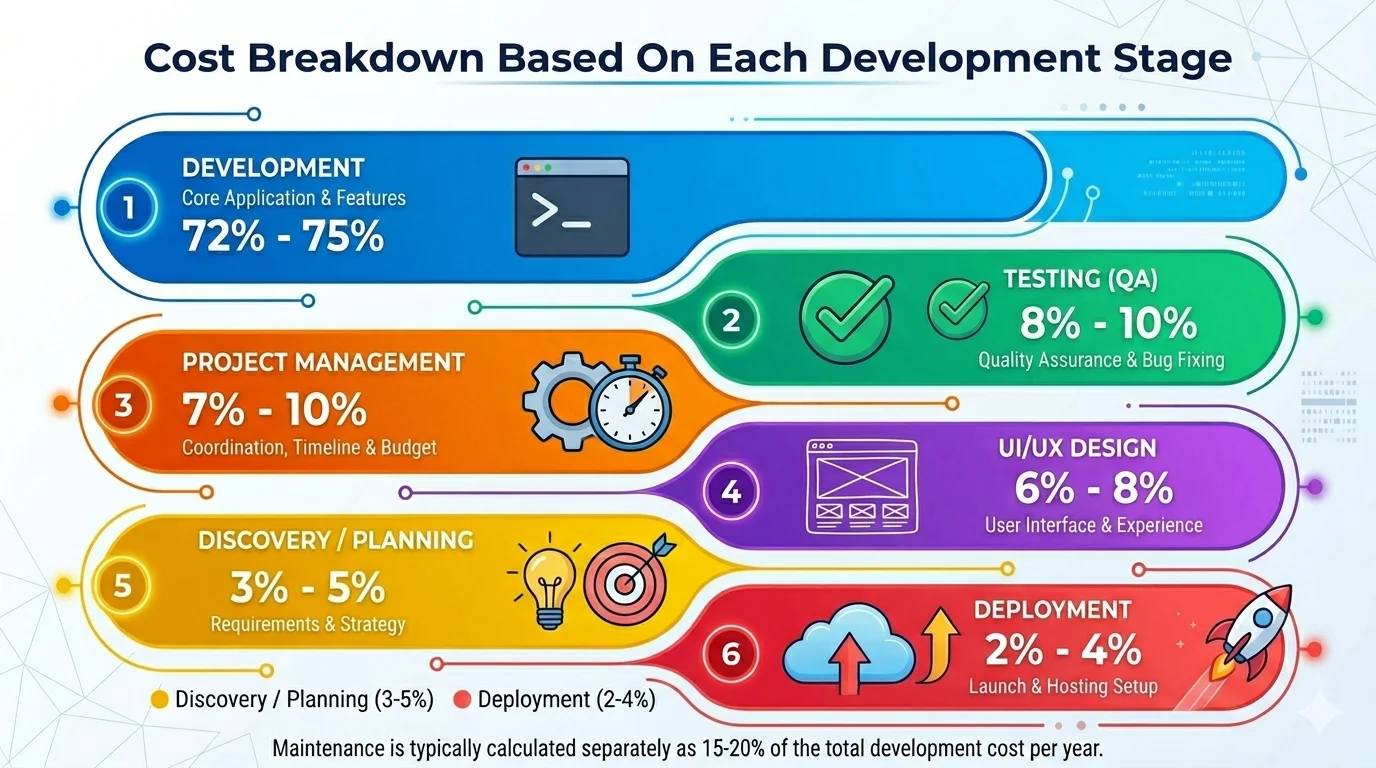
So, for further clarity, let’s have a look at app development pricing based on each development stage.
1. Discovery And Planning
The discovery and planning stage involves in-depth market research, competitor analysis, and feature scoping. This stage is extremely crucial as it sets up the technical architecture of the app.
This phase roughly accounts for 3-5% of the whole cost. On average, this can range from $750 to $5,000 for a modern, customized app.
2. Project Management
While this isn’t essentially one of the developmental stages, it is a main coordination point that keeps the entire process running smoothly. A lot goes into managing a project efficiently, such as team coordination, managing deadlines, budget oversight, risk management, and client communication.
While this doesn’t require any technical work, this part is still very crucial. There are no specific numbers for this. However, to give you an estimate, project management can cost 5–10% of the total app development cost. Sometimes even more if the app is enterprise-level.
3. UI/UX Design
The second stage is designing the User Interface and User Experience. This helps determine the user flow, ensuring the app is intuitive and visually appealing.
This stage consists of about 6-8% of the overall cost. It requires strong wireframes and prototypes to confirm the design. Hence, requiring more investment.
In the US, developers might require $2,000 to $9,000, considering how well-structured the design is and all the mock-ups for it.
4. Development
Next comes the development stage. It involves both the front-end and back-end development, hence the process is very extensive.
Moreover, any integrations needed by the app are added during this phase.
That’s not just it, though. The database setup, admin panels, and even security implementations are all taken care of in this stage.
All these technical developments make this phase the largest cost driver. It accounts for about 72-75% of the whole cost.
For building a moderately complicated, customized app, this process can cost anywhere between $8,000 to $60,000. However, don’t limit yourself to this budget. If your app has a more complicated infrastructure, the cost will jump up significantly.
5. Testing
Before the app is ready to be deployed, it needs to undergo a series of tests. Only then can a developer confirm the launch.
There are many different tests, such as:
- Unit Testing,
- Integration Testing,
- System Testing,
- Acceptance Testing,
- and finally Beta Testing.
All these tests help highlight any bugs and glitches, which are then fixed. Thus, ensuring the app has no room for failure.
This phase costs 8-10% of the overall cost. Developers might require $1,000 to $9,000, depending on the levels of testing, debugging, and retesting.
6. Deployment
The next stage is deployment, which isn’t as simple as it might sound. The app has to be submitted on App Store or the Play Store. Moreover, the app has to be optimized according to the store guidelines before the final launch.
Other than the store submission, this process also involves CI/CD setup, server configuration, and final environment testing.
Deployment accounts for 2-4% of the total cost. This stage can cause developers to charge $2,000 minimum, if there are no complications.
7. Post-Launch Maintenance
Once the app is launched, developers have to focus on its maintenance over time. This could mean post-launch bug fixes, OS update compatibility, feature upgrades, performance optimization, and more.
Typically, the maintenance is charged completely separately from the rest of the cost. It costs 15-20% of the original development cost, once everything else is finalised. For a moderately complex app, this could mean $300 to $4,000 per month.
How To Estimate The Cost To Develop An App?
So far, we have given you the average cost to develop an app.
However, those numbers aren’t specific to your unique needs, nor are they dependent on the type of developer you’re hiring.
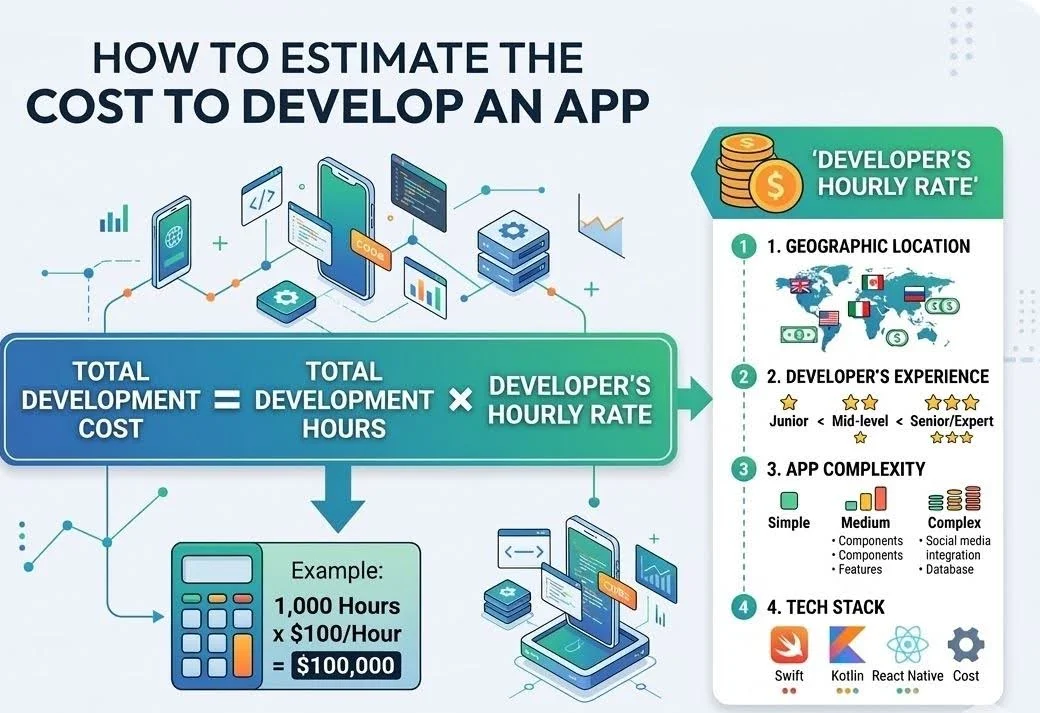
We will now tell you how to figure out the exact numbers based on the developer’s hourly rate.
All you need to know is the total development hours and the app development hourly rate, both of which you will be informed of when you contact a developer.
Total Development cost = Total Development Hours x Developer’s Hourly Rate
For example, if developing an app takes 400 hours and the developer charges $40 per hour, the estimated app development cost would be 400 × $40 = $16,000.
Using this formula, you simply multiply the total development hours by the developer’s hourly rate to get the final cost estimate.
So, if you have the right information, you can get accurate numbers and decide on a suitable budget!
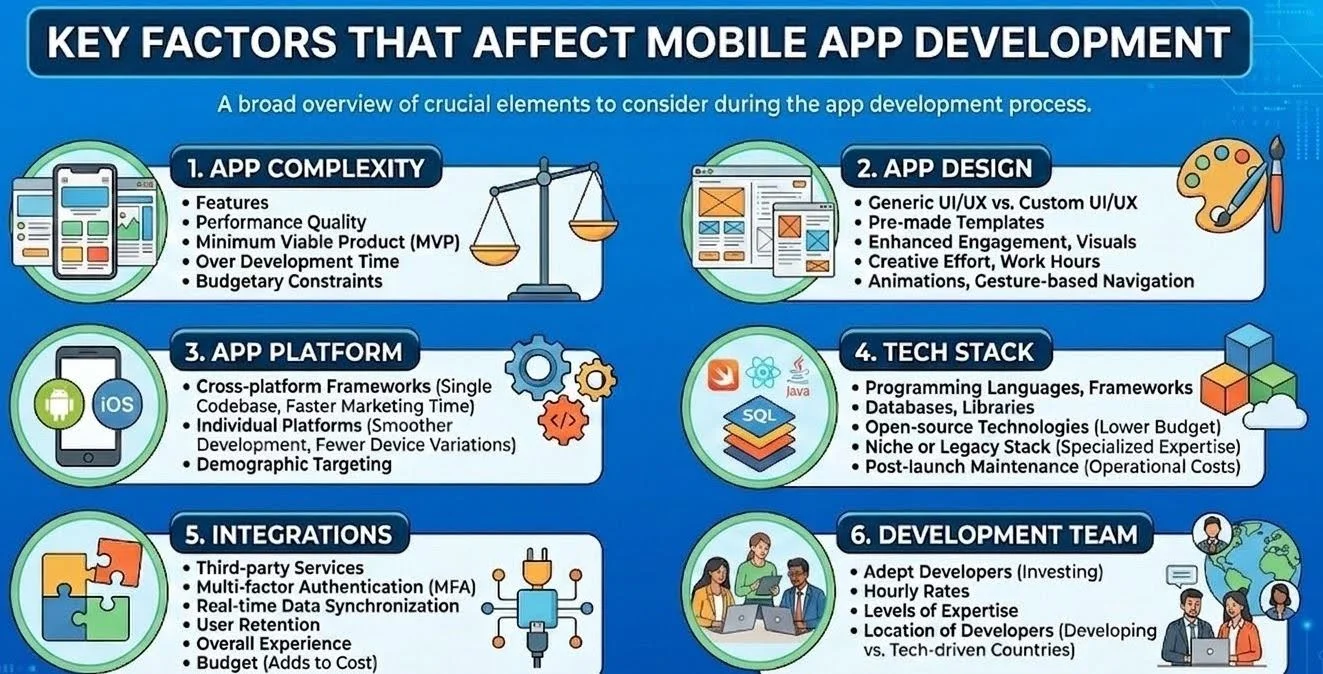
6 Key Factors That Affect Mobile App Development
Knowing random figures about the development won’t help. If you’re serious about this, you should expand your knowledge about the whole process.
This means you must familiarize yourself with the factors that affect the cost to build an app. This will not only help you determine a budget, but also allow you to negotiate at the right time.
1. App Complexity
It goes without saying that the complexity of the app is a big cost factor. While it might sound so obvious, you still have to be cautious. Even more so if you’re planning on getting a more advanced app.
A basic app will benefit you if you have budgetary constraints. In fact, a Minimal Viable Product will give you the best results. Such a product has very few features, cutting short the over-development time and cost.
However, if you plan on indulging in a more advanced app, the cost will definitely go up. Needless to say, the number of features and their performance quality affect the complexity during app development. Thus, affecting the whole app development cost.
2. App Design
While it is easy to get carried away with the app design, you must remember that it can significantly increase the cost.
For a generic UI/UX that allows the use of pre-made templates, the cost will be comparatively low. However, this would also mean you won’t have a competitive edge when it comes to visuals.
For a more enhanced engagement, developers usually resort to custom UI/UX. However, this increases the cost significantly as it means more creative effort and longer work hours.
Furthermore, some apps need advanced design elements such as animations and gesture-based navigation. These details require more interactive prototypes and wireframing. Thus, extending the process and increasing the budget.
3. App Platform
It is very crucial that you choose the right platform for your app. Not only will it help reach a certain demographic, but it will also affect your cost.
Cross-platform frameworks are typically the first choice for those with a limited budget. It involves a single codebase and even has a faster marketing time. Thus, cutting the development effort and cost.
Frameworks for individual platforms, such as either Android or iOS, will definitely increase the budget. However, they can ensure a smoother development process for fewer device variations.
4. Tech Stack
The platform framework isn’t the only factor you have to consider. The framework, programming language, database, and libraries all make up the tech stack, which contributes to the overall cost.
Open-source technologies are ideal for lower-budget projects. They are easy to use, even without long-term expertise. However, if the app requires a niche or legacy stack, specialized expertise is required. Thus, increasing the overall cost.
Moreover, the tech stack doesn’t only affect the development process. It also contributes to the post-launch maintenance. Simple, modern tech stacks are much easier to maintain and, hence, reduce maintenance costs. However, legacy technologies increase the operational costs.
5. Integrations
Integrations are a key aspect of app development and consequently, the cost. Any third-party services that you’re using for your app will, of course, add to the cost.
Now, the increase in budget depends on the kind of service you plan on adding. Complicated features such as multi-factor authentication or real-time data synchronization can put a dent in your wallet.
However, they will enhance the overall experience and increase user retention. So, if you have the budget, try to make the most out of these services.
6. Development Team
Lastly, it’s not just about the requirements of the app. What also matters is the team that’s developing the app.
Simply put, if you want highly adept developers who are ahead in the game, you need to invest in them. You have to be able to afford their hourly rates, which will keep on increasing with their levels of expertise.
Moreover, sometimes, the location of the developers plays a huge role in the cost. Developing countries that are still continuing to progress through this tech-driven world have lower hourly rates.
On the other hand, developers from countries with very well-established tech sources will charge you significantly more.
Hidden App Development Costs That You Should Be Aware Of
Sometimes, clients aren’t presented with numerous factors that go beyond the development process. Deep into the process, they’re hit with various hidden factors that raise the cost significantly.
This is a position that you shouldn’t land in. So, let’s go through some hidden costs of app development. This will help you stay prepared from the very beginning!
1. Server Hosting Costs
Regardless of which platform you’re using, you have to account for the long-term cost of hosting the app. The hosting fee depends on a number of factors such as user traffic, APIs, server requests, etc.
As the app starts reaching to wide audiences, it has to be optimized accordingly to keep up with the increased demand. Or else, the hosting bill will rapidly climb up, causing you to lose a significant chunk of money.
2. Marketing And User Acquisition
You can’t expect an app to do well without a proper marketing strategy. Be prepared to invest in different marketing strategies, including paid ads, influencer marketing, and app store optimization (ASO).
Platforms like Meta and Google have competitive bidding systems, which can increase customer acquisition costs higher than expected.
3. Updates And Feature Expansion
Long after the launch, you might feel the need to add newer features. Or, maybe user feedback will persuade you to do so.
However, even if you don’t add extra features, be prepared to invest in updating the existing apps. Regular updates are mandatory to maintain OS compatibility.
Always keep these factors in mind. They will eventually increase the budget.
4. Security Audit
You can’t compromise at all when it comes to the security of your app. Understand that it won’t simply be a one-time expense.
You will need consistent security audits that will identify vulnerabilities or prevent data breaches. The frequency of these audits and their validity will definitely impact your budget.
If the app handles sensitive data, it might require stronger support, such as cybersecurity experts or third-party audit firms. This can add substantial costs to your app maintenance budget.
Build Scalable and High-Performing Apps with App-Concept
Hopefully, you now have a clearer understanding of the costs involved in app development. However, turning an idea into a successful app often requires the expertise of a professional development team.
The right agency can help build a scalable, high-performing product while keeping the process efficient and cost-effective.
This is where App-Concept agency comes in.
As a leading app development agency, they help startups, businesses, and enterprises turn their ideas into powerful digital products.
From simple MVPs to advanced AI-powered applications, the team provides everything.
Services of App-Concept include:
| App Development | Technology Based |
|
|
Why Should You Choose App-Concept?
Choosing the right development company can make a major difference in your app’s success. App-Concept.com GmbH focuses on delivering reliable, scalable apps that provide real business value. Here’s what it has to offer:
- Strategic App Planning: Projects begin with strong research and planning to build the right product from the start.
- MVP-Focused Development: Launch faster with a Minimum Viable Product that validates your idea before full scaling.
- User-First Design: Apps are designed with intuitive interfaces that keep users engaged and satisfied.
- Proven Portfolio: They have built many successful software and apps for themselves and their clients in the past. Examples include the C-AR App and SAJOKI.
- Innovative Development: Creative solutions and modern technologies help your app stand out in competitive markets.
- Strong Technical Expertise: Experienced developers ensure secure, high-performance applications.
- Agile Workflow: Flexible development processes allow quick improvements based on feedback.
- Cross-Platform Capabilities: Apps can be built for iOS, Android, and web using efficient shared technologies.
- Reliable Project Management: Clear communication and structured workflows keep projects on track.
- Scalable Solutions: Apps are built with future growth and feature expansion in mind.
- Long-Term Support: Continuous updates and maintenance ensure your app performs smoothly after launch.
With the right combination of technical expertise, innovation, and client-focused development, they can help you turn app ideas into successful digital products.
So, if you need to build a successful app, contact App-Concept now!
FAQ
Q. Can I reduce app development costs?
Yes. You can lower costs by launching a Minimum Viable Product (MVP) first, using cross-platform frameworks, limiting initial features, and working with experienced developers who can optimize the development process.
Q. How can choosing a cross-platform framework reduce development expenses?
Cross-platform frameworks allow developers to use a single codebase across different operating systems. This makes them a budget-friendly option as they cut the development hours significantly.
Q. What budgeting strategies help lower app development costs?
For a lower mobile app development cost, try to opt for a cross-platform framework, reach out to developers from a cost-effective region, or consider going for a Minimal Viable Product (MVP) with just core features.
Conclusion
There is no straight answer to how much does it cost to develop an app. The average cost to develop an app depends on numerous factors, such as the level of app complexity, the tech-stack used, the app design, and even the expertise and location of the developer.
However, if we simply consider the levels of complexity of an app, a simple app will require $20,000 – $50,000. On the other hand, an enterprise-level app consisting of highly advanced features like AI/ML models and real-time data integration can increase the cost to $500,000!