Mobile app development is no joke. It is a rigorous, high-stakes process that requires meticulous planning, strategizing, and flawless execution. Needless to say, the process is resource-heavy and demands extensive time, often leaving people to question the duration.
So, the question is, how long does it take to develop a mobile app?
The mobile app development timeframe doesn’t involve specific numbers. It is dependent on a number of factors, with the duration being anywhere between two months and a year. However, for enterprise-level apps, the duration can be up to even two years. It actually depends on the size and complexity of the app.
Stay tuned as we give you realistic guidelines regarding the time required for mobile app development. We will also break down the app development stages and their individual timeframes. So, without a further ado, let’s dive right into it!
How Much Time Does It Take To Develop A Mobile App?
When it comes to mobile app development, there is no one-size-fits-all timeline. You won’t get a precise duration until you specify what your requirements are from the app.
With that being said, we still give you a comprehensive understanding of how long it takes to develop a mobile app.
On average, it can take anywhere between 2-10 months to develop a strong mobile app.
However, the duration can extend to a year or even two years, if you need a more complex, enterprise-level app.
This, however, is just a rough estimation. Now, let’s get into a more in-depth breakdown of the duration based on four different complexity levels.
Here is a breakdown of the time required to develop different types of apps alongside their examples.
| App Type | Development Duration | Examples |
| Simple apps | 2-4 months | Calculator, Flashlight, Basic to-do list Apps |
| Medium complexity apps | 4-8 months | Food delivery Apps |
| Complex Apps | 7-12 months | Social Media Apps, Ride-sharing Apps, Marketplace Apps |
| Enterprise-level apps | 12-24+ months | CRM or BI, HR or Finance system apps |
Simple Apps
A simple app with no extravagant integrations is usually built in 2 to 4 months. These apps are basically similar to the Calculator app we all have on our smartphones. They have very minimal functionalities and backend, and hence, can be developed in such a short time.
Medium Complexity Apps
Mobile apps that are moderately complex, such as food delivery apps, are developed in approximately 4 to 8 months.
They usually have simple integrations and some real-time features, which explains the longer timeline.
Complex Apps
Social media apps or ride-sharing apps are considered to be significantly more complex.
These kinds of apps require advanced features, in-depth security regulations, real-time data sync, and sometimes even AI integrations.
These little details can stretch the development timeline to 7 to 12 months.
Enterprise-Level Apps
Enterprise-level apps, such as CRM software or BI systems, can take 12 months to 24+months.
These apps have a very complex backend and require high scalability to be able to serve company-wide operational needs.
6 Mobile App Development Phases And Their Timeline
By now, you probably already understand that no two mobile apps will have the same development duration. Every app is built with meticulous attention to detail at each developmental stage.
In fact, each of these stages requires its own timeline, which we will now break down. This will further give you an idea into mobile app development timeline.
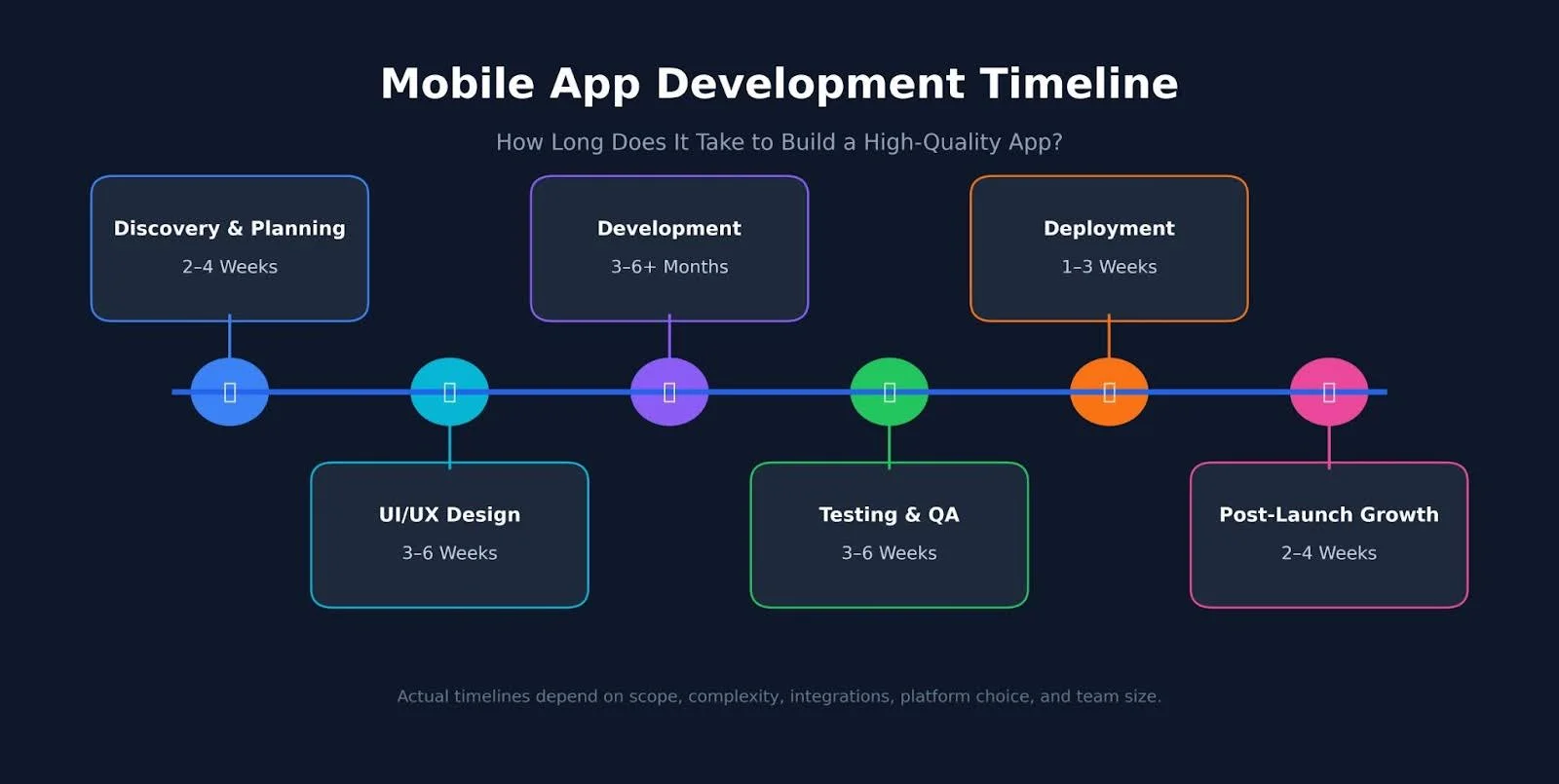
1. Product Discovery And Planning – 2 to 4 Weeks
This is the first and foremost stage where developers start playing with a raw idea to turn it into a functional app. However, it’s not as simple as one might think, this process involves a lot of brainstorming and market research. Thus, explaining why it takes roughly 2 to 4 weeks for this phase.
In this stage, developers strategize the app’s requirements and technical feasibility. Additionally, they conduct a market analysis to further understand how the app will serve a specific audience.
This helps developers figure out the right platform, features, integrations, development timeline, and cost. From there, they proceed with a solid roadmap.
2. UI/UX Design – 3 To 6 Weeks
Next comes the design phase, which isn’t just about the app’s visual appeal, but also about the user journey across the app. Developers in this stage have to balance the users’ needs with proper functionality and operability.
The User Interface (UI) design and User Experience (UX) design together impact the user-friendliness of the app. They determine whether the app will successfully engage a crowd, especially in today’s oversaturated market.
Although it does not require robust programming, this stage still takes 3 to 4 weeks. This is because developers have to come up with a strong design system and back it up with proper wireframes and prototypes. So that they can confirm the usability testing before moving on to the actual development.
Apps that are to be developed with minimal interactive features usually need fewer prototype designs. As a result, developers spend much less time on the design phase for such apps.
3. Development – 3 To 6+ Months
The third stage is where the real game begins. After all the planning, designing, prototyping, developers finally reach a stage where they can comprehend the app and the tech-stack and framework needed by it.
This phase demands the longest time as well as effort from the developers. And, this stage will explain why app development duration varies so drastically.
Here, the core work involves front-end development, back-end development, and necessary integrations. How intensive each of these factors will be completely depends on the app’s requirements and development approach. Hence, the duration for the main development can take 3 to 6+ months.
Needless to say, this stage is dependent on a highly technical infrastructure. It involves configuring servers, managing the database architecture, responsive designs, and APIs.
Moreover, developers stay prepared for iterative cycles of feedback and refinement during this stage. This creates the scope of improvement without waiting for the testing phase, after everything has already been worked on.
This can drag the duration of the development phase. However, it helps eliminate the need to make drastic refinements at the end. Thus, ensuring efficiency in the overall process.
4. Testing – 3 To 6 Weeks
This is the stage where the product being developed undergoes thorough testing. Security and performance are two core factors of this process. The goal is to ensure a well-developed product that meets client expectations.
Since the process needs to be very rigorous, it is structured with many layers of testing. It all begins with Unit Testing, which checks individual functionalities. What follows is the Integration Testing that tests the link between front-end and back-end, as well as APIs.
Additionally, there are System Testing and Acceptance Testing. These two tests are for the whole functionality and user experience. Ultimately, there is Beta Testing, which helps developers collect the feedback of real users.
Overall, the process can be quite extensive, requiring 3 to 6 weeks. After the many different tests, developers go back to fix any bugs or glitches. More importantly, every change they make to the product is retested.
5. Deployment – 1 To 3 Weeks
Once the bugs and glitches have been fixed and the client is satisfied with the end-product, the app is going to be prepared for deployment.
Depending on the app design, developers have to submit the product on App Store and Google Play Store. More importantly, the apps have to be optimized as per the app store’s guidelines. Once developers get the approval from these stores, the app is good to go!
This process should not take too long if the app adheres to proper security regulations and has complete metadata. If not, it can take a little longer to comply with the guidelines, extending the duration to roughly 3weeks.
6. Post-Launch – 2 To 4 Weeks
The app has been launched, so what now? Now comes the post-launch maintenance and upgrades. For the next 2 to 4 weeks, the app has to be monitored carefully, checking for app activities and analytics.
Some key analytical metrics involve checking user retention and in-app behavior. This gives developers insights into how well the product is doing.
Moreover, user feedback is also collected during this phase. Altogether, these little details allow developers to schedule upgrades or maintenance as per the app’s needs. Thus, future-proofing the app to ensure proper growth and success!
4 Key Factors That Affect Mobile App Development Duration
By now, you can probably sense all the technical chaos behind the mobile application development timeline. It is not a straightforward process; there are various aspects to be considered along the way, which can affect the overall mobile app development timeframe.
So, let’s explore some key factors that affect mobile app development duration.
1. App Complexity
The most common factor that influences the development duration is the complexity of an app. Now, you might wonder, what determines the complexity of an app?
Simply put, we are referring to the number of features in the app and how they function. Needless to say, a more complex app with advanced features and APIs has a much longer development timeframe than a simple app.
2. Tech-Stack
The technology stack that you choose can also impact the overall development time. A strong, well-thought-out tech-stack will enure a smooth development process, reducing the overall duration.
The framework for the app is really important in this case. Whether it’s cross-platform or native is dependent on individual needs. However, cross-platform frameworks typically reduce the need for writing individual code for Android and iOS.
Moreover, using well-established frameworks that offer built-in tools can save a lot of time. On the other hand, writing personalized code from scratch will inevitably slow down the process.
3. Development Team Structure
The development team plays a huge role in determining how long the process will be. Their expertise, team size, and even teamwork abilities are all important factors that must be considered beforehand.
Undoubtedly, a well-experienced team will know the best possible development approach and make sure to deliver on time. Moreover, they are more likely to handle any mid-project refinements without causing delay.
What also matters is whether you’re working with in-house developers, freelancers, or agencies. Typically, in-house developers are more efficient because of their exclusive attention to the project.
4. Third-Party Integration
Another common factor that can hamper the development time is third-party integrations. When used correctly, third-party integrations can be extremely helpful in reducing some developmental load.
However, APIs tend to have limitations as well. Not only do they increase the testing period, but they can also lead to additional debugging, especially if the third party’s code is faulty.
Speed Up Mobile App Development – Foolproof Approach
Developing a mobile app often requires a significant amount of time. However, with today’s fast-paced culture, not everyone can afford such a long-drawn-out process.
Well, good news, as technology continues to evolve, developers can now access advanced tools and strategies to speed up the process.
Here are some solid approaches that can minimize tedious workload and instantly boost the app development process
Prioritizing an MVP
Developing a Minimal Viable Product (MVP) can be the most efficient route for those in a rush. Such a product usually contains only the core features, with the sole focus being on addressing a specific problem for the audience.
This helps avoid feature overload. More importantly, the whole process depends on real-world user feedback, ensuring the product is built with purpose.
However, building an MVP isn’t just about speeding up the process. It also makes the whole process cost-efficient and sustainable.
Using Cross-Platform Frameworks
Another key tactic to move things along is using cross-platform frameworks. While native frameworks are better tailored for individual ecosystems, they often lead to higher costs and longer timelines.
Cross-platform development allows developers to use a single code for multiple platforms. With such an approach, the iteration cycles are much faster, and the maintenance effort is minimal as well.
Hence, the development is quick and allows the app to reach a wider audience.
Relying On Pre-Built Features
A customized development approach that requires the infrastructure to be built from scratch can be time-consuming and expensive. This isn’t always feasible, especially for start-ups.
Instead, a better and faster approach is to utilize pre-built components. Many development frameworks come with ready-to-use templates. Some even allow code reusability.
These opportunities enhance the development, not just by reducing the time, but also by ensuring fewer bugs. Moreover, it becomes much easier to scale the apps over time.
Connecting With an App Development Company
Another important strategy to speed up the process is to partner with the right team. An app development company saves you from the technical, strategic, and operational headaches of building an app on your own.
Usually, they handle everything, from planning and design to development, testing, and launch. So, always try to use an experienced team that knows the process inside out.
This means faster development, better quality, fewer risks, and proper long-term support. If you can get the right company, it will save you a lot of time, too!
You can focus on growing your business instead of managing technical problems.
This is why we recommend App-Concept GmBH, a leading Berlin-based mobile app development agency.
With more than decade-long experience in the industry, App-Concept is ready to provide tailor-made solutions for diverse needs. That too, in the shortest time possible.
You’re guaranteed to receive strategic planning and agile methodologies that ensure extraordinary outcomes!
So, contact App-Concept to turn your vision into reality!
FAQ
Q. Can you build an app in 3 months?
Although the timeframe is quite short, you still can do it. However, it is only viable with simple to medium-complexity apps with a focus only on core functionalities.
Q. How long does App Store approval take?
Typically, most apps are approved within 24 to 48hours. However, if you fail to comply with the guidelines, it might take longer or even result in rejection.
Q. How to measure the success of an app after development?
To measure the app’s success, you need to track certain metrics such as user engagement, retention rates, active users, average revenue per user, etc.
Conclusion
So, how long does it take to develop a mobile app? The timeframe for mobile app development largely varies depending on the app complexity, the tech-stack used, and even the expertise of the development team.
Considering all those factors, the time required for mobile app development can take anywhere from 2 months to 1 year. In fact, the duration can be longer if the app is being developed for enterprise-level use.
However, with the right development team and tools, the process can be optimized for maximum efficiency!